Details
Title: Brake Clubs
aka: Supporters Club, Travelling Supporters, Celtic Brake Club
Reference: Organised travelling supporters groups in the early years of Celtic
Started: 1889 – 1920s
Background
From its very earliest days Celtic has attracted a faithful and vociferous support willing to travel near and far to support their team.
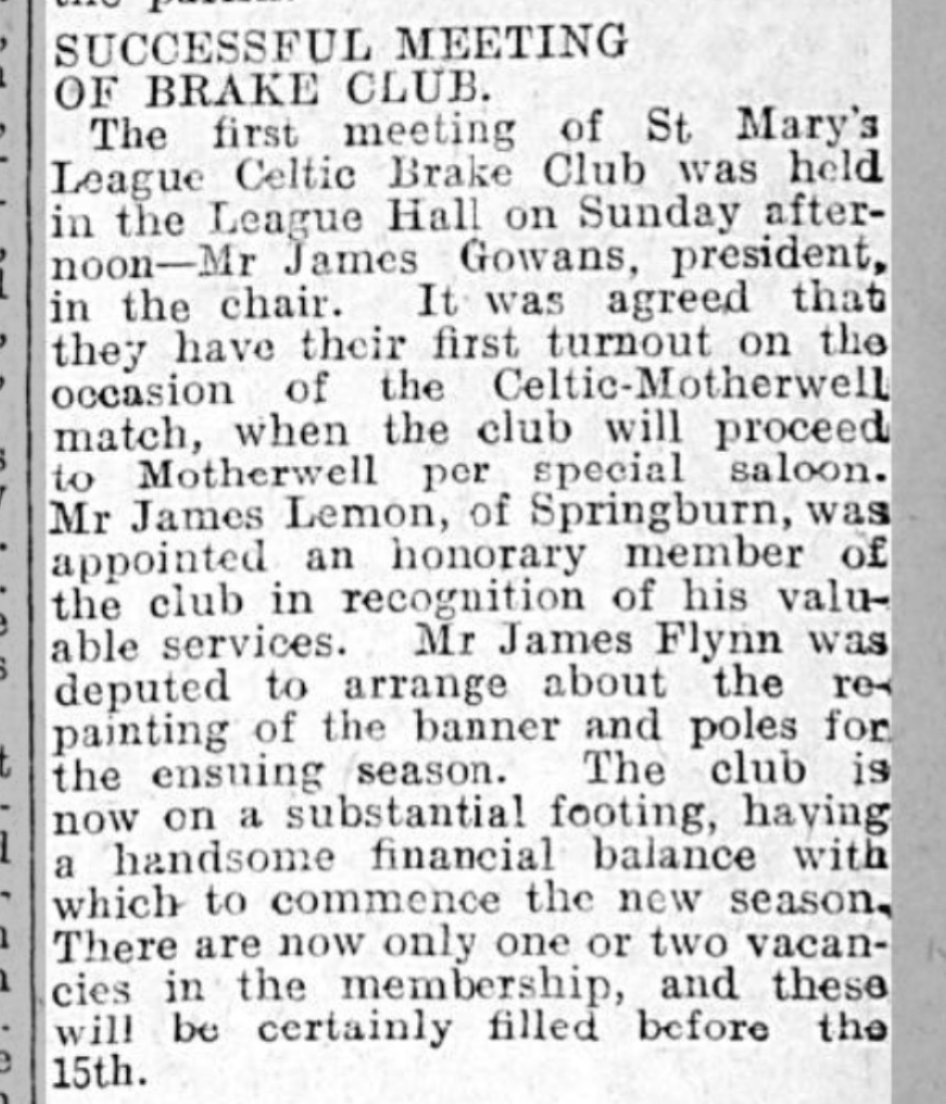
The earliest form of organised supporters groups sprung up very soon after the club’s birth and were known as ‘Brake Clubs’ – so called because of the large horse drawn wagons they travelled in. These large wagons could hold 25 supporters and brakes would make their way from across Glasgow to Parkhead and beyond to cheer on their favourites.
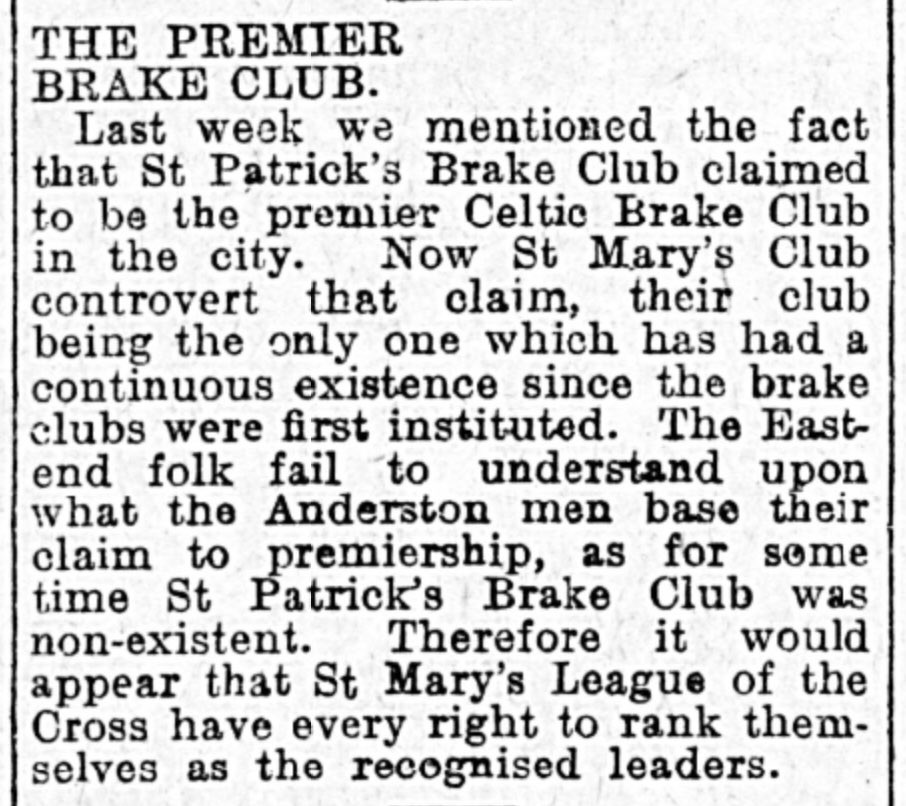
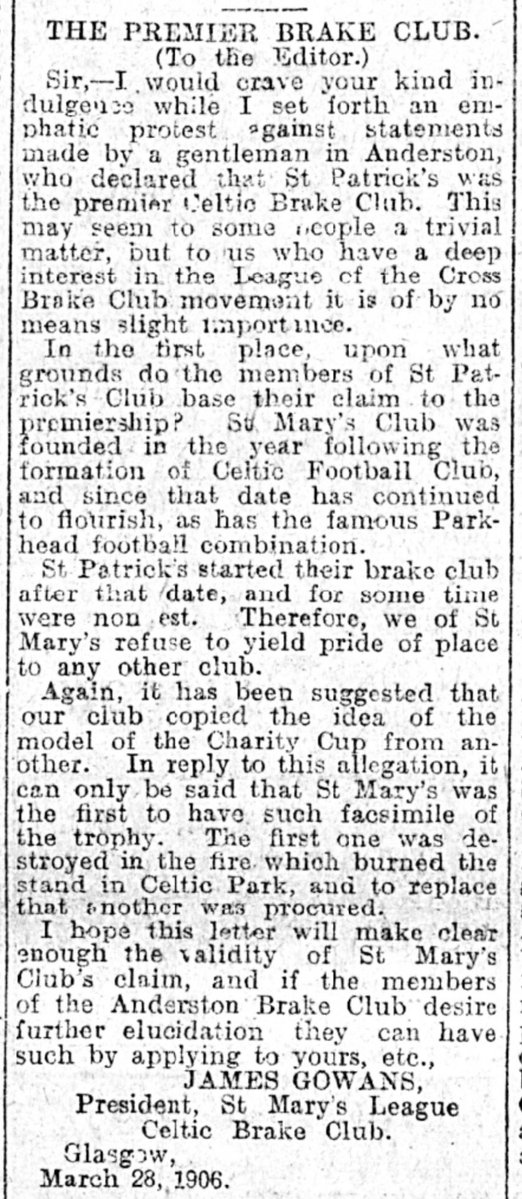
This horse powered form of transport was suited for getting to matches within the city and in the neighbouring areas of Lanarkshire, Dunbartonshire and Renfrewshire – although for matches further afield the train was really the only viable option. The earliest Brake Club was formed, naturally, enough in the Calton parish of St Mary’s in Glasgow’s east end, the very place Celtic itself was formed.
This brake club and most others were essentially extensions of already established branches of the League of the Cross. The League was a temperance society set up by the Catholic church. Each parish in Glasgow had a branch and it was from these groups that the Brake Clubs emerged.
In the early days of the club the Brakes would meet at Carlton Place on the south bank of Clyde in the city centre and close to the traditional Celtic heartlands of the Gorbals. From this point the wagon would travel in a noisy and colourful convoy to the game. As the Brakes grew in number an annual gathering of the ‘United Celtic Brake Clubs’ would be held.
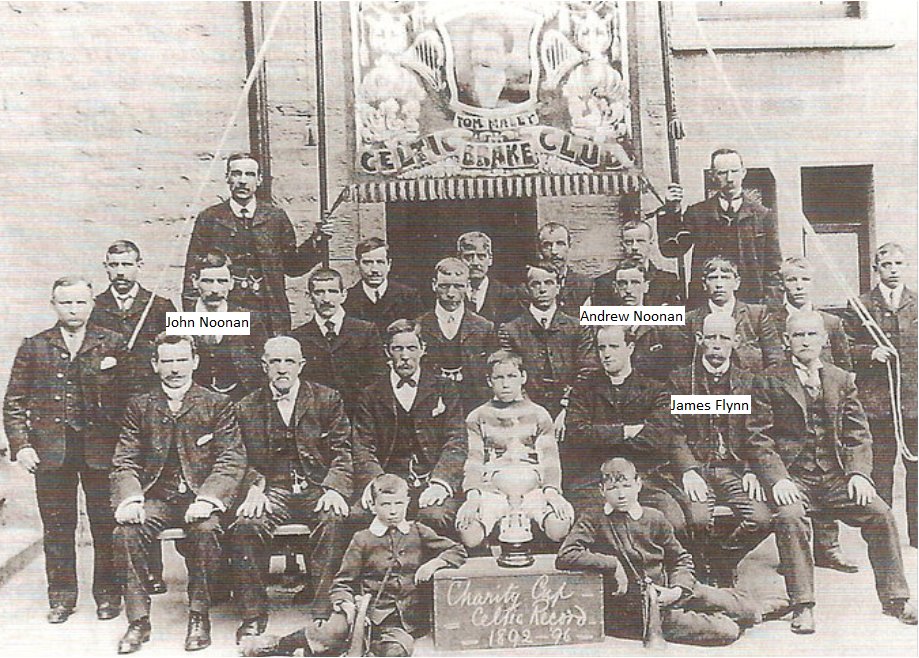
Each brake would proudly display their own unique banner with a picture of a favourite player. In the above photo, there is a mysterious anomaly. The youngster in the centre is wearing hoops, but at that time Celtic hadn’t played in the hoops but in vertical stripes. The top he is wearing is a curious point for some. The “St Mary’s Celtic Brake Club Banner” can be viewed by anyone who wishes to pop their head into the “Baird’s Bar” in the Glasgow Gallowgate area.
It’s only natural given the social climate of the time that these large groups of mostly working class, Irish Catholic men would contain a political element and it was not unusual to see banners in support of Irish nationalism and trade unions. True to the founding traditions of Celtic, the Brakes also raised substantial money for charity.
With virtually all the Brake Clubs being born from Catholic parishes in Glasgow it was equally no surprise to find that faith too had a strong influence on the opinions of the members. This was best illustrated in 1897 when certain of the Brakes called for Celtic to ditch their non-discriminatory traditions and field an all Catholic team. Thankfully the club comprehensively dismissed the idea, something that most others also agreed with.
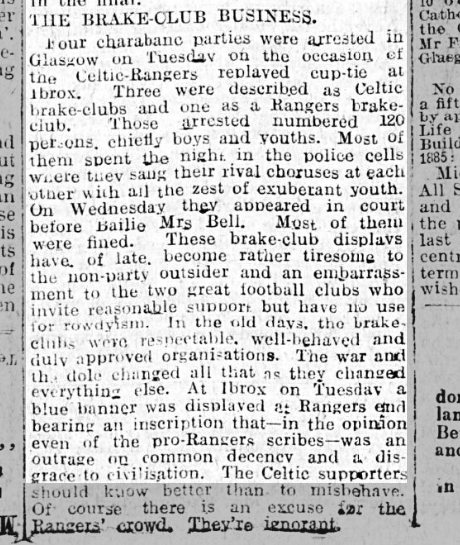
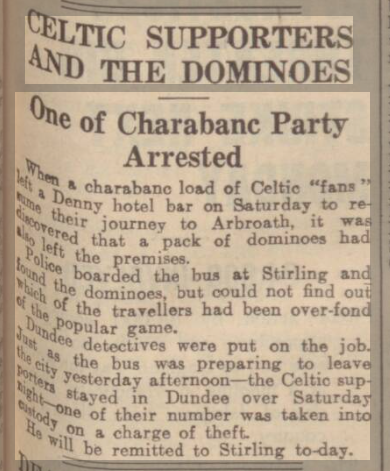
By the 1920s the once thriving Brake Club movement was in an irreversible decline. The emergence of the motorcar and the growth of the railways meant supporters were now finding independent means to attend games. An increased number of alcohol related violence involving Brake Clubs, which had ironically emerged from the temperance movement, also saw membership figures dwindle or saw the clubs evolve into different types of supporters’ groups.
It’s quite an irony how times have changed. Football fans are hardly icons of innocence when it comes to alcohol, but the early Brake Clubs stem from the alcohol abstinence and temperance movements, likely taking advantage of their organisation skills to push their message through football (it obviously didn’t work!). Various members of the Celtic board and certain early players were pub owners and licensees, or as one smart-alec once defined the Celtic board as being composed of “six publicans and a Glass [i.e. Celtic Director John Glass]“. Times have changed in many ways.
While the Brake Clubs may now be a closed chapter in the history of Celtic, their legacy is significant and lives on in thousands of supporters clubs found & located across the globe today.
Quotes
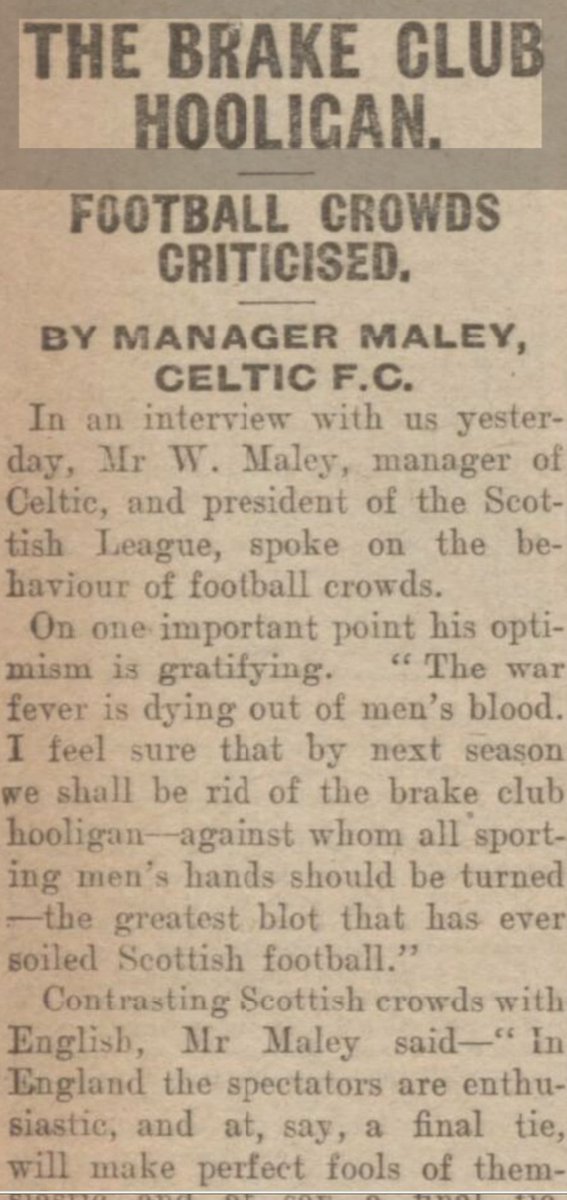
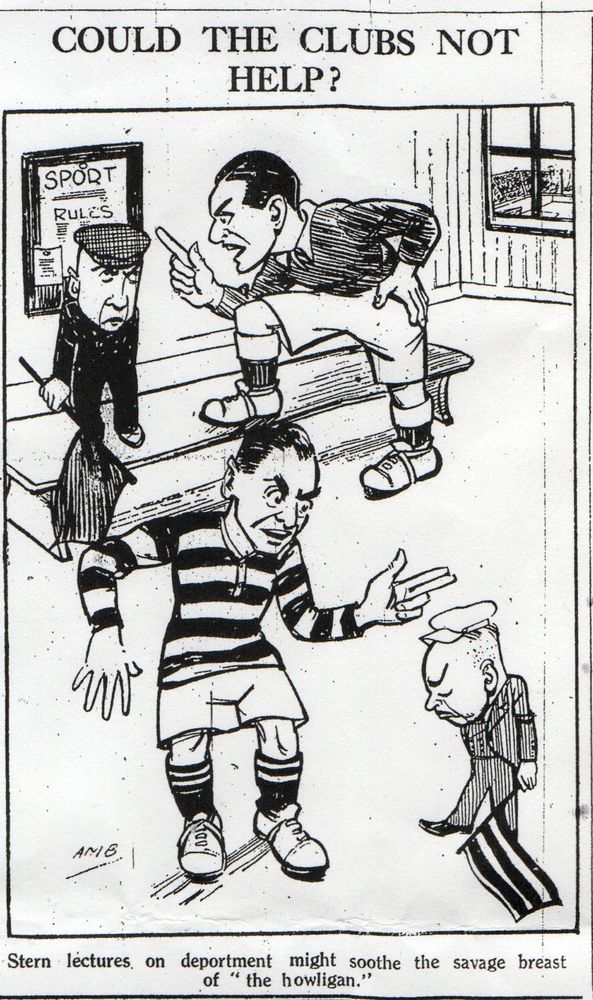
“The war fever is dying out of men’s blood. I feel sure that by next season we will be rid of the brake club hooligan, against whom all sporting men’s hands should be turned. The greatest blot that has ever soiled Scottish football.”
Willie Maley was very critical of Brake Clubs.


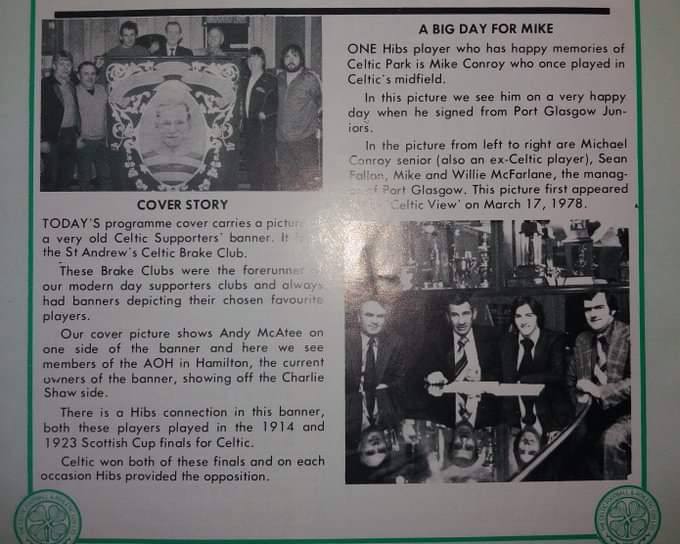
St Andrew’s Celtic Brake Club Banner
The pics show a St Andrew’s Celtic Brake Club Banner with paintings of Charlie Shaw and Andy McAtee.
St Andrew’s was one of the original parishes, along with St. Mary’s and St. Alphonsus, that Celtic was initially set up to fund Poor Children’s Dinner Tables in. The parish was centred on St. Andrew’s Cathedral in Clyde Street and included the Briggait, the Saltmarket, Argyle Street and the High Street, which were densely populated areas in the 1880s. Following early disagreement the parishes of Sacred Heart (Bridgeton) and St. Michael’s (Parkhead) joined with St. Mary’s (Calton) to found plans for the new football club.
Charlie Shaw a Goalkeeper was born in Twechar/Kirkintilloch and he moved from QPR to Celtic in May 1913, in his First Full Season he only conceded 14 goals in 38 league games, a Record that still stands even today, He played 492 games for Celtic which is certainly Another Record he holds for a Glasgow Celtic Goalkeeper.
Charlie had won six league titles for the years 1914-1917, 1919 and 1922 and two Scottish Cups 1914 and 1923. He owned a tobacconist at Bridgeton Cross and went on loan to Clyde and remained at Shawfield until the end of the season 1924-25.
In the summer of 1925 aged 40 he went as Player Manager to New Bedford Whalers FC., the USA”s leading Soccer Team, he took a few Celtic players with him and funnily enough one of those was Andy McAtee, whose painting is on the reverse of this Brake Club Banner.
Amazingly he was never capped for Scotland although he did play for the Scottish League twice, his record of Appearances for Celtic is a tribute to his ability and consistency over a 12 yr period. A true Celtic Great & brilliant Goalie who sadly died in New York from pneumonia in March 1938.

Andy McAtee was born in Cumbernauld in the year 1888, he made his debut against Partick Thistle in the year 1910 and went onto form a brilliant, almost telepathic, right wing partnership with the great Patsy Gallagher, the strong winger made over 300 League Appearances with the Club.
During World War One he worked in the mines before spending the last year of the conflict in uniform, he retired in 1925 after scoring close on 80 goals in over 450 games for Celtic and in that year he moved to the USA where he played for one of their best teams New Bedford FC. Another Celtic Great who dedicated 14 years of his life to the wearing of the Hoops.

Sarsfield Celtic Brake Club Banner

Sarsfield Celtic Supporters 1952

“The Sarsfield Brake Club had a banner of my great great granda Davie Hamilton on their club flag. They stole it from an Orange walk and painted him over it!”
Sean Hamilton (GG Grandson of Davie Hamilton) on a Davie Hamilton Brake Club banner (see Brake Club) (we don’t believe this banner is now still around, the Davie Hamilton banner is pictured above.)

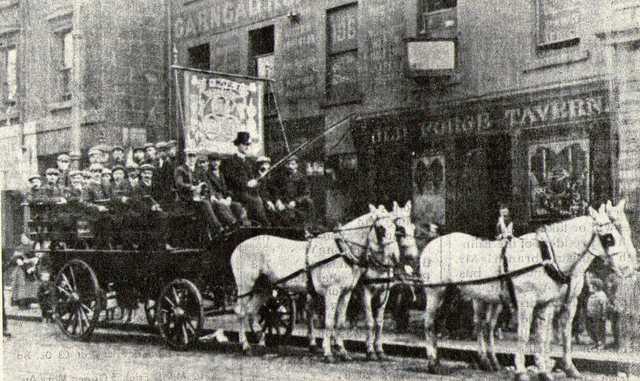
Garngad Emerald, St Mungo’s?


The Old Forge Tavern was situated at 194 Garngad Road, (Royston Road)
Source John Goroven author of oldglasgowpubs
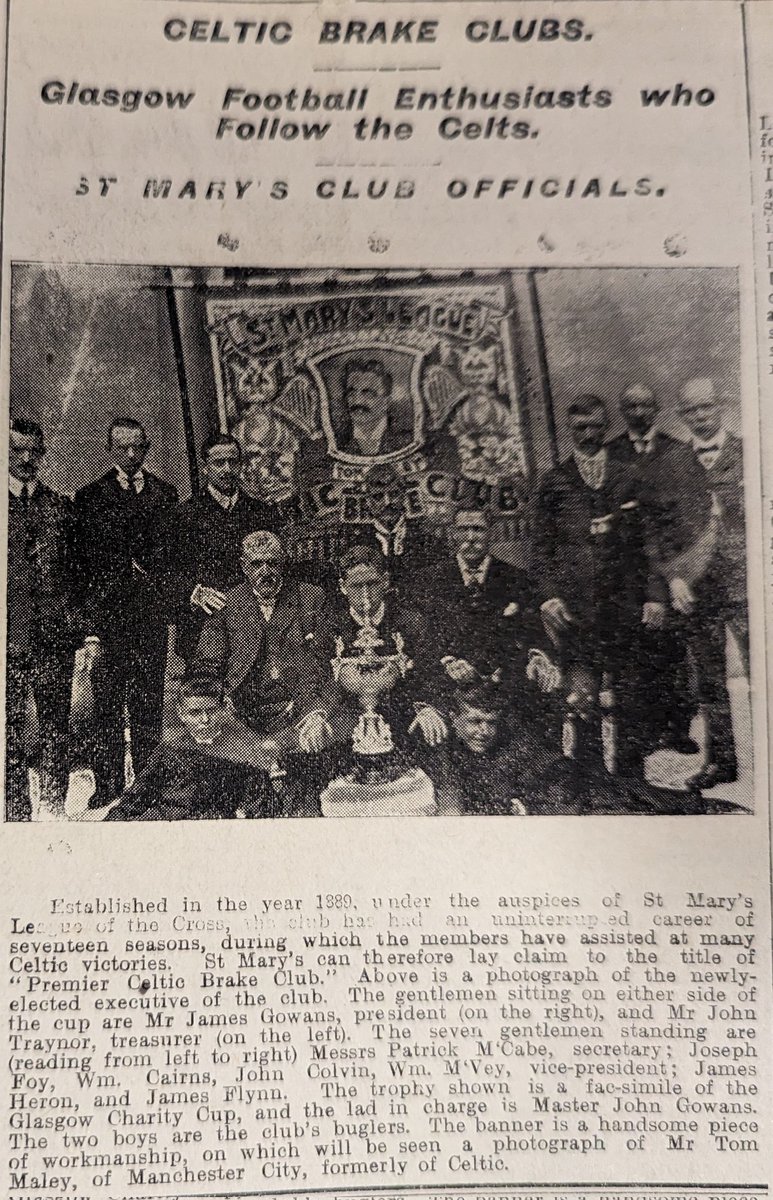
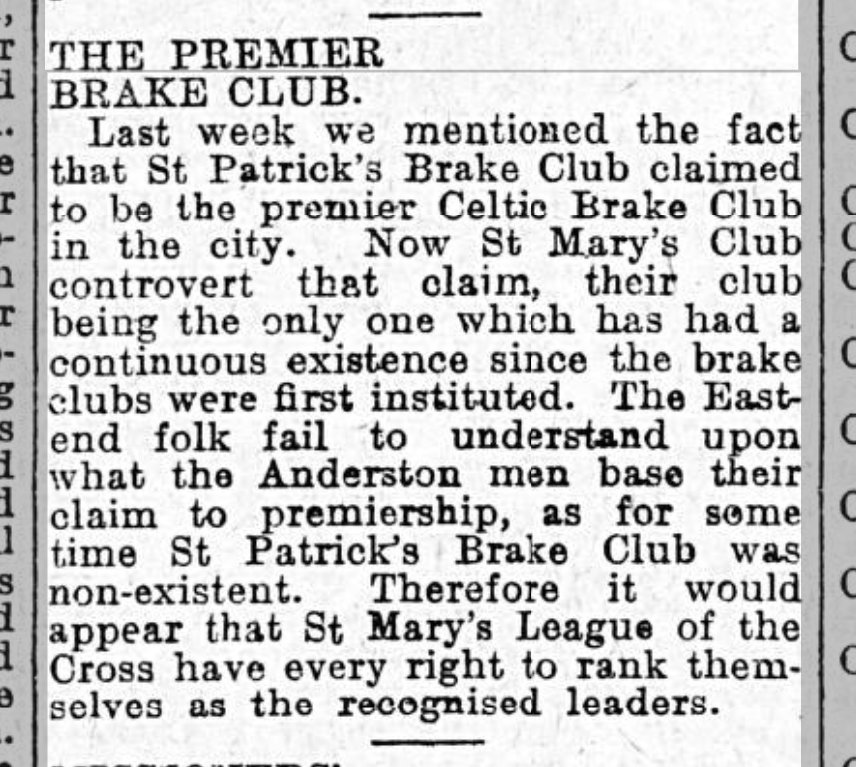
St Mary’s League


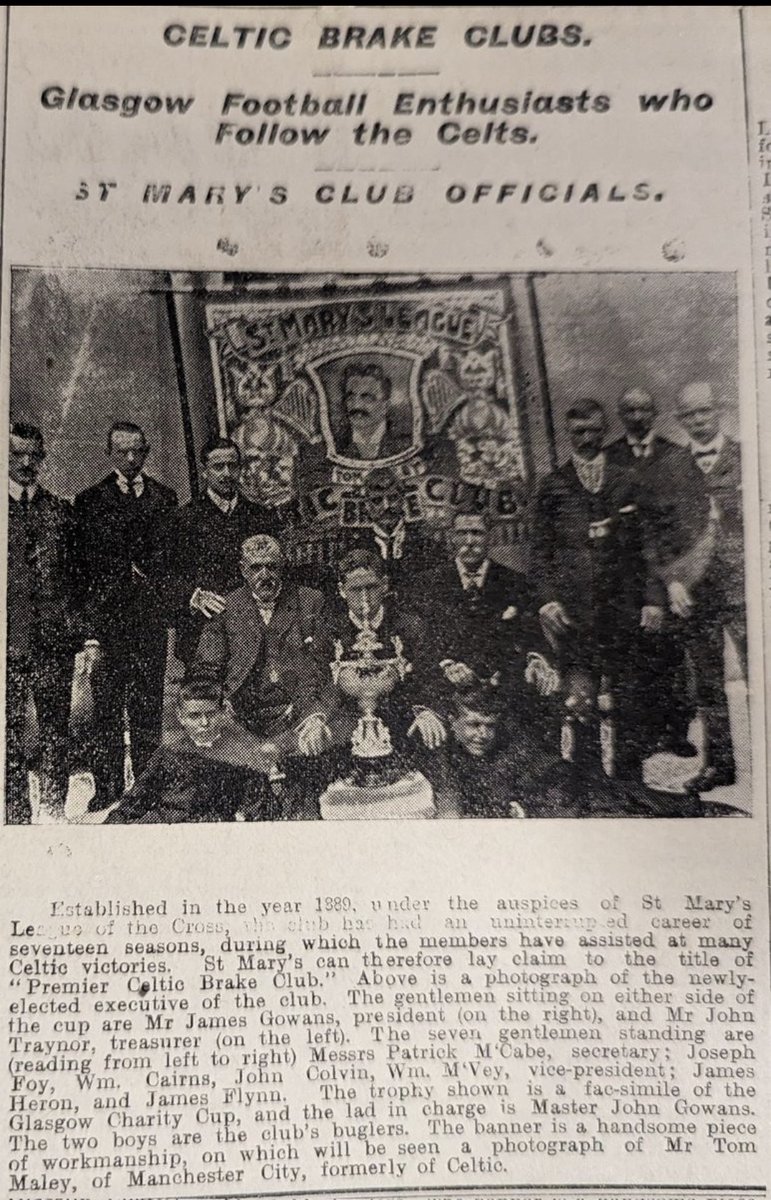
The Tally Ho Brake Club.
Hamilton Celtic Supporters Club for the rest of us


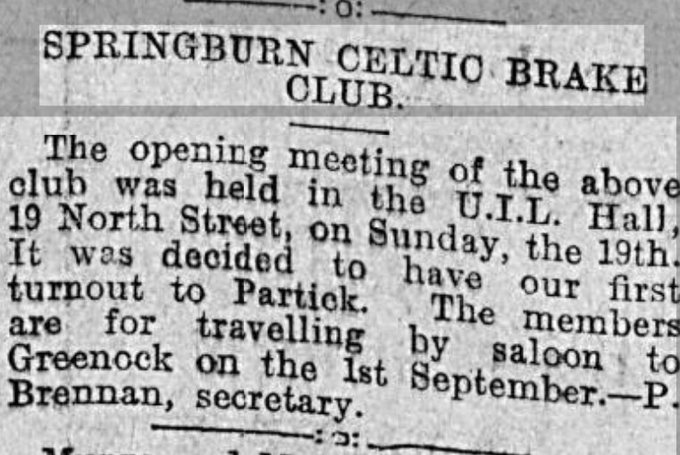
St Aloysius, Springburn
The below Brake Club Banner has been identified as St Aloysius, Springburn.
The writing says League Champions 1892346, which equates to Champions in 1892, 1893, 1894 and 1896 missing out in 1894-95.
So banner likely dates to around 1896.


UNITED CELTIC BRAKE CLUBS OF SCOTLAND SILVER BADGE.
A very rare silver Celtic Brake Club badge which would be worn on the buttonhole. Fully hallmarked for Birmingham 1919.
Possibly the oldest Celtic badge around.

The Badge is the property of Tom O’Neill which was purchased by his Father.


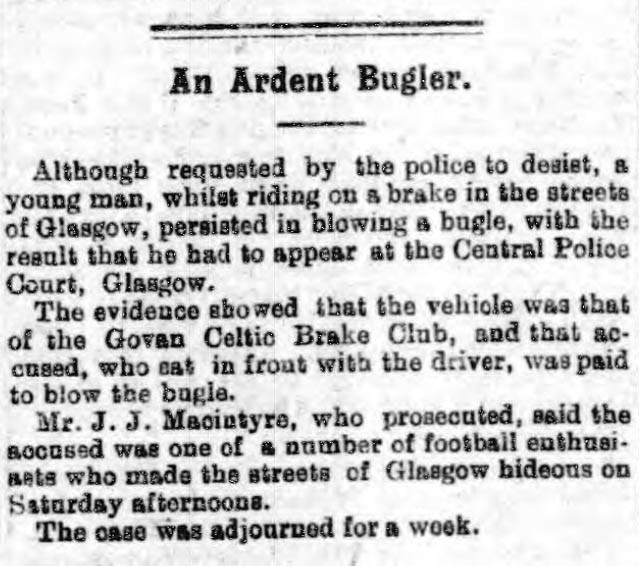
Some Articles & Background on Brake Clubs


FAITHFUL THROUGH & THROUGH Part 1: The Brake Club Phenomenon
01/04/2014 theshamrock1887
http://theshamrockglasgow.wordpress.com/2014/04/01/faithful-through-through-part-1-the-brake-club-phenomenon/
Celtic is a unique football club in many ways. Throughout its history one thing that has set Celtic apart from other clubs has been the fervour and commitment of the supporters, drawn initially from the Irish communities and Catholic parishes of Glasgow before widening out throughout Scotland to Ireland, England and ultimately, beyond the waves to other continents.
Fanaticism was a key feature of the Celtic support from the earliest days. Attendances at the first Celtic Park and away grounds grew at an incredible rate and the Celtic fans quickly earned a reputation for being vociferous and colourful in their support. The magazine Scottish Referee proclaimed on 7 September 1891 that ‘The Celtic are blessed with having a following that simply defy the elements, whose enthusiasm for the club is never lukewarm.’ In early 1889, reporting on a home friendly, The Scotsman wrote of the Celtic fans that ‘The enthusiasm of the spectators was tremendous’. When Neil McCallum scored in the 1889 Scottish Cup Final one newspaper reported that the Celtic terracing was “a scene which simply baffles description”.
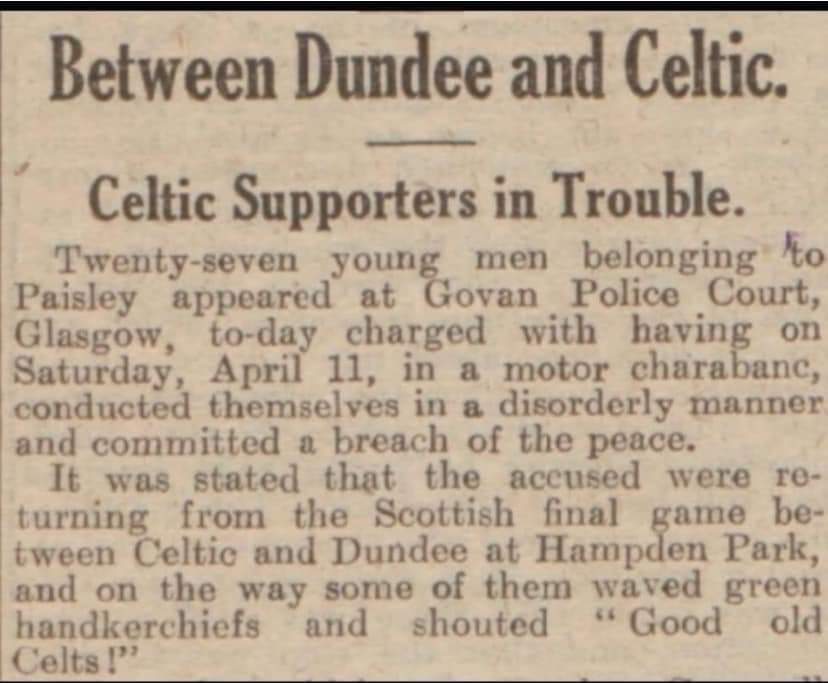
The 1892 Scottish Cup final saw Celtic fans carry pipes into the game with ‘Play Up, Celts’ printed on them and some unfurled a large green banner proclaiming ‘Good old Celtic’! Hurry up!’. Official recognition even came from the SFA Annual of 1892/3 with a profile of the Celtic support of the day: “Good old Celts!” Such is the cry that greets them, such is the only expression that many an ardent follower can give to this feeling, wrapped up as they are entirely in “the bhoys”.
Celtic supporters began to organise themselves into clubs with the first being formed in 1889 and based in St. Mary’s Parish in the Calton where the club itself was established two years earlier. The St. Mary’s Celtic Brake Club was attached to the non-alcohol Catholic temperance organisation, the League of the Cross. A ‘brake’ was the horse drawn carriage which was used to transport fans to the game and also allowed the club’s banners to be proudly displayed behind the driver for all to see where their loyalties lay. The original St. Mary’s Brake Club banner, which featured early Celtic hero Tom Maley, could – until recently – be viewed close to its spiritual home at Baird’s Bar in the Gallowgate.
Celtic supporters helped established a feature of football which had not previously existed but has become an integral part of the modern game: the away support. Previously, fans would simply attend home matches and occasionally games against local rivals but Celtic devotees helped change all that. David Goldblatt, the author of the acclaimed book The Ball Is Round – A Global History of Football explained how:
“First established in the 1880s, the brake clubs were the first organised away fans in football history. Initially, groups of fans would hire, even occasionally own, their own horse-drawn transport which turned into a mobile drinking parlour on the journeys to and from away games. By the late 1880s Celtic could boast an entire federation of brake clubs. In the inter-war era they grew in popularity and became motorized, massively increasing their radius of action. Rangers and other clubs soon followed suit and so large numbers of away fans were regular features of Scotland’s most combustible sporting encounters.”
The Celtic brake clubs became a regular sight in Glasgow and beyond – and what a sight they were! A brake club from Camlachie, near Celtic Park itself, caught the eye of the writer JH Muir in his portrait of a typical Saturday in the city in his book ‘Glasgow in 1901’:
Domestic couples go by, carrying little parcels for each other, and making pleasant pictures of contentment. Shop girls, set free at four o’clock, are bent in the same direction. Matinees or afternoon concerts, “skailling” towards five o’clock, keep the westward-going throng thick and thicker. This is the hour when Renfield Street takes on its evening character. Quite suddenly you will hear a great clatter of wheels, and loud cries and shrill blasts of trumpets, and a brake full of men in “gravats” and “bunnets” rattles past you with a banner flying, and much clamour and loud chaff. These are the “fitba’ supporters new back frae their gem.” They are great strapping men, dight in their Sunday braws, and all belonging to the “Legion that never was ‘listed.” The business of their football club is other than to play. They “support”; they follow their team from field to field; they drive to and from the match in their brake; they wave their banner with the strange device – “Camlachie Shamrock ‘Celtic’ Football Club”; they roar obloquy and ridicule at any rival club whose brake may pass theirs. And they have solved, in a way, the problem of Happy Saturday Afternoons for the People.
The Celtic stronghold of the Gorbals was home to the Sarsfield Brake Club, named after the famous Irish patriot Patrick Sarsfield. The story of the Sarsfield brake club banner is legendary – it was originally stolen in a ‘skirmish’ with an Orange march passing through the Gorbals in the World War One era, and repainted down the years to feature great Celtic players including Davie Hamilton, Joe Dodds and Stevie Chalmers. It was rumoured that, on occasion, Celtic players from the Gorbals would get the brake to and from the game. For many years the brake would leave from Teacher’s Pub in the Gorbals, on occasion led by the Sarsfield Flute Band. The famous banner, which was still in circulation in the 1960s, can be seen above on a packed brake getting ready to leave for the game, probably in the 1920s.
The brake clubs were the beating heart and proud voice of the Celtic support in the club’s earliest years. As late as 1924, reporting on a memorable Celtic victory at Ibrox, the Glasgow Observer, the city’s main Catholic newspaper, lavished praise on them: “the Celtic brake-clubs (supporters’ clubs) whose members, reasonable sentient human beings, are models of decorum and possess official testimonials to their blameless behaviour . . . They are fond of singing, and to this no-one can reasonably object. On Saturday, the boys sang to their heart’s content. They gave us so many rousing choruses. “Hail Glorious St. Patrick”, “God Save Ireland”, “Slievenamon” “The Soldier’s Song”…. When Cassidy’s goal made victory sure, it was fine to hear the massed thousands at the western end of the Ibrox oval chanting thunderously “On Erin’s Green Valleys.”
It was through colour and noise that these early Celtic fans demonstrated that their support for the cause was unyielding. It is a tradition we should all be proud of. And one we should all be trying to maintain and enhance.
An Irish Invasion
– Daily Record & Mail
– Thursday, January 1st, 1914
– The OriginalCorteo?


Govan Emerald Celtic Brake Club –
still on the road today. Featuring ‘Sniper’ Jimmy McColl, Johnny McMaster and John Browning.