Details
Ref: Celtic Badge history
Notes: Four leafed clover, Celtic Cross badge
Background
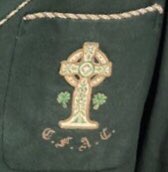
Celtic’s first crest was the Celtic Cross, as was seen on the first strip.
However, advertisements of Celtic in the early years, showed a harp against a blue background. The team also wore an away strip with a large three-leafed shamrock as the badge in the fifties, but then all the strips were without a crest on the strip.
It wasn’t until the late seventies when the four leaf clover became the emblem emblazoned on the strip, and has been since used to the present day as the club crest.
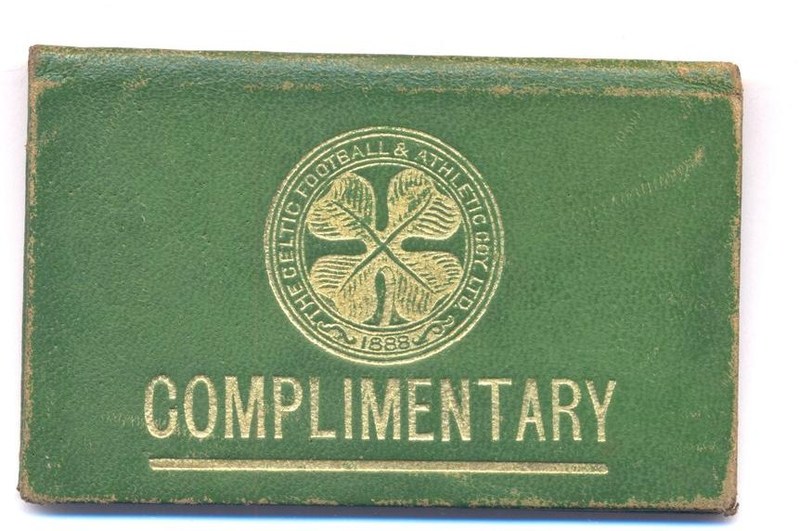
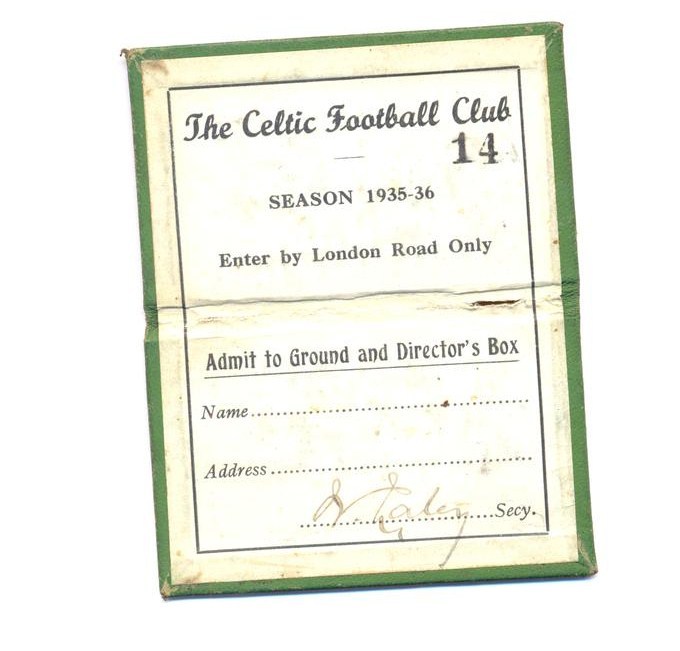
At present, the earliest known official usage recorded of the four-leaf clover badge has been traced back to 1935 when the badge was printed on the back of a season-ticket book.
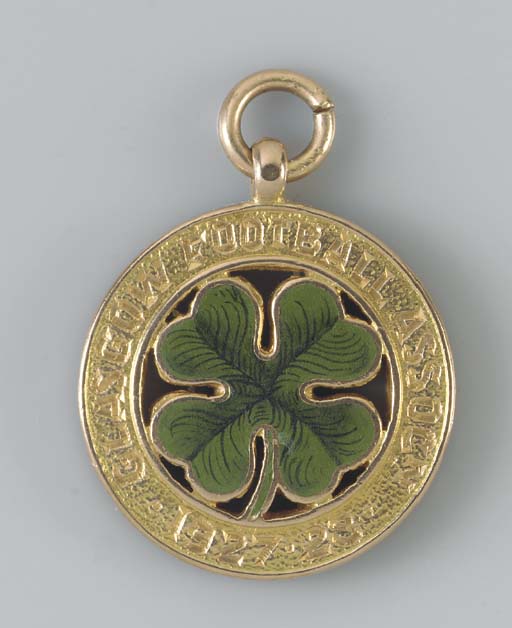
However, back in 1908, four-leafed clover badges as below were created by the club and presented to players in honour of the first team’s great achievement in season 1907-08 for winning a domestic quadruple. One possible theory is that it is possible that if Celtic had won only the three then a three-leafed clover would have been used likely gone on to become the club emblem. As it is, the club won four trophies that season and in effect the whole history of the club was to change. However, it was not for many years before the club did formally adopt the four leafed clover as the official club badge, but the first steps had already been taken.
The old traditional Celtic Cross badge made a re-appearance in the ‘Centenary Season’ (1987-88), and again in 2003 to celebrate 100 years of the Hoops top.
It’s an important emblem of the club and the support, and one of the world’s most recognisable symbols. A classic of all sport.
Post 1995 Badge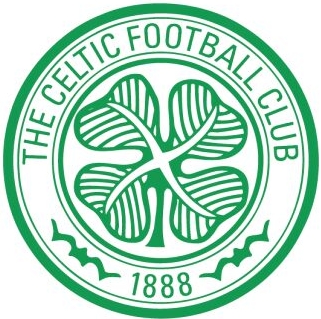
The current badge is an amendment of the previous badge after the takeover in 1995 when the club changed their financial status to a Public Limited Company from a Private Limited Company, hence the writing around the badge had to be amended.
The only significant change to the badge was that the name around the badge now stated “The Celtic Football Club” as against “The Celtic Football and Athletic Coy. Ltd” as it was previously.
During the amendment, there was even speculative consideration by Fergus McCann (the then Chief Executive) of possibly changing the crest at one short point, but thankfully was never taken any further see article.
History of the Badge;
From fanzine ‘Welcome To Paradise’ Issue 14
Today the 4 leaf clover is as instantly identifiable of Celtic as the green and white hoops.
Obviously the club’s symbols and colours are Irish befitting of our humble beginnings but many probably don’t know that we only started using the hoops in 1903 after wearing green and white stripes before then and of course the original white top with green collar and Celtic cross on the right breast for the first season only.
After our first year when the club badge was without doubt the Celtic Cross, it was another 90 years before the club badge would appear on the jerseys.
Having studied our early years it’s clear that although badges were not as prominent as they are today in recognising a brand we did use the Celtic Cross, the harp, and the 3 leafed shamrock.

Clear examples of the 3 leaf being used until then was the large green 3 leaf shamrock glass plaque in honour of John Thomson along with the large 3 leaf shamrock used on his goalkeeper top which was common at that time.
In fact stronger proof that the official badge until 1938 was the 3 leaf is seen on the back of the 1929/30 season ticket with the badge stamped proudly.
The most popular away strip ever worn by the club also featured the large green 3 leaf shamrock as late as the early 60s. The strip was white with green sleeves and shorts and was originally a gift from Belfast Celtic.
The 3 leaf shamrock is used often in the early days in Celtic publications, especially the Celtic Handbooks but one example of the 4 leaf is seen as early as 1908 when the club made up medals to commemorate the 4 trophies won that glorious year and gave them to the players. This seems to have been a one off and was down to the club winning four trophies and not three as there are no other examples of the 4 leaf being used until 1938. [N.B. Evidence has been found since this article was initially written that the Celtic four leafed clover badge was used officially even earlier in 1935, see below].
One story that does the rounds for the reason the 4 leaf took over from the 3 leaf was that Desmond White and local delegates from the Celtic Supporters Association admired the Bonnybridge CSC club logo so much they asked for permission to adopt it. “After due consultation and consideration, Celtic supporters either at club or association level responded to this ‘request and the plaque design was gifted to Celtic F.C. without any thought of 1% of any future royalties”.
It’s a nice story but unfortunately Celtic first used the 4 leaf in 1938, six years before the birth of the CSA and nine years before Desmond White joined the Board.
In more recent years the Centenary season was marked with the return of the Celtic Cross in a very popular move.
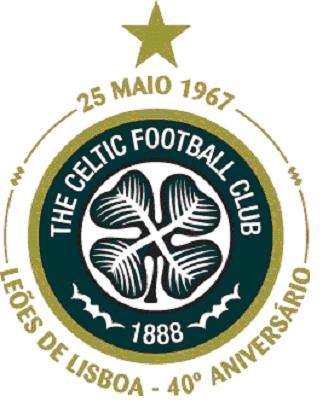
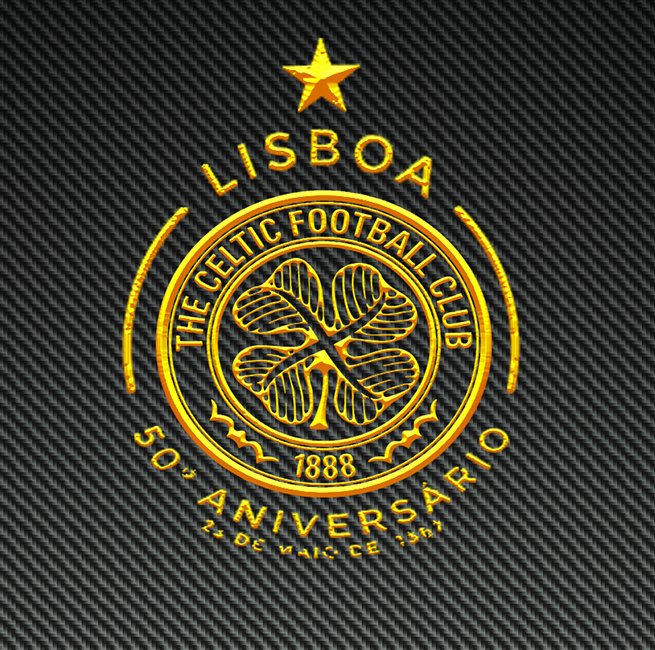
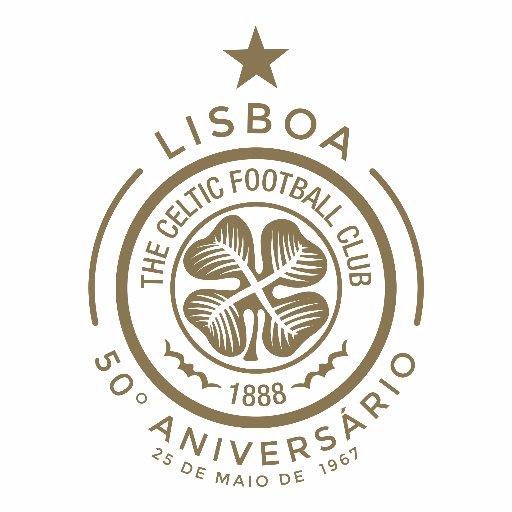
The 40th anniversary of Lisbon was also marked with the legend 25th May 1967 at the top with Lisbon Lions & 40th Anniversary along the bottom in Portuguese. A gold star above the badge marks the European Cup win to this day.
When Fergus McCann took over the club in 94 the wording on the badge changed to reflect the new status of the club, going from The Celtic Football & Athletic Coy Ltd 1888 to simply The Celtic Football Club 1888.
Not surprisingly for Fergus there was controversy too as he tried to get the idea off the ground that the badge should be changed to appeal to the Scottish business community and should incorporate a thistle.
Unfortunately for Fergus his idea didn’t take into consideration the strength of feeling amongst the Celtic support and it didn’t get off the ground. To this day the club badge varies very little from when it was first seen in 1938.
Articles
Links
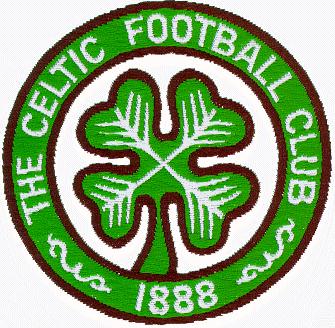
Pre-1995
Prior to becoming a PLC, the full previous company name was used as below “The Celtic Football & Athletic Coy. Ltd” (“Coy.” as in Company). The Athletic aspect covered that in the original days the board likely wished to attract other events to the club as well as football to broaden the club’s mandate as well as to generate revenue (e.g. cycling).
Original Celtic cross badge on the Celtic shirt 1888
Original design:

Centenary
In season 1987-88, to celebrate the club’s centenary the club did a one-off redesign of the badge reverting it to include the old Celtic Cross which was the symbol on the original Celtic badge when the club was formed back in 1888.

Below is an early record of the badge in use (season ticket 1896-97)


Lisbon anniversary badge
(following badge was put on the Celtic home top in season 2007/08 to celebrate the 40th anniversary of the Lisbon Lions victory in 1967)

125th Anniversary of Club’s foundation
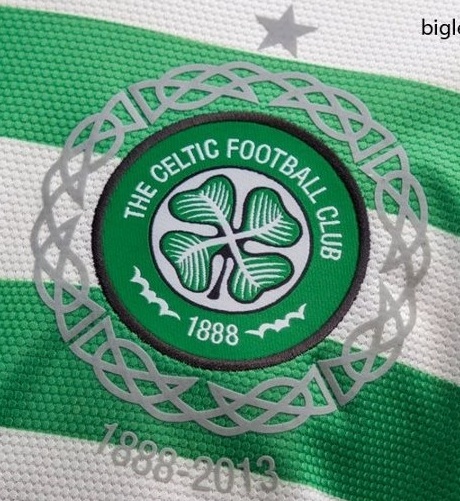
For the 125th Anniversay
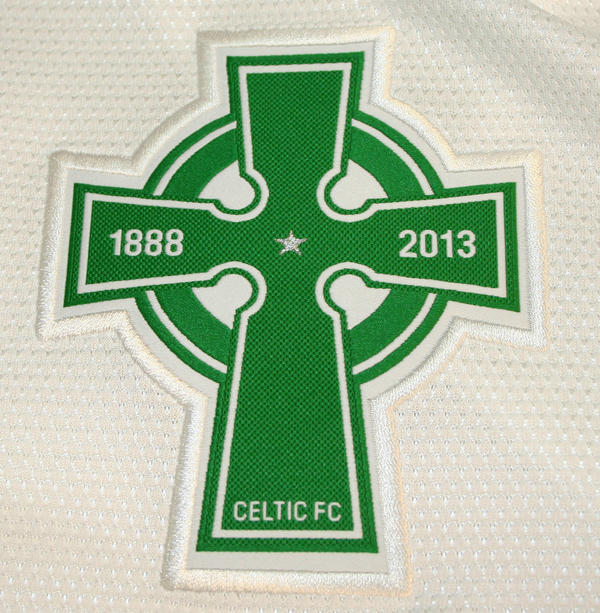
Special badge on the 125th anniversary top!

2018-19 Season Third Strip

Celtic 50th Anniversary of Lisbon Lions 1967 (2017)


2020
Articles
First official usage of the Four-Leaf Clover badge?
Green 1935-36 Season Ticket book with the Four Leaf Clover on the front
Obtained by the Celtic Graves Society at an event in August 2011. Possibly the earliest evidence of the standard four leaf clover badge officially being used by the club.
This is the earliest found official usage of the four leaf clover as our badge an crest.
There are reports that the shamrock was used on the Wee Green Book from 1932, so maybe that trumps this one.
1938 Handbook

The menu from 1938, 50th Jubilee Dinner, showing the 4 leaf as the official badge.

Earliest usage of the four leaf clover?
The badges below were created by the club and presented to players in honour of the first team’s great achievement in season 1907-08 for winning a domestic quadruple. Very much the same as the modern badge, but this was just a one-off usage and not used further as the official badge of the club till the 1930’s. Still it’s the earliest use by the club of the symbol and a likely forerunner of the official badge. Again was used in a medal design in 1927-28.
Theory: The below medal is the earliest known usage of the four leaf clover, and the design represents in part reflects the winning of four senior trophies that season. Therefore, it is possible that if Celtic had won only the three then a three-leafed clover would have been used likely gone on to become the club emblem. As it is, the club won four trophies that season and in effect the whole history of the club & badge was set in gold.
A 9CT GOLD AND ENAMEL MEDAL
The obverse inscribed Celtic Football Club, 1908, the reverse inscribed Presented By The Directors Of Celtic F.C. To Celtic , In Recognition Of, Record Achieved By Winning The Following Trophies in 1907-8, Scottish League Champ, Scottish Cup, Glasgow Cup, Glasgow Charity Cup, the rim inscribed Donald McLeod.


A 9CT GOLD AND ENAMEL CELTIC F.C. MEDAL
The obverse inscribed Glasgow Football Association, 1927, the reverse inscribed Won By Celtic F.C., To J. Maloney, From T.B.McNally, with ring suspension in case, Sold 23 November 2004 Christies London, South Kensington £335
Early badges
1929 match ticket (front & rear) showing official 3 leaf Celtic badge.

1892

1891
Below images are from an advert for Admission Tickets in the Glasgow Observer dated 22nd August 1891.
Not known to have been an official badge, and there is actually a badge which was 99% the same as used for similar Rangers adverts, in papers.
So likely both badges were mock-ups to assist advertisements, but were not official badges.


Evening Times 1938 – Four Leaf Clover Badge

Probably the Oldest Four Leaf Clover Badge
c1921

Esporte Fino
(Translated, 6 Feb 09 Link)
This Friday ESPORTE FINO blog discloses the ten best looking football team badges in the world. On Monday positions 50 to 41 were revealed and today we reveal the top ten football badges in the world as voted by the blog over the last few months.
The competition started with the blog team making a short-list of team badges as our chosen judges would have gone crazy if they had to look at all the team badges from all the teams on the planet. The preliminary selection was made with help from journalist and historian Rodolfo Rodrigues, author of the book Badges of Football Teams of the Entire World. He whittled it down to 128 badges from 45 countries.
With these chosen finalists, the second phase of the project was to invite journalists and design specialists to judge the badges. All were informed that the idea was to choose the best looking badge, independent of their support for the clubs. The judges who participated in the election, plus four judges from ESPORTE FINO, were: Everaldo Marques (ESPN Brazil), Helena Jacob (journalist, graphical teacher of design and master in semiotics), Mauricio Noriega (SporTV), Mauro Beting (Bandeirantes Radio, TV Band, BandSports) and Rodolfo Rodrigues (journalist and historian, author of the book, Badges of Football Teams of the Entire World).
First placed badge on each judge’s list received 60 points, second received 49, third, 48 and so on with 50th placed badge receiving 1 point. We now reveal the top ten badges of the vote as homage to Luiz Fernando Bindi, journalist, a great specialist in club badges who died prematurely in July of 2008.
Top 3
1. Botafogo
2. Celtic
3. Juventus
Panini Sticker Album badge

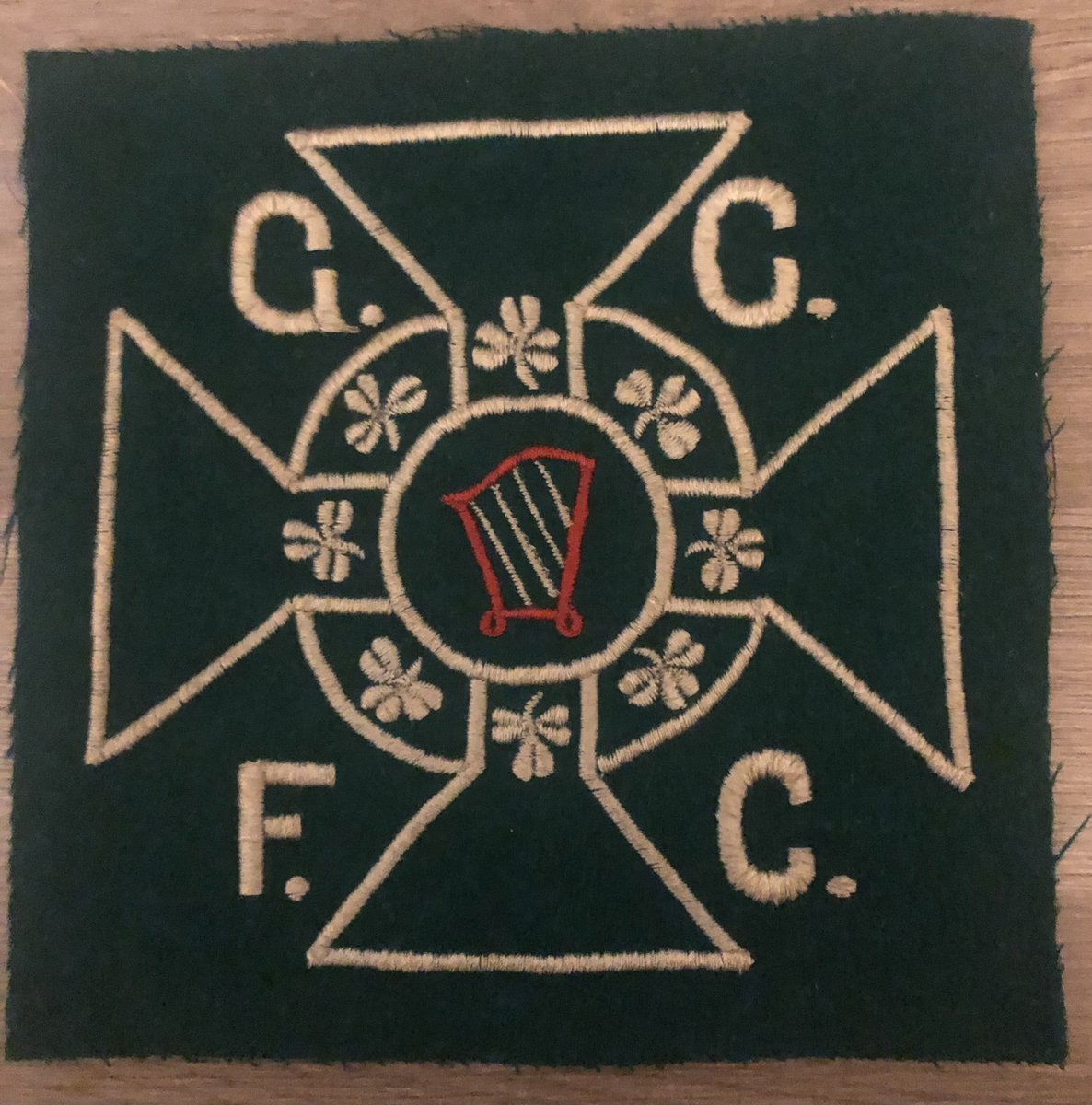
GCFC
An original Glasgow Celtic embroidered blazer badge, formerly owned by Alec McNair. Not know if officially used badge or in what context it was used. Noted the very rarely used initials of “G.C.F.C.” for the club.