H | Player Pics | Manager Pics | A-Z of Players | Managers | Quality Street Gang
Personal
Full name: David Hay
aka: Davie Hay, The Quiet Assassin
Born: 29 January 1948
Birthplace: Paisley
Signed (player): January 1965 (prov) / 20 March 1966 (full)
Left Celtic (player): July 1974
Position: Full back/Midfielder
First game: 6 March 1968 Aberdeen home 4-1 League
Last game : 6 May 1974 Morton 0-0 Celtic League
First goal : 21 February 1970 Rangers home 3-1 Scottish Cup
Last goal : 13 April 1974 Dundee United away 2-0 League
Internationals: Scotland
International Caps: 27 caps
International Goals: 0
Manager: July 1983 – May 1987
First game as manager : 9 August 1983 Partick Thistle away 2-0 Glasgow cup
Last game as manager : 9 May 1987 Hearts away 0-1 league
Succeeding & Successor: Billy McNeill
Playing Career
| “Davie Hay has a fresh pair of legs up his sleeve.” John Greig (ex-Rangers captain/manager) |
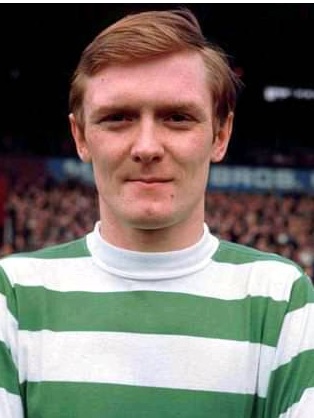 David Hay (“Davie Hay”) is unquestionably one of the most complete players to have ever pulled on Celtic’s green and white Hoops.
Signed from St Mirin’s Boys Guild in March 1966, Paisley-born Davie Hay learnt his trade in the legendary ‘Quality Street Gang‘ Celtic reserve team of the late 1960s alongside the incredible talents of Dalglish, McGrain and Connelly. He made his first team debut as a substitute in a 4-1 league win over Aberdeen at Parkhead on 6th March 1968 and initially he was played in the right-back position.
Jock Stein however recognised that Davie Hay’s qualities would be much better utilised in midfield and that is where he really earned his reputation as one of the finest players of his generation. Davie Hay was the rarest of creatures in that he was a creative midfielder who was also a peerless ball winner.
His big break came in October 1969 when he was picked at left back for the League Cup Final against St Johnstone after Tommy Gemmell was controversially suspended by Jock Stein. Celtic won 1-0 through a Bertie Auld goal and Davie Hay had his first medal.
On 21st February 1970 the versatile Davie Hay ploughed through the Rangers midfield and fired a glorious 25 yard goal, the key moment in Celtic’s 3-1 win. At this point he came face to face with Rangers captain and hard man John Greig but Davie Hay came out on top of their encounters even at such a young age. He was impressive at right back against Leeds United in the 1970 European Cup semi final games and handled himself well in the final against Feyenoord, also at right back despite the disappointing defeat.
By the 1970/71 season he had became a key player especially with his versatility. In 1971 he was in central defence as left half in the Scottish Cup final replay 2-1 win against Rangers and was instrumental in bringing the title to Parkhead, helping hold off a strong challenge that season from Aberdeen. In the European Cup Celtic went out 3-1 on aggregate to the magnificent Ajax team as Europe marvelled at the unique talents of the great Johan Cruyff.
He won another league medal in 1972 though he was injured from the run in and missed the 1972 Scottish Cup final romp against Hibs. More importantly that injury cost Celtic the chance to play him against Inter Milan in the 1972 European Cup semi final games which Celtic lost on penalties and Davie’s appearance could have swayed the tie in Celtic’s favour. Hay’s presence was key to Celtic’s great success of the period and he played regularly in both full back positions and in midfield.
The 1972/73 season was another outstanding one and the league was won for the 8th successive season on a memorable spring day at Easter Road. Jock Stein stated that it was the reappearance of Davie Hay and Jimmy Johnstone in the Spring of 1973 that had given Celtic the edge in a tight league race with Rangers, which went to the wire on the last day for Celtic against Hibs. By this time Davie Hay was an established Scottish international and the big clubs in England had him in their sights.
In December 1973, Davie Hay and George Connelly were in dispute with Celtic over their pay and conditions, basically David Hay went on strike and refused to play or train. Connelly yielded but broke his ankle against Basle in 1974 and eventually Davie Hay also had to make up with Celtic and was in the side in midfield that won the league at Brockville and defeated Dundee United 3-0 in the Scottish Cup final at Hampden. At this point in his Celtic career Davie Hay had played in the numbers 2, 3, 4, 5, 6, 8 and 10 such was his versatility and he had excelled in every position. Put simply, Davie Hay could play anywhere on the field and be relied to turn in good performances on a regular basis.
He captained Scotland against West Germany in early 1974 and that summer Davie Hay was magnificent when Scotland beat England at Hampden, their first victory over the English since 1967 and also in the 1974 World Cup finals in West Germany when he was Scotland’s outstanding player against Brazil, Yugoslavia and Zaire. In the game against Brazil, Davie Hay and Billy Bremner were superb when pitted against the great Brazilian midfield pairing of Rivelino and Clodoaldo. It was Tommy Docherty, who was a Scotland manager, who gave Davie Hay the moniker of “The Quiet Assassin” to define his style and quality of play on the pitch.
However when Davie Hay returned from the World Cup, Chelsea, Spurs and Manchester United were after him and he was disappointed when Celtic accepted Chelsea’s bid of £225,000. It’s said that Davie Hay was willing to stay at Parkhead at that time for an extra tenner a week and so Celtic lost the heart of their team and future captain. Given the player’s pivotal role in the success of Celtic and his growing reputation on the world scene the requests for a pay rise were probably well justified.
After a European Cup final appearance (1970), winning five league championships, two Scottish Cups and a league cup, Davie Hay left Parkhead for Chelsea. He had made 230 appearances for the Hoops with 12 goals.
Post-Celtic
Following his switch to Stamford Bridge, Davie Hay’s career would be interrupted by injury but his talent was one Celtic would struggle for years to replace. If he had stayed there is every chance Celtic would have won 10 in a row in 1974/75 as he was the driving force of the team and when he left the team was never quite the same without him and Rangers would prevent the 10 from becoming reality.
One notable point to Davie Hay’s departure was the impact on George Connelly. A precocious talent, George Connelly found it hard at Celtic, and after Davie Hay’s departure he didn’t stay long himself. Close friends with Davie Hay to this day, Davie Hay has remained silent on much of the period of events that surrounded George Connelly. In part, it is said that Jock Stein allowed Davie Hay to leave Celtic as he felt that it could help George Connelly (as a break between the two could be good) but it didn’t work out like that.
In May 1976, Davie Hay returned to Parkhead to play for Celtic as a guest in the Johnstone/Lennox testimonial game against Manchester United. Davie Hay played as if he’d never been away and the fans gave him a superb ovation as Celtic won 4-0 with a Dalglish hat trick. Actually the fans were chanting: “We want Hay!“. This spurred rumours that he was to return to Glasgow but, sadly, nothing ever came of it.
Davie Hay would return to Parkhead as manager in 1983, and then later again as part of the management team under Tommy Burns in the 1990s.
Davie Hay is unarguably one of Celtic’s greatest ever players. We only wish that the club could have held onto him for longer but board financial mismanagement saw an end to that.
Playing Career
| APPEARANCES (goals) |
LEAGUE | SCOTTISH CUP | LEAGUE CUP | EUROPE | TOTAL |
| 1965-74 | 130 | 30 | 45 | 25 | 230 |
| Goals | 6 | 1 | 5 | 0 | 12 |
Major honours as a player
Scottish League titles
Scottish Cups
League Cup
Manager 1983-1987
“The league championship win in 1986 over St Mirren will live with me forever… Celtic fans still come up to me and want to talk about that day in Paisley and thank me for it. There is no better feeling in the world. Money can’t buy that.”
Davie Hay
Davie Hay after his playing days were cut short was destined to find some niche in football coaching or management.
He was given a role on the Chelsea youth coaching, and then later his first major management role came at Motherwell where he helped to guide them to the Premier Division by winning the Division One title. A great feat in itself and he was well respected at the club, however an opportunity from the US came knocking and he decided to take the chance with the club’s blessing. It turned out to be a major error as circumstances in the US turned the dream into a nightmare and he soon returned.
After Billy McNeil’s departure from Celtic, Davie Hay became a surprise appointment taking in his inexperience aged only 35.He was probably one of the last of his kind, as soon after the modern financial revolution began with Graeme Souness becoming Rangers’ manager and changed the face of football business management in Scotland.
Seen as an intelligent, respected tactician with a relaxed style but a harder edge than his demeanour suggests, he didn’t have it easy having to compete against the strong “New Firm” duo of Aberdeen and Dundee Utd. He made a rash announcement on his appointment that he would quit if Celtic didn’t win a trophy in his first season. It wasn’t to be so easy but rather was agonising for the new manager.
Celtic finished runners-up in the league to Aberdeen, the League Cup to Rangers and the Scottish Cup to Aberdeen again, but there were no calls from the support for his head, and as someone humoured to Davie Hay, Celtic did win the BP Youth Cup so he was saved. It was difficult and there were elements of bad luck.
It was just as difficult in the following season where Celtic finished second in the league (again), but Davie Hay finally managed to land the silverware he deserved by managing the side to the Scottish Cup win in 1985 where defeated Dundee Utd side 2-1 with goals from Davie Provan (yes THAT free kick) and Frank McGarvey in a cracking match. It was our first trophy since 1982 and as it was the 100th Scottish Cup final, it was a special victory. It was relief for Davie Hay and gave him valuable breathing space, but it was the least he deserved after the way his tenure had gone to date being a nearly man too often in every competition.
He may not have won the league as yet, but we competed well and he had some fine but difficult players under his belt including Brian McClair, Murdo MacLeod, Alan McInally and Mo Johnston, which created a great attacking side to watch. Defensively things were not as good as they could be and was a continuous weakness. Overall, Davie Hay was gaining experience and could see increasingly where things were going right and wrong. It was learning at the deep end but he was doing a fine job.
Despite the difficulties at home, there was some respite and drama in Europe for Davie Hay. A cracking match against Sporting Lisbon rekindled memories of old as we won by a breath-taking 5-0 at home after being 2-0 down from the first away leg. The match is marked by many as one of the club’s greatest European matches (but then Celtic lost out to Notts Forest in a later round).
The main talking points on Europe have been the matches against Rapid Vienna (Austria) in the UEFA cup in 1984. In the first games, after a difficult 3-1 first leg defeat Davie Hay’s team got it right in a wonderful 3-0 win only for all the work to be then undone. Cheating and deceit saw UEFA at its lowest and most incompetent, awarding Rapid with a third game. Rapid duly won the replay match at Old Trafford 1-0 despite some good play by Celtic; we’d let ourselves but most importantly the players had let Davie Hay and themselves down.
Taking in that Celtic really were more than a match for Rapid Vienna then Celtic could have gone all the way to the final as Rapid Vienna did that season (thankfully losing to Everton). It was heart breaking for Davie Hay, and he was cheated out of scaling the heights in Europe.
The 1985-86 season was a difficult season. Despite the parsimonious nature of the Board, the 1985/86 season started well with McClair and Johnston the celebrated scoring duo in the League but the defensive errors and deficiencies soon became apparent. It was exciting play to watch and Davie Hay was building a good side. However, Davie Hay was denied the cash to go out and buy the defenders required and with the appointment of the hapless Jack McGinn to Chairman the rumours for the replacement of Davie Hay grew. Jack McGinn was out of his depth and his man management was later to show just how woeful he was.
To the surprise of many the championship went down to the wire between Celtic and the Gorgie Cloggers (Hearts), and against all expectations we won the League on a memorable last day at Love Street. Hearts only needed a draw whilst Celtic needed to win by a hatful, and that Celtic did actually win by a giant margin whilst Hearts lost, it sent the Celtic support into raptures. It was the least Davie Hay deserved. The team had fought all the way. Some critics ridiculously refused to give Davie Hay full credit but the league is a marathon and not a sprint and Celtic had finished top.
For the 1986-87 season, things were to change dramatically for Scottish football. Rangers were reinvigorated with large cash injections and an ambitious new manager (Graeme “the Beast” Souness). In contrast, Davie Hay was again denied any support or real funds to go out and buy the players required to shore up the squad. Around Jan 1987, Jack McGinn (newly appointed chairman) disparagingly stated: “If Davie Hay wants to bring those players to Celtic then he will have to pay for them himself!“. The biscuit tin mentality was really in vogue with the board.
Defensive lapses were the real problem. Celtic had a terrific attacking side but not a complete team. If the management were more effective then Davie Hay could have been allowed to buy those defenders he required, and it was to backfire on the club badly.
Celtic had established a good points lead in the League, but this was thrown away as points were lost later through repeated defensive errors. Furthermore the issue of player re-contracts had not been addressed (which led to the loss of Brian McClair to Manchester United for next to nothing at the end of the season and the departure of the gems in the squad at the time e.g. Murdo MacLeod to Borussia Dortmund, Mo “Judas” Johnstone to Nantes etc).
The league was lost to Rangers in a truly lacklustre style. A little extra spent on transfers would have made all the difference and given Davie Hay the recognition he deserved. The mutterings for the replacement of Davie Hay grew, and with Jack McGinn at the helm of the club, it was already believed that he had wanted Davie Hay out months long before the end (a personality clash?).
Strangely, at the end of the season Davie Hay was finally permitted to go out and buy a defender – Mick McCarthy for £500,000 from Manchester City – a player precisely the kind he had been begging the board to buy during throughout the season. Then the following week he was called to a meeting with chairman Jack McGinn, and Davie Hay was asked/forced to resign. According to Davie Hay in his biography, Jack McGinn said:
“We have decided that we must get rid of you as manager of the club. You can either resign or you can be sacked, but we would like you to resign. There will be compensation from the club.“
Davie Hay refused and was sacked on 28th May 1987. He learnt of Billy McNeill‘s return as manager from the radio later that same day. Ironically, he was being replaced by the manager he had taken over from.
Shabbily handled by the board, it is a clear illustration of the often cruel nature of the game and the incompetence of certain management. Davie Hay was being sacrificed by the board having gained the invaluable experience he required. In truth, he made a few poor purchases and this was all on a limited budget. If the board were set to sack Davie Hay, why did they let him go out and buy a player for so much just before they dumped him? Baffling!
In fairness, Davie Hay had now been given four seasons and only succeeded in one to win the league. His side lost the league title challenge in his last term even though Celtic had a ten point cushion at one point but then Celtic allowed Rangers to overtake and grab the title. That was difficult to argue against. He’d had success in getting strikers yet not any defenders, so could the blame then really be the board alone?
On the other hand, how was any manager to succeed against the free spending Rangers in his last season whilst Davie Hay’s hands were tied behind his back? At the time, English clubs were banned from Europe and so a number of their better players were easy to cherry pick which Rangers did. Sadly, Celtic’s financial and board level blindness held the club back, and Davie Hay was left to suffer the consequences.
Tommy Burns summarised a common opinion on Davie Hay saying: “Davie Hay is a hard, hard guy and a lovely, totally straight-forward and honest bloke. But I don’t think he was the right man to manage Celtic“. Maybe it is simply true that the management life wasn’t for Davie Hay, but he had succeeded well in inauspicious circumstances so Tommy was being a touch unfair. It didn’t stop Davie Hay to try his hand elsewhere again in management and he showed he had the bottle to take on the difficult role and succeed.
Davie Hay was unfortunate in that he was given the job when inexperienced and still learning the ropes (which contributed to the mixed results), but as soon as he gained the experience he was dumped by the board. Poor treatment of a good man. Who knows how it might have panned out if he remained. Nevertheless, he can hold his head up high for his time as Celtic manager and many believe he should have been kept on.
In the new commercial world of football, Celtic were to be initially poorly placed relative to Rangers, and Davie Hay became the club’s first casualty of this new era. He was not to be the last.
Post-Celtic Management
Davie Hay went on to have rewarding spells in management at St Mirren, Motherwell, Lillestrom (Norway, where he won the league) and Livingston (winning the league cup), returning later to Celtic as a scout for players, finding amongst others the highly talented but ultimately troublesome “Three Amigos” – Pierre Van Hooijdonk, Paolo Di Canio and Jorge Cadete.
At the end of the 1996/97 season following the sacking of Tommy Burns and resignation of Billy Stark, Davie Hay held the fort at Celtic until the new General Manager, Jock Brown was appointed.
Under Jock Brown, Davie Hay was appointed Assistant General Manager as well as Chief Scout. When Wim Jansen was appointed they found that they had a lot in common and worked well together to identify players and signing targets at the start of 1997/98.
Sadly, a fallout with Jock Brown lead to Davie Hay’s moving on again from Celtic, and this departure was with some acrimony, and sadly led to a court case for compensation.
Time passed, and Davie Hay remained very much a Celtic man to the core, regularly appearing on Celtic TV. His opinions and comments are always well thought-out and valued by many within football. He will always be a great Celt.
Honours as Celtic Manager
Scottish League
Scottish Cup
Pictures
Links
Articles & Interviews
- Misc Articles
- Mon the Hoops interview with Davie Hay
- Interview with David Hay after he rejoined as Chief Scout in June 1994
Books
- Paradise Lost: The Davie Hay Story by Davie Hay with Ken Gallacher (1988)
- The Quiet Assassin: The Davie Hay Story by Davie Hay with Alex Gordon (Author) (2009)
Quotes
“Davie Hay has a fresh pair of legs up his sleeve ”
John Greig (ex-Rangers captain/manager)
“Davie Hay is a hard, hard guy and a lovely, totally straight-forward and honest bloke. But I don’t think he was the right man to manage Celtic.”
Tommy Burns 1996
“When you travel away to Europe you are there almost 24 hours a day.”
Davie Hay on Setanta Sports before a friendly against Basel
“The league championship win in 1986 over St Mirren will live with me forever. It was ironic as I used to live 100 yards away from Love Street and I grew up a St Mirren supporter so it was special for me to achieve the ultimate high as a Celtic manager by winning the championship on that ground. It was the style in which Celtic won the league that day as we went 16 games unbeaten and won our last eight on the bounce. If ever something typified the Celtic way and the manner in which this club plays football it was Maurice Johnston’s goal that made it 3-0 and it was second to none. Now, 30 years on, Celtic fans still come up to me and want to talk about that day in Paisley and thank me for it. There is no better feeling in the world. Money can’t buy that.”
Davie Hay