| M | Player Pics | A-Z of Players |
Personal
Fullname: Thomas Edward Maley
aka: Tom Maley, “Handsome Tom Maley”
Born: 8 Nov 1864
Died: 24 Aug 1935
Birthplace: Portsmouth
Signed: May 1888
Left: 1891 (retired)
Position: Outside-left
Debut: Celtic 5-2 Rangers, Friendly, 28 May 1888
Internationals: n/a
Director: 13 Apr 1897 – Aug 1902
Biog
| “Speed, stamina, dash – all three were mine.” Tom Maley |

The slopes of Celtic Park have frequently resonated to the sound of that popular Hoops hymn in praise of the eponymous Willie Maley. His long and illustrious reign at the helm of Celtic has ensured him an eternal reverence. But if it hadn’t been for the earlier football success of another Maley, it is doubtful if Willie Maley himself would ever have passed through Parkhead’s gates.
That “other Maley” is of course Willie Maley’s elder brother, Thomas Edward Maley. Tom Maley was recommended by family friend Pat Welsh to the founding fathers of the fledgling Celtic Football Club. A renowned Victorian footballer and a trained teacher, Tom was seen as an ideal candidate to help kick-start this noble new venture and so it was that on a December night in 1887 John Glass and Brother Walfrid set out to the Maley home in Cathcart with the aim of making Thomas Maley one of their first signings for the newly born club.
The son of a soldier, Portsmouth-born Tom had by the time of Celtic’s formation already played for Partick Thistle, Third Lanark, Hibernian and the Clydesdale Harriers Football Section. Away from the football field he was a successful athlete, though not so well known as Willie Maley. He went on to win many prizes – and in 1887 he won six first, three second and one first prize, then the following year he won one first, two second and one third but also took third place in the NCU 100 yards championship.
The athletics success was grand, but his attention was turning increasingly towards the booming game of football.
Famously Tom would not be at home that evening when John Glass and Brother Walfrid came calling. He was engaged in a courting of another kind, enjoying an evening out in the company of his wife to be. But the Celtic party ensured their trip wasn’t wasted by recruiting his younger brother Willie Maley – a move which of course had massive repercussions on the development and success of the club for decades to come.
Although his own role would be less celebrated than that of his brother, there can be no doubt that Tom too would play a pivotal part in the incredible growth and rapid success of Celtic Football Club.
At Celtic
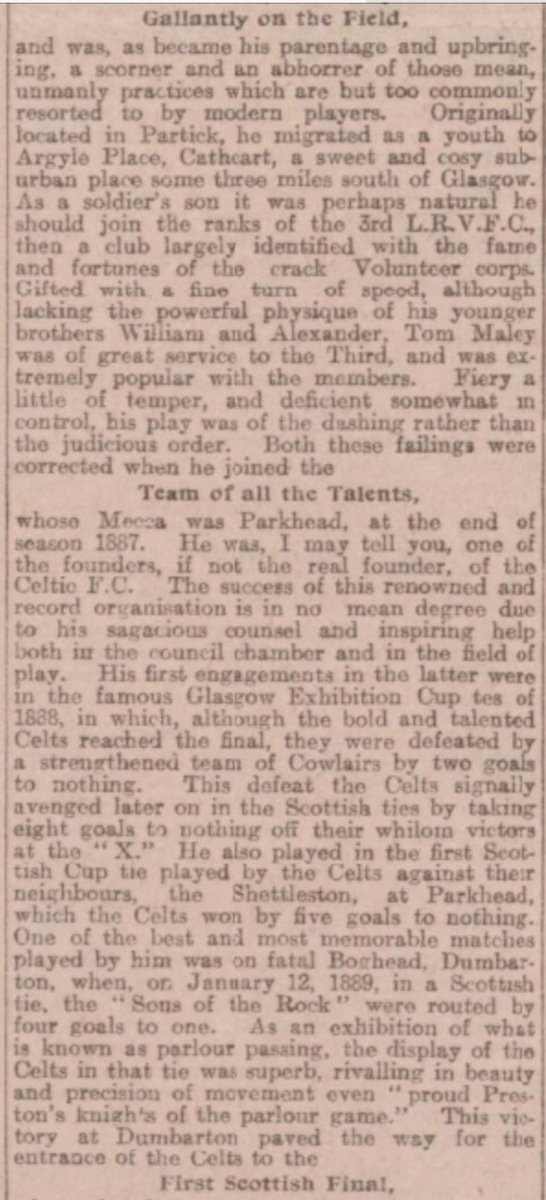
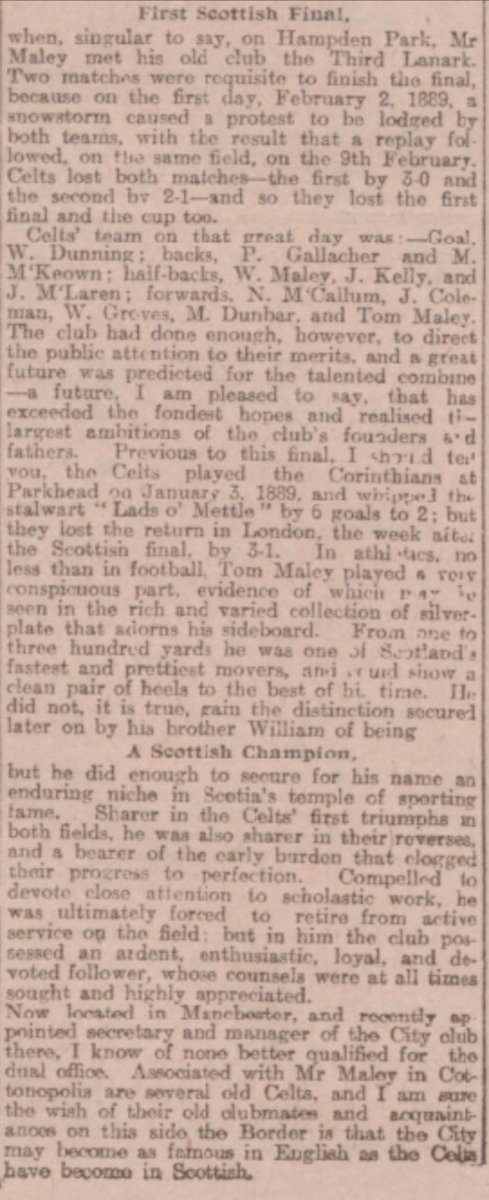
Having joined his brother at Parkhead, the pair lined up for the club’s inaugural game against Rangers on May 28th 1888 at the original Celtic Park. Although accounts of that game are not conclusive it is believed Tom scored three goals in that 5-2 victory. He would later play in the club’s first ever Scottish Cup tie when the Bhoys defeated Cowlairs 8-0 and hit six goals as the Bhoys reached the final in their first season.
A quick-footed outside-left Tom’s attributes as a footballer were varied. As he stated himself: “Speed, stamina, dash – all three were mine“.
In January 1889 Tom inspired Celtic to a wonderful 6-2 win over England’s famous Corinthians when, on a muddy swamp of a Parkhead pitch, his speed and stamina wowed one of the largest crowds that had yet witnessed a game in Scotland. That same year Tom underlined his commitment to the Celtic cause when he interrupted his honeymoon to speak for team-mate Willie Groves at an SFA disciplinary meeting.
Behind the scenes Tom was tireless in his devotion to establishing Celtic as Scotland’s premier football club. His contacts throughout the world of football were extensive and from the day of his recruitment Tom’s influence in attracting other players to Celtic Park was considerable. His whole hearted efforts on the pitch were matched by work as a committee member.
An eloquent and persuasive speaker Tom’s interests were not entirely exclusive to football. A man of faith, charity and politics he was a passionate defender of maintaining the link between Celtic and the Poor Children’s Dinner Table, while he was also known to speak at Irish nationalist rallies and meetings.
Tom retired as a player in 1891 having played nine league & Scottish Cup games and scoring 6 goals.
He however would later play for Preston as an amateur. Given his knowledge of the game it was no surprise when he became a Celtic director in 1897. Unlike some of his peers on the board, Tom was a football man and had played for the first team, so in that respect it put him head & shoulders above them.
He really fought for Celtic. In 1890, in a Scottish Cup tie v Larkhall Royal Albert, after a Larkhall player named Frame fouled Celtic player Johnny Madden, Tom Maley (the appointed linesman) punched Mr Frame! There were just 2 policeman at the match to quell any trouble, and after a struggle they managed to deal with the subsequent pitch invasion, but following subsequent thuggery on and off the pitch, the referee was compelled to abandon the first game which Celtic were winning 4-0. A replay was ordered and Celtic won that 2-0, played at Ibrox.
Time At Man City
In 1902 Tom was lured to Manchester City as manager and despite incredible success with the Lancashire club it was here that Tom would endure his darkest days in football. Maley joined City at the start of the 1902-03 season following the club’s relegation from the English top tier the previous campaign. Almost immediately his team suffered a tragic setback when experienced Wales international full-back Di Jones cut his knee after falling on some glass during a pre-season practice game. The wound turned septic and within days the player had died.
Despite that tragedy City would romp to the Second Division championship as Maley built a fearsome attacking force around the considerable skills of the Welsh Wizard Billy Merrideth. Back in the top flight, City in season 1903-04 proved to be a formidable outfit. While a second place league finish was an outstanding achievement it was eclipsed by the lifting of the FA Cup with a 1-0 final victory over Bolton.
The 1904-05 campaign saw City take their league title challenge to the final game. They needed to defeat Aston Villa to claim the championship but the day would end in a 3-1 loss marred by a punch-up and accusations that Merrideth had offered Villa’s captain Alec Leake £10 to throw the game. An FA investigation found Merrideth guilty of the charge and he was banned for a year. Angry at a perceived lack of support from his club Merrideth decided to report City for illegal payments to it’s players.
During the subsequent FA inquiry Tom Maley admitted payments had been made to his players in addition to the permitted maximum £4 a week wage. It was in truth an admission of a practice which was widespread throughout football. But while some 17 City players would be hit by bans it was Tom Maley who took the full brunt of the punishment – a lifetime suspension from football. The FA’s actions caused uproar with thousands of supporters calling on the governing body to think again.
Football journalists accused the FA of a gross hypocrisy, stating that Maley and City were being unjustly punished for a practice which virtually every club in the Football League was indulging in. Some even attributed this draconian clampdown as a deliberate attack on football in the north from the London-based FA.
It was indeed an unnecessarily cruel punishment for Thomas Maley, who had acted no differently to many of his colleagues at clubs across England. Yet he took this harsh set-back with typical decorum. Tom returned to the teaching profession and he remained in education until his ban was belatedly lifted by the FA in the summer of 1910.
Post-Man City
In February 1911 Tom returned to England to become manager of Second Division Bradford Park Avenue. He would change the club’s colours to green and white and with a large contingent of Scottish players took the Yorkshire side to promotion to the First Division. He guided them to their highest ever league placing before eventual relegations in successive seasons saw the club in Division Three (North).
As a measure of the respect some had for him one English journalist in the 1920’s for ‘Athletic News‘ stated:
“I never happened on a greater enthusiast than [Tom] Maley, nor yet a better informed man. If [Tom] Maley had had average luck he would have gone down in history as one of the most successful managers the game has known”.
He departed Bradford in 1924 for a brief spell with Southport. But for all his years and success in England, Tom’s heart remained forever with Celtic. In 1931 he temporarily took over as acting manager for the side from his brother Willie Maley during a trip to the USA.
He died on 24th August 1935. An all-time Celtic great and a very important man in the foundation of our club.
Quotes
“The greatest record of all, however, is the charitable works that appear opposite the name. No club in these lands can show aught like to it.”
Tom Maley on Celtic
Playing Career
| APPEARANCES | LEAGUE | SCOTTISH CUP | LEAGUE CUP | EUROPE | TOTAL |
| 1888-92 | 2 | 7 | n/a | n/a | 9 |
| Goals: | 0 | 6 | – | – | 6 |
Major Honours with Celtic
none
Pictures
Links
 DEATH OF NOTED FOOTBALLER AND ADMINISTRATOR
The Scotsman – Monday, 26th August 1935, page 4
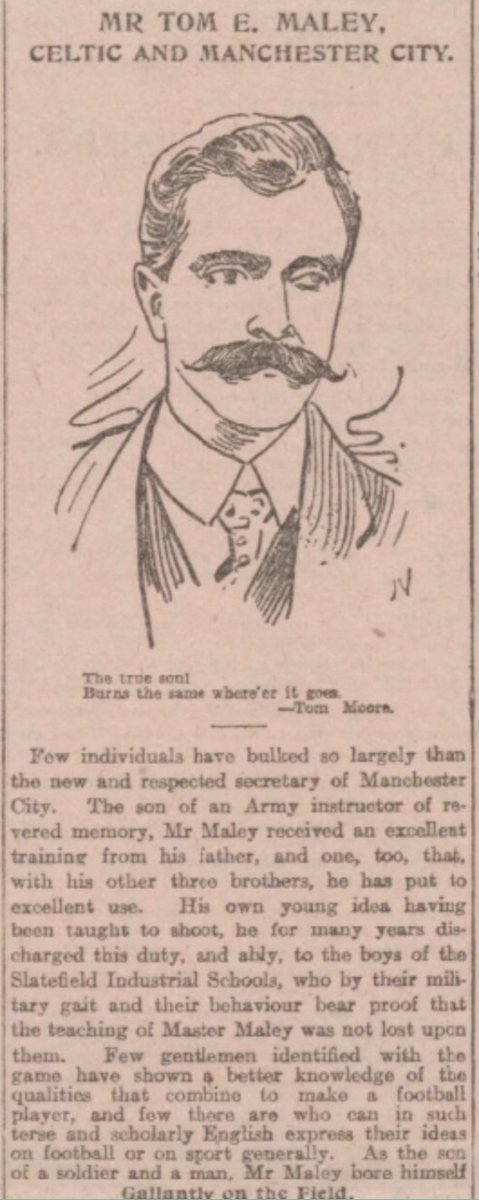
TOM MALEY
The death occurred in Glasgow at the weekend of Mr Tom Maley, a well-known player and football administrator in his day, and brother of Mr Wm. Maley, Celtic F.C., and Mr Alec Maley, formerly of Hibernians and Clyde.
Mr Maley who was 71 years of age, was a keen amateur footballer in his younger days, and played for Partick Thistle, Dundee Harp, Hibernians, Third Lanark, and Celtic. A school teacher by profession he became governor of Slatefield Industrial School, later leaving that post to become manager of Manchester City F.C. Under his guidance the club prospered, and many famous players were recruited to the team.
His engagement ended with the wholesale suspension of club officials and players over the payment and acceptance of excessive bonus money, but some years later that ban was lifted in his case and Mr Maley became manager of Bradford Park Avenue Club. Later he was associated with Southport F.C prior to:his retirement.
The funeral takes place to-day to Kentigern R-C Cemetery Glasgow
Quotes
“When the whole of the Celts were at their best, and this happened pretty often last season in their Challenge Cup ties, Mr. T. Maley generally rose to the occasion, and led his team brilliantly. His steady-going style is much liked, not only by his colleagues, but spectators, and it is quite a rare thing to see him grassed by an opponent. When approaching the goal with the ball, he is like the priest who had a “wonderful way wid him”—slipping through the backs in a manner that is sure to make the goalkeeper gnash his teeth, and wish Maley was far enough away.”
On Tom Maley, from Scottish Football Reminiscences and Sketches, by David Drummond Bone
“Our method and style of play was at the first moulded on lines somewhat original, but was football pure and unadulterated all the time.”
Tom Maley on Celtic
Scottish Athletic Journal 5th June 1888

Scottish Athletic Journal May 15th 1888

Tom Maley – A Man City perspective
Posted on November 28, 2011 by Gary James
Source: http://www.bluemoon-mcfc.co.uk/Blog/index.php/2011/11/28/tom-maley/
The recent ceremony organised via the Celtic Graves Society marking the grave of former City manager Tom Maley has brought a few mentions of the great man.
Few City fans today probably know Tom’s story in detail and to be fair some won’t know his name. It is for this reason that I thought I’d share some basic stories and comments about him. He really is a manager all City supporters should be aware of. Without him Manchester’s Blues may never have found success at all.
Tom Maley was, without doubt, the first truly great Manchester manager, not simply City’s first great manager.
He had been a successful player in Scotland during the 1880s and was a member of Celtic at formation in 1888. Nicknamed ‘Handsome Tom’, his time at Celtic was mainly as an administrator and as such he is recorded by Celtic historians as one of the club’s most important early figures. Interestingly, despite being a proud Scotsman, he was born in Portsmouth on 8th November 1864.
He arrived at City’s first proper home, Hyde Road, following the Blues relegation in 1902 and immediately encouraged the Blues to play stylish football. His view was that playing in the Scottish passing style – uncommon in England at the time – would bring the club success and would excite the fans. He was right. At this stage in English football the key tactic seemed to be to run with the ball until it was taken from you or you were able to have a shot, whereas Celtic in particular had perfected a passing style which seemed to bamboozle most sides.
By the time he arrived in Manchester he was known as an excellent football administrator and tactician and, by adopting the passing style, he turned City into a major force. According to a 1920s journalist, Maley built the Blues: “It was when Tom Maley came to Hyde Road that Manchester City may be said to have entered fully into their kingdom. Under his management, he built a team for the club that was comparable with the mightiest sides in the country.
“I never happened a greater enthusiast than Maley, nor yet a better informed man. If Maley had had average luck he would have gone down in history as one of the most successful managers the game has known. It is enough to say that so long as Maley was at the helm, the family at Hyde Road was a particularly happy one.”
At City he managed to attract great players and the club’s popularity increased as a result. City’s average attendance exceeded 20,000 for the first time during his reign as the Blues became Manchester’s premier club, although it’s fair to say Maley’s first few weeks were a particularly difficult time for the Blues. Welsh international and star player Di Jones gashed his knee during the pre-season public practice match and, despite treatment from the club doctor, within a week the wound had turned septic and the played died. Another significant player Jimmy Ross also died that summer. Maley had to lift spirits quickly.
His first League game ended in a 3-1 win and the Blues went on to lift the Second Division championship in Maley’s first season. This was a remarkable achievement but more was to follow in 1903-4 when Maley’s men won the FA Cup for the first time in their history. The Blues were the first Manchester side to win a major trophy and the feat had come a mere ten years after formation as Manchester City F.C.
In addition City narrowly missed out on the double, finishing second to Sheffield Wednesday after fixture congestion forced the Blues to play five League games and the cup final in the space of 16 days! No squad rotation possible back then. Who said fixture congestion was a modern phenomenon?
City’s success wasn’t popular with the footballing establishment – in particular the southern based FA – and FA Officials soon arrived at Hyde Road to check up on the young northern upstarts. They found one or two discrepancies over transfers but nothing major, however the following year Maley’s side were once again bidding for the League title. A controversial match with Aston Villa gave the FA another opportunity to investigate the club’s affairs and this time the FA claimed to have found widespread anomalies including overpayments to players. Tom Maley was questioned at length and admitted that he had followed what seemed like standard English practice. He claimed that if all First Division clubs were investigated, not four would come out ‘scatheless’. He was right but it was City the FA seemed determined to punish and they suspended 17 players and 2 directors. But the harshest sentence fell on the Chairman and on Maley. They were both suspended for life.
The northern based Football League and the footballing press supported the Blues but the FA got their way and Maley’s brief but successful reign was over.
Maley suffered more than most by the unfortunate events of 1905/6, and his role in football history has been tainted forever by the F.A.’s harsh treatment. However, in the eyes of thousands of Mancunians he is remembered as the man who brought exciting football and the F.A. Cup to the city for the first time.
Without his period at Hyde Road, Manchester may never have found real football success. Many of his players were forced to join United after the scandal of 1905, and went on to bring the Reds their first trophy success only a few years later. Had Maley been allowed to develop those players further who knows what success may have come City’s way. I reckon he would have created a dynasty at Hyde Road.
After City he became a headmaster in Glasgow, but in July 1910 the F.A. lifted his suspension and the following February he became Bradford Park Avenue’s manager. The Bradford club gave him full control of team affairs – something unusual at the time – and he remained there until March 1924. During his reign the club achieved its highest position (9th in Division One, 1914-15), and for a period played in his beloved green and white hoops. During the First World War he is said to have acted like an “amateur recruiting sergeant” and was famous for his entertaining lectures.
After Bradford he is said by some to have managed Southport between May and October 1925, and then in 1931 he temporarily took over as Celtic manager from his highly successful brother Willie during a trip to the USA.
On 24th August 1935 he passed away at the age of 70. Had his time at City not ended prematurely, it’s possible he would be remembered today as one of Britain’s most successful managers. As it is, he should always be remembered as one of Manchester’s greatest leaders.
I’ve added a few references/images concerning Tom to my facebook. Take a look at the folder “Research – Maley”: http://www.facebook.com/media/albums/?id=289818652815
Early in 2012 I will be announcing details of my next history book on City via http://www.facebook.com/GaryJames4
Tom Maley’s City Career Details
- Secretary/Manager – July 1902 – July 1906
- Took Over From: Sam Ormerod following the Club’s first relegation.
- Inherited: The legendary Billy Meredith and Billy Gillespie.
- Players Brought In Included: Sandy Turnbull & George Livingstone – both major stars.
- Nickname: Known as ‘Handsome Tom’ in Glasgow
- First Game: City 3 Lincoln City 1 (City scorers Willie McOustra 2 & Fred Bevan), 6 September 1902, attendance 16,000.
- High Points: Coming close to the League & Cup double in 1903-04 and developing a quality side that truly represented Manchester for the first time.
- Lows: The scandal that rocked City in 1905-07 and caused the Club to be severely punished.
- Last Game: Birmingham 3 City 2 (City scorers Herbert Burgess & Irvine Thornley), 28 April 1906, attendance 3,000.
Season By Season Record:
League
1902-03 P 34 W 25 D 4 L 5 GF 95 GA 29 Pts 54
1903-04 P 34 W 19 D 6 L 9 GF 71 GA 45 Pts 44
1904-05 P 34 W 20 D 6 L 8 GF 66 GA 37 Pts 46
1905-06 P 38 W 19 D 5 L 14 GF 73 GA 54 Pts 43
2 points for a win
FA Cup
1902-03 P 1 W 0 D 0 L 1 GF 1 GA 3 Reached 1st round
1903-04 P 6 W 5 D 1 L 0 GF 12 GA 3 FA Cup winners
1904-05 P 2 W 1 D 0 L 1 GF 3 GA 3 Reached 2nd round
1905-06 P 1 W 0 D 0 L 1 GF 1 GA 4 Reached 1st round
TOTAL (League & cup fixtures)
P150 W89 D22 L39 GF 322 GA 178
Trophies Won: FA Cup (1904) & Second Division title (1903). His brother managed Celtic to Scottish Cup success in 1904 to complete an unusual double.
He Said: Talking about City’s 1904 homecoming in which, it was widely reported, the entire population of Manchester turned out to welcome the Cup winners home: “Perhaps the love of sport had something to do with the bringing together of so great a gathering, but love of Manchester had much more to do with it.”
(I love this quote and included it in the Introduction to my book on all of Mancunian football “Manchester A Football History”:
http://www.facebook.com/photo.php?fbid= … permPage=1
They Said: “I never happened on a greater enthusiast than Maley, nor yet a better informed man. If Maley had had average luck he would have gone down in history as one of the most successful managers the game has known” – A 1920s journalist for Athletic News.
From The Blizzard Dec 2016
The Sadness of the Master Builder
Death, the War and the Bradford Park Avenue manager Tom Maley
By Alexander Jackson
At Elland Road on 18 December 1915 the Bradford Park Avenue manager Tom Maley was keeping an eye out for a friend before kick-off. As he informed readers of his regular column in the Yorkshire Weekly Record, he had been befriended on his first visit there by a Scottish fan of Leeds City and Celtic, who had seen Maley play for the Glasgow club.
“Every match at Elland Road since then he has turned up. Never do I sit myself on the stand, for then I would miss my Celtic friend…’I thought that was you with the sodger’s coat and bonnet…I am glad to see you,’ he said, and then in his own way, and with a sincerity that couldn’t be questioned, a few words of regret at the loss of my boy.”
The ‘boy’ in question was Tom’s second eldest son, Corporal Joseph Maley of the 9th (Glasgow Highland) Battalion, Highland Light Infantry, who had died from his wounds on 17 May 1915.
The image of a football manager receiving sympathy for his loss from a fan is one of many moving wartime scenes that Tom Maley recounted in his columns for his readers. They shed light not only on the wartime game, which has so often been overlooked, but on something more profound. They give an idea of the emotional impact the war had on one manager, his personal sacrifice and his attempts to support the war effort in the way he knew best, through football. As a manager and a former school superintendent, he was connected to the battle front through scores of former players and pupils. Adrian Gregory, a leading historian of the Home Front, has written that, ‘such is the emphasis on emotional bonds between the soldiers in the most famous literature of the war that the significant bonds with the home front have disappeared from view.’ Maley’s columns help to bring some of them back into view.
In the summer of 1914 Tom Maley could have looked upon his football career with some pride, having successfully re-established himself as a leading manager. Born in 1869, he came from a military background, his father a soldier who had served in the Crimean War and the Indian Mutiny. He already enjoyed a famous place in Celtic’s history as one of its founder members, playing in the club’s first game in 1888. Having trained as a teacher he had entered into the new world of football management with Manchester City after they had been relegated to the Second Division in 1902. There he enjoyed great success, winning the Second Division in 1902-03 and the FA Cup in 1904.
Then disaster struck. An FA investigation into illegal payments to circumvent the maximum wage led to lifetime suspensions for several City directors and Maley. Denying any involvement, Maley returned to Glasgow to become superintendent of Slatefield Industrial School, his football career seemingly over.
But then came a second chance. His ban was overturned and in 1910 he became the manager of Bradford Park Avenue. The club was struggling in the Second Division, but Maley transformed their fortunes and also their kit, changing it to the green and white hoops of his beloved Celtic. In April 1914 Avenue secured promotion to the First Division, only seven years after the club’s creation. A review of the club’s progress called him “The Master Builder”, a testament to his astute signings, often from Scotland. Successful and respected in his profession, proud father to four sons and one daughter, and with his brother William, the celebrated manager of Celtic, Tom Maley might well have looked back at the summer of 1914 as a Golden Age.
The following season was, as many writers would observe, like no other. With Britain’s declaration of War on August 4, the 1914-15 season became highly controversial, with football attacked by, in the words of one football writer, “political cartoonists, kill-joys, conscriptionists, anti-sports, and many others whom the deadliness of the fighting had somewhat unbalanced.” From the outset Maley would argue for the value of sport in wartime as an antidote to the depression of war: “It indicates no lack of loyalty or absence of patriotism does match playing. It fulfils a function and purpose useful.”
Maley also encouraged the war effort in other ways. His son Joseph volunteered early on and soon he and his brother William had two sons each in the services. They were joined by Joseph’s Avenue reserve teammate, the schoolteacher Donald Simpson Bell. Maley recalled that “at the outbreak of war he [Bell] spoke strongly about those who could go, ought to, and didn’t. When he learned that my son had joined up he was mighty pleased.” Despite this, the sight of professional football continuing offended some, with Maley and the directors receiving hate mail. One anonymous letter from London called them “enemies of the country, worse than naturalised aliens, worse than Germans!”
Ignoring the criticism, Maley guided Avenue to their highest-ever finish, a respectable ninth place – above their rivals Bradford City. But at the end of the season the FA announced the cessation of professional football. No one was sure whether organised football would return but Maley still believed in the importance of football to the war effort. This was soon to be tested to the utmost.
As the 1914-15 season came to an end, the British Army set out on its first major offensives, resulting in horrific losses. Nearly 66,000 men were killed in May, the deadliest month of the war until July 1916. Among them was Joseph Maley, killed by shrapnel while on a trench raid. As the son of a leading football personality, his death was covered in some detail by Athletic News on May 31. Amid the praise for his personal character, it noted that his death had “come as a great blow to his father, to whom ‘Josie’ was a son and a companion… All the weary winter through, when trench life was sapping the life of our army, ‘Josie’ was cheery and optimistic. ‘I’m all right Daddy, I’m in the “pink”, doing as you say and as fit as a fiddle.’ Again he would turn to football and say encouraging things when defeat was our portion at Bradford.”
What was the impact of Joseph’s death on Tom? In the short-term he attempted to enlist despite being over the age limit, intimating to readers that only the fact that he was recognised stopped him from being accepted. He spoke at recruiting meetings, preferring to persuade rather than harangue his audience. But most of all, he threw himself into his work.
This response was remarkably similar to that of another celebrated Scotsman, the music hall star Harry Lauder. He lost his only son at the front in 1916 but continued to perform, including for the troops in France. He also penned the popular hit “Keep Right On Till the End of the Road.” This song, with its call to carry on through hard times reflects the spirit of Maley’s wartime efforts – and became the anthem of Birmingham City.
It was this spirit that was visible when Maley rose to speak in favour of wartime football at a meeting of the Football League on July 19. Some clubs wished to shut up shop completely, including the chairman of Blackburn Rovers, who referred to the death of one of his relatives during the course of his speech. Athletic News recorded how Maley rose to speak on behalf of the working men of Bradford.
“They were working all hours. They wanted recreation because they needed to return to their work with new life and vitality. They in Bradford had given men to the colours – men who had been slain and men who had been wounded. He, the speaker, had given his son. Another son was also serving, and they could take the father too.”
This and other speeches turned the tide in favour of organised football. Between September 1915 and May 1919, football was organised on a regional basis in Lancashire, the Midlands and London. Playing before reduced crowds, these games have often been overlooked by historians. Yet to many, including Maley, they were seen as vitally important, not in terms of results, but as their contribution to the war effort.
For Tom Maley, wartime football served an important role in supporting both civilian and troop morale. Moreover, his columns allow us to see the game as an important site for civilians like Maley to connect with soldiers, so often portrayed as completely alienated from the home front. For Maley, the game was central to connecting with all his ‘boys’.
If there was one thing that justified the wartime game above all else in Maley’s eyes, it was the joy that it brought wounded soldiers. Throughout the war years his columns would be peppered with observations on this theme. One typical example is this description of wounded men attending a home game against Rotherham in 1917: “There was a very big contingent of them, and all were very cheerful and bright, and my word, they did enjoy themselves. They made the roof of the stand ring again with laughter, and shout, and how good-humouredly they gave and took banter.”
Maley would often mingle with the wounded, enjoying the badinage he encountered on account of his Celtic sympathies. It also offered Maley a chance to feel closer to the troops and, by extension, his lost son. In his description of the Rotherham game, he went on to mention that one soldier attracted his attention because, “Of his ‘club’… true, he wore the regulation blue, but in his bonnet he wore a badge dear to me – that of the Glasgow Highlanders. He was a Glasgow laddie, and though not by nature or physique a big one, yet he carried with him all the qualifications that mark that grand regiment of which my dear, brave, departed son was so proud and worthy a representative.”
Games also allowed Maley and the fans to reconnect with their players in the forces. Wherever possible, players would play while on leave. The sportswriter James Catton described to readers of the Sporting Chronicle in 1916 that for forward Tommy Little, “Home on leave, his first thought was for a game with his old club. Nay, it was his second thought, for prior to leaving France he found out the grave of Joseph Maley and brought some memento from that sacred spot to his father. If there is one thing that Tom Maley can do it is secure the affection of the players with whom he is brought into contact.”
Soldier-footballers like Tommy Little or his fellow forward Jimmy Smith were often made captain of the side on these occasions and greeted with great applause from the fans. In one game against Barnsley, Maley reckoned the team made a greater effort to get a goal for Jimmy Smith than they did in winning the actual match.
But not all encounters were as enjoyable to Maley. James Catton recounted that on one occasion that “a foolish man at a match asked Tom Maley why he was not at the front… But Mr Maley pointed, on removing his hat, to the silver threads among the brown. Whereupon the thoughtless man remarked, ‘Send your son!’ This was more than a taunt; it was a sore provocation. The father’s heart was roused and the brazen became acquainted with the fire of the Celtic temperament.”
Any joy that could be derived from football during the war, though, had to be weighed against news from the front. Throughout the war Maley kept up a keen correspondence with his players and these letters supported his morale as much as theirs. At the height of the German spring offensive of March 1918, Maley received a letter from his keeper Ernest Scattergood. Depressed by the German advance, Maley’s spirits were raised by Scattergood’s cheerful vein. “Best of all are the closing remarks. In that awful hell… he councils… ‘Keep smiling! Isn’t it wonderful! What spirit!’”
For all of these happy letters there were many that sent tidings of bad news, which Maley relayed to the wider football community. In July 1916 Maley wrote to several newspapers to inform them of the death of Joseph’s friend, 2nd Lt Donald Simpson Bell, who was posthumously awarded the Victoria Cross for his actions during the Battle of the Somme. Maley wrote proudly of Bell’s actions and his character, “Poor chap! His hour has come. He has triumphed, and if blameless life and unselfish and willing sacrifice have the virtue attached with which they are credited, Donald is in the possession of eternal happiness, and in his glorious record and great reward there is much to be envied. He was a fine fellow, and a good friend, and while I regret his loss I feel privileged in being able to place him amongst my boys; my big band of heroic and noble boys. God bless them, every one.”
Also among his band of ‘boys’ was Sandy Turnbull, whom Maley had brought to Manchester City and developed into a star player. In 1917 he was reported missing, believed dead. “Peace to his ashes, and to his surviving ones the sympathy deep and sincere of he called ‘The Boss.’”
Then there was Donald McLeod of Celtic and Middlesbrough, also killed in 1917 and whom Maley knew extremely well. Maley would take Avenue to Middlesbrough to play a joint benefit match for the families of McLeod and William Cook. There was also Robert Torrance, centre-half for rivals Bradford City and killed in 1918. Maley had met him shortly before he had joined up, wishing him all the best and calling him a hero. “I most deeply and sincerely sympathise with the bereaved ones, and the grief and feeling I know too well. May they find some solace… in the words of sympathy from the dead hero’s friends.”
There would be one final fatality in 1918 that would affect Maley directly and deeply. On October 19 he informed his readers that “this week my writing is of a sadder topic… I have received word of the death of our former bright and cheerful little centre-forward Jimmy Smith.” Maley’s pain was compounded by the tone of Smith’s last letter to him. “But a few weeks ago I received a letter from him; it was written just a day or so before he met his death… He told me of his intention to get married.”
Within a few weeks of this news the war was over. Like so many others, Maley experienced the joy of victory intermixed with grief for those who could not return. He shared these powerful emotions with his readers on November 16.
“Peace is here. Peace, how sounds the word now? We have sighed and longed for reality, and here it is now! Shout and shout again, ye merry children. Germany defeated, the world saved, and war is over! How we rejoice – ay, even those of us who cannot be privileged to welcome home all our heroes. Tears fall – they do not mark me as unmanly: tears fall – I let them. They are the refreshing showers that prepare for the work of redemption. They are begotten of joy and sadness and typify our life – sorrows and joys for joys and sorrows. God, but it is good news – it is a great day!”
Perhaps overcome by the emotion of what he had written, Maley then attempted to explain himself to his readers.
“I pause now and wonder how these lines will read, as they must and will be read days after this day… my good readers, forbear unkindly criticism: just bear with me as one who has suffered, could feel for sufferers, and, having suffered, could feel for sufferers, and having known much, could join with those similarly placed.”