M | Player Pics | A-Z of Players
Note: There has been more than one player to have played for Celtic with the same name, so please check the other namesakes if need be.
Personal
Fullname: Gordon George Banks Marshall
aka: Gordon Marshall, Gordon Marshall Jr
Height: 6.02
Born: 19 April 1964
Birthplace: Edinburgh
Signed: 12 August 1991
Left: 19 January 1998
Position: Goalkeeper
Debut: Airdrie 0-3 Celtic, League, 23 Nov 1991
Internationals: Scotland
International Caps: 1 cap
Biog
| “Believe me. Some folk will like you, some folk will think: ‘for what we paid [£270,000], it’s what we got – value for money’. Others will say, ‘he cost us the bloody League Cup final’!” Gordon Marshall Jr |
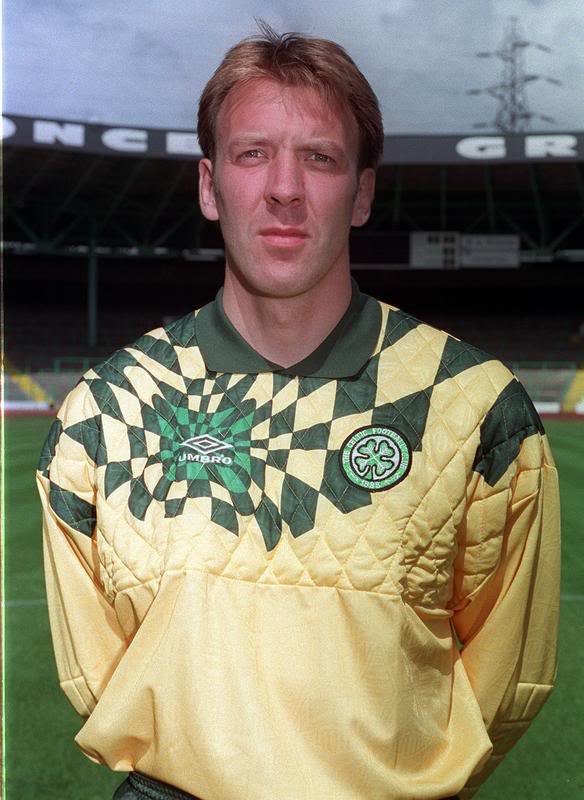
Gordon Marshall (Jr) is one who gets a mixed reception from Celtic fans. Some cynics like to remark that as a youth he was on Rangers books, but that’s not fair on Marshall and he never got anywhere close to their senior squad. In addition, there have been a number of great players at Celtic who had grown up as Rangers fans only to later see the light and come to Celtic and prosper (e.g. Dalglish). Notably, Marshall turned down overtures to go to Rangers under Walter Smith for a second chance.
Gordon Marshall is the son of a former Celtic player (Gordon Marshall Sr), albeit one who himself played few games. His brother Scott Marshall also briefly was at Celtic (just one match). Few other families have provided as many first team players as the Marshall family despite the lack of glory.
Anyhow, on moving to Celtic (a £270k transfer from Falkirk) Gordon Marshall was a subordinate to Paddy Bonner (who was reaching the tail-end of his career). With Bonner having clearly lost his way in goals, Liam Brady stepped up and gave Marshall a chance which he took with both hands, and Marshall at the outset did a very good job of it. A fair shot stopper he easily took over as the mainstay from the ever popular Paddy Bonner in goals, the first to do so in over ten years.
Must be remembered that this was the barren years of the ‘Sack the Board‘ era for Celtic, and results and team performances were often poor. Marshall was a good keeper but not great, and as the defence as a whole was poor then the goalkeeper was made to look worse than he actually was. He had to play behind some poor performers like Gary Gillespie, and who wouldn’t have looked bad playing behind such a weak defensive unit in front of them as Marshall had to.
The main problems really began when the pass-back rule was brought in and simply he didn’t adjust well. In time he won back his place as the number one goalkeeper (after being dropped) but many were never convinced by him no matter how hard he tried (finding reasons for our poor form). Unfair for him but he plugged away and did have a number of good performances. He survived through a number of managers, and under Tommy Burns finally managed to play in his first Cup final with Celtic. So was this redemption for him? Sadly no, Celtic drew two each with Raith Rovers and lost on penalties. It was a defeat that hurt more than most:
“It was 11 years ago [since the cup final defeat to Raith Rovers] and I don’t talk about it. It was a bad day, certainly, but, though I can’t erase it, I don’t think back on it. I have never even opened the box that my medal sits in.”
Unfairly castigated for the league cup final defeat, some supporters turned on Marshall, with some even booing him when he was in goals. He wasn’t to blame solely for the defeat. As he expressed later:
“It is not pleasant being booed by 50,000 of your own supporters. I meet Celtic fans now and they always tell me they weren’t the ones who booed. But someone must have because I heard them loudly enough.”
An exaggeration from Marshall that all booed, but in truth those that did do so were undeniably more than audible and can’t be ignored. It was excessive & unacceptable by those who booed. With Rangers having the admittedly excellent Andy Goram in goals, the inevitable comparisons from across the city just made things more difficult for Gordon Marshall.
Must add that he had his chances and tried his very best, plus he was capped once by Scotland, against the United States in May 1992. An indication of sorts of his quality at a point in his career when the national side actually had some quality.
The team management had faith in him, and he was an ever present in season 1995/96 when Celtic lost only one match in the league and were not far from title winners Rangers in stopping the ten. Manager Tommy Burns didn’t help the defence, as he generally set the team out to play attacking football with the defence being overworked on counterattacks, which lead to so many draws in the season, 11 in total.
Into the next season, following losses to Hearts, Rangers and SV Hamburg (twice) in September 1996, change was called for and Marshall was to be demoted, but given a short run of games at the end of the 1996/97 season.
In January 1998, Gordon Marshall left for Kilmarnock. Unfairly maligned by certain sections of the Celtic support, the likely reasoning behind the criticism was that he was too closely identified with the barren days and so too many regarded him as partly attributable for the poor form in those days. In some ways he was just unlucky to have been with Celtic during the most difficult of times, but those who can look beyond the gloom of that era remember a guy who tried his best and that’s all we can ask for. In his early years he had a good shut-out rate in his games and that must be remembered, and he was no worse than many other keepers Celtic had had over the previous and following decade.
He was a better keeper than some care to remember, but the barren years definitely were a hard time to find any gold nuggets from. In one interview in 1995 with the official magazine he was asked what was the best game he had played in with Celtic, he replied: “I’m still waiting on that special one!“. It never really did come for him sadly and great Celtic moments were thin on the ground for much of the 1990s, and he was there through much of the worst.
He never did play in a major Cup final winning side and his single contribution for a league title win was in the 1997/98 season in the demoralising opening day 2-1 defeat to Hibs. This is a shame as he deserved some better recognition and reward for his efforts and time at the club. He had handed his Scottish Cup winners medal from 1995 to fellow Celt Brian O’Neil (who was out due to injury) during the post match celebrations as he felt that Brian O’Neil deserved it more which was a humbling act. This could be seen in the background scenes of the TV coverage and Brian O’Neil teared up due to the incredible gesture.
Despite his general lack of success of Celtic during his time at the club, on being asked on what his happiest moment at Celtic had been, he replied simply:
“Every time I play in the first team and we win.”
It wasn’t easy at Celtic, and unfairly & wrongly he took a disproportionate amount of the flak that came about from the frustration of that time.
He would face Celtic again with Kilmarnock & Motherwell in last day title deciders in 2003 and 2005. In 2005, he had a good game as he denied Craig Bellamy, Stilian Petrov and John Hartson with fine saves in the second half. The match went on to go down in infamy as Motherwell won in the final moments to win Rangers the league, but later this title should have been annulled due to the EBT scandal. Gordon Marshall, in fairness, did a very good job winning three points for his team.
His last senior match was a 4-4 draw for Motherwell v Celtic on 30 July 2005 on the opening day of the league season. He just seemed to always be tied up to Celtic even to the end. Maybe this game helped encapsulate all about his career, as should he celebrate having helped his side win a point v Celtic, yet missed out on a victory and having conceded so many goals?
He moved into coaching after playing, and even returned to hairdressing which was his apprenticeship in his younger days.
We wish him well.
Playing Career
| Club | From | To | Fee | League | Scottish Cup | League cup | Other | ||||
| Kilmarnock | 19/01/1998 | £ 150,000 | |||||||||
| Celtic | 12/08/1991 | 19/01/1998 | £ 270,000 | 100 (0) | 0 | 4 (0) | 0 | 4 (0) | 0 | 4 (0) | 0 |
| goals / game | 0 | 0 | 0 | 0 | |||||||
| Apps | Goals | Apps | Goals | Apps | Goals | Apps | Goals | ||||
Honours with Celtic
- 1997-98
- (one appearance in the season, opening day 2-1 defeat to Hibs)
- 1995
- (one appearance on the road to the final)
Pictures
Second Review
Gordon Marshall Jnr. was the son of Gordon Marshall Snr., Celtic goalkeeper in season 1971/72.
Marshall began his career as a youth player at Rangers, but failed to make any first team appearances for the club. He went on to play for East Stirlingshire (loan from Rangers following a broken leg), East Fife and Falkirk.
Liam Brady brought him to Celtic for a tribunal set fee of £270,000 in August 1991. At the start of the season he was in competition for the No1 goalkeeping spot with Celtic stalwart Pat Bonner but he won his chance when Bonner was dropped by Brady after one mistake too many against Motherwell in November 1991. He started 92/93 as first choice keeper but lost out to Bonner in September before making a return at the end of the season after Bonner returned injured from international duty.
Falkirk made a bid to take him back on loan but this was vetoed by the SFA. He was out of contract at the end of the season and he rejected the first terms offered to him in April ’93. He signed a new 3-year deal after Lou Macari arrived to replace Brady. Macari promptly dropped him and sent him on a month loan to Joe Jordan at Stoke from 25/11/93. The loan was extended for a further month and, on return to Celtic Park, he initially found it hard to get a game before settling in to the Premier Reserves. Macari had signed Carl Muggleton
With the sacking of Lou Macari, Tommy Burns arrived as manager, re-signed Bonner on another 1 year deal and installed Marshall as his No1 between the sticks, before changing heart and reinstating Bonner during the middle of the season. Gordon started 95/96 as first choice keeper again and had a very good season with Bonner fading from the picture as age finally started to catch up with him. However there was new competition waiting in the wings. He saw half of 96/97 as first choice before losing the starting spot to Stewart Kerr.
Season 97/98 was his last season at the club and Celtic’s season of the Curse of the Goalkeeper. Kerr was injured. Marshall started the season but fell aside to newly acquired Jonathon Gould. Jansen clearly did not fancy Marshall and lent him to St Mirren only to recall him when he realised that the only fit back-up keepers were youngsters Barry John Corr and Andy McCondichie. This proved to be the turning point. Marshall put in a transfer request and he departed for Kilmarnock in January 1998.
Career after Celtic:
Gordon had 5 positive years at Rugby Park before moving to Motherwell in 2003 where he also joined the coaching staff. He retired in 2005 and joined the Hibernian coaching staff in November 2005. He was to work a Goalkeeping Coach with Hibernian but left that role in 2009.
Articles
Why old Marshall deserves a medal
Published Date: 20 March 2005
WHEN out and about these days, Gordon Marshall has become accustomed to being met with the same greeting. “People will come up to me in the street and say: ‘Are you still playing, you old bugger?’” says the Motherwell keeper. “I take it as a compliment.”
So he should. For Marshall isn’t merely “still playing”. His age – he will be 41 in a month – may put him in the super-veteran bracket. But on taking to the field for his club’s CIS Insurance Cup final against Rangers at Hampden this afternoon, the keeper can content himself he is still prospering at a level he has maintained through most of his 23-season, 651-game senior career.
For, whatever happens today, Marshall will be coming as close to snaring a major honour as ever; the competition bringing him losers medals with Kilmarnock, after their 3-0 reverse against Celtic in 2001, and with the Parkhead club themselves, the keeper never truly forgiven for his part in the penalty shoot-out defeat at the hands of Raith Rovers in 1994.
Equally, in the history of this tournament, only Jim Leighton, close on 42 when turning out for Aberdeen four years ago, had more days on his body clock when appearing in a League Cup final than Marshall will have today. His longevity the Fir Park keeper attributes to a little luck and the manner in which he has been handled in his two years with the Lanarkshire club and the five-and-a-half years he spent at Rugby Park prior to this.
“I have learned to be sensible in how I prepare myself and Terry Butcher, just like Bobby Williamson before him, has allowed me to manage my own fitness,” Marshall says. “I know what I can get away with now, and by that I don’t mean selling myself or my team short. It is all about preserving my energies for games through working within my limitations. But I’ve been fortunate with my physical shape. I have had operations on my knees and shoulder but these were minor tidy-ups.”
Marshall’s outlook has also proved advantageous to his incredible endurance. In making his first-team debut on September 4, 1982, against future employers East Fife while on loan at East Stirling from first club Rangers, half of the current Motherwell squad weren’t even born when he was taking his first significant step towards carving out a senior career. But in his day to day existence, Marshall can still relate to the colts wearing claret and amber.
“I don’t think the Motherwell lads see me as an ancient codger and I certainly don’t feel that way,” Marshall says. “My age hasn’t had any bearing on what I am able to contribute. As for the nights out, I am still in among boys. There are places I won’t go, places that, when they are mentioned, I just say: ‘Listen, I’m off for my train home to Edinburgh’. But we have a mutual understanding.”
As well as mutual respect. This quality was instrumental in Motherwell reaching their first League Cup final in 50 years. Just before the extra-time period of their semi-final with Hearts at Easter Road last month, the one-time hairdresser, appropriately enough, took it upon himself to give his team-mates the hairdryer. After surrendering a two-goal lead late on, he impressed on them, with choice language, that they had won the tie once and had to win it again. Many of the Fir Park side have said this bore fruit.
“Terry has since told me that Alf Ramsey said something similar when England won the 1966 World Cup final, but I didn’t know that,” Marshall says. “I am vocal on the pitch but have never been a ranter and raver off it. That night I just felt we couldn’t allow such a great opportunity to slip from our grasp.”
Yet Marshall did just this as a teenager on Rangers’ books. Goalkeeping was in the blood. His father, Gordon Marshall senior, remains his sounding board and collected the full set of medals with record-breaking Hearts and Hibernian sides during a career which also brought him a stint at Celtic. But in joining Rangers straight from school, junior did not apply himself as was necessary. This forced him to part-time football with East Fife after being released by the Ibrox club in the summer of 1983. Then, a young keeper called Andy Bruce was considered better back-up than Marshall to Peter McCloy and – regular confidante to this day – Jim Stewart.
“I can understand why John Greig opted for Andy over me,” Marshall says. “I didn’t lark about or anything but failed to treat my duties with the seriousness required. The day John told me I was released I didn’t even appreciate what was happening.”
Establishing himself as a regular at Fir Park, he helped win them promotion and continued to learn his trade under coach Mike Marshall. By March 1987, he was a full-time performer with Falkirk. At both clubs he played in excess of 100 league games, which was also true of his spells with Celtic and Kilmarnock that followed.
“I can look back at my career and say I wasn’t just on the bus but on the pitch at the clubs I’ve been with,” Marshall says. “I had good times at Falkirk in winning the First Division and playing in the Premier. I have always looked to play for managers who wanted me and gone elsewhere when feeling that might not be the case. That is why I can take good memories from all the teams I have turned out for.”
Although the six and a half years he was with Celtic on signing for them from Falkirk for £270,000 in August 1991 represents the longest he spent with any club, this also provided him with more downs than any other stop-off. Yet, initially, he seemed well served by his guiding principles. These had led him to reject an offer from Rangers manager Walter Smith in favour of accepting one from his Old Firm counterpart Liam Brady. Smith had told him straight that Andy Goram would forever be his No.1 while Brady had insisted he would be allowed to vie for this position with Pat Bonner.
“Both were honest and everything went according to plan in my first year at Celtic,” says Marshall. “I made it into the team and at the end of my first year won my only Scotland cap [in a friendly against the USA in Denver in 1992]. Then in the early months of the next season I lost my place.”
He regained this but his Celtic nadir arrived in the form of the Coca-Cola Cup final of November 1994. Marshall did not cover himself in glory when Gordon Dalziel made it 2-2 to earn a penalty shoot-out but is understandably narked some choose to define his Celtic service by the events that afternoon. “It was 11 years ago and I don’t talk about it,” Marshall says. “It was a bad day, certainly, but, though I can’t erase it, I don’t think back on it. I have never even opened the box that my medal sits in.”
In January 1998, Kilmarnock provided him an escape route from a posting that had clearly gone wrong. “It is not pleasant being booed by 50,000 of your own supporters. I meet Celtic fans now and they always tell me they weren’t the ones who booed. But someone must have because I heard them loudly enough.”
At Rugby Park he was the target of appreciation. He played more games for the Ayrshire club, both domestically and in Europe, than he has racked up with any other employer. “My Kilmarnock days were as satisfying as any I have known in the game,” he maintains. “I even moved to the area for two years which, as a confirmed Edinburgher, says everything about how at home I felt there. I know they had won the Cup but when I joined them the focus was still on avoiding relegation. By the time I left it had changed to making a pitch for Europe regularly. As with Motherwell, the sense of togetherness was terrific. Kilmarnock was full of great people, real people, and I was fortunate to swap one club like this for another.”
No way, he says, could he have anticipated coming within a solitary victory of trophy wins with both. No way, equally, can he say with certainty whether next season will allow him any further such opportunity. A qualified goalkeeping coach, he hopes to stay in the game beyond the completion of his third consecutive one-year deal. There is surely every chance this will be as a player.
Interview: Gordon Marshall on signing for Rangers and Celtic and his return to hairdressing
scotsman.com
Interview: Gordon Marshall on signing for Rangers and Celtic and his return to hairdressing
Alan Pattullo
2019 August
A tweet from Richard Osman recently caused a stir by pointing out that Dexys Midnight Runners’ Come On Eileen came out nearer to the end of the Second World War than to today. There’s a mind-blowing football equivalent involving Gordon Marshall, whose career – as it happens – also began nearer to the Second World War than now.
When he played his first game, for Rangers reserves, his opposite man was England 1970 World Cup fall-guy Peter Bonetti, who was winding down his career at Dundee United. Marshall’s last game for Celtic was Henrik Larsson’s league debut against Hibernian. But he still had eight years to run and clocked up another couple of hundred games at Kilmarnock and Motherwell. The final game of his career, a barmy 4-4 draw between Motherwell and Celtic, was the opening match of the 2005-06 season, which seems remarkably recent for someone who played with Tommy McLean, Willie Johnston and Alex Forsyth for Rangers reserves.
It was 1980 when he made his debut for the Ibrox stiffs as a nervous 16-year-old recruited from Tynecastle Boys’ Club. “Bonetti was in the other goal for Dundee United, my dad was at the game,” recalls Marshall. “Here is a 16-year-old, just starting his career. I think Bonetti might have been in his 40s. My dad had obviously played against Bonetti and was watching two different eras collide. We got beat 4-0 but he loved it.”
Marshall walked in the long shadow cast by Gordon senior. Both played in an era before goalkeeper coaches became the norm but Gordon junior had the ultimate teacher, a father who also played in goal to a high level. Marshall senior once mused that while he might have been the more natural goalkeeper, Gordon, his son, worked harder at it after a false start at Rangers, where he was released by John Greig after being de-railed by a broken leg.
“He does say things like that to me which I find quite hard because he was so successful. Everyone who says you were never as good as your dad and, well, I do believe that – I wasn’t as good as my dad. To play in the Hearts team at 17 years old with Willie Bauld and guys like that is incredible. And you are not talking about Tynecastle the way it is now, there was 50-odd thousand in the place. He ends up winning the league twice – he has some winners’ medals!”
This self-deprecating comment references the only real absence on Marshall’s CV. It’s something he might be more conscious of on League Cup weekend since he was on the losing side in three finals – for Celtic, Kilmarnock and Motherwell. Now goalkeeper coach with Aberdeen, he is preparing for tomorrow’s clash with Dundee. But he has links with seven of the clubs in action this weekend, eight if we include his father, who played for Hibs and Hearts among other sides, including Newcastle and Arbroath.
“It does not matter where I go, all the old guys are like: ‘how’s your dad?’ They never ask for me! It was the same at Celtic, players like Billy McNeill and Stevie Chalmers, it was always how is your dad? It was always the same first question.”
And in a sad year for football, when we’ve said farewell to both McNeill and Chalmers, how is the old man? “He is OK,” says Marshall. “He is a wee bit frail now. He had his 80th and we had a big party for him at the Norton House Hotel. He was in good form. He still has his seat at Tynecastle and goes along to watch. He will still moan about them but he still goes!
“Whenever Craig [Levein] is there, he is all over him. He still calls him “Mr Marshall”. For all the doom and gloom he sometimes has, he walks into Tynecastle and he is suddenly ten foot tall.”
Marshall has clearly always looked up to his father, who in terms of the League Cup is the ying to his son’s yang: he won three winners’ medals at Hearts. But there’s something Marshall junior does have over him in this particular competition. His old da’ never scored against a team who were, at the time, the most expensive ever assembled in Scottish football history, and neither has he saved a penalty from Ally McCoist. It was six games into the Graeme Souness revolution and things were not quite unfolding as planned on the pitch.
After a loss on the opening day to Hibs, it’s tempting to wonder what might have happened had East Fife, where Marshall reignited his senior career, then knocked Rangers out of the League Cup, which they came close to doing.
Marshall kept them in it shortly after half-time of this third-round tie, flinging himself to his right to save McCoist’s kick after East Fife were penalised when the ball struck Paul Hunter’s hand. No goals all night meant the tie went to penalties. East Fife manager Dave Clarke had an uncomplicated way of selecting takers: who, he asked, could give the ball the greatest welly? “I remember gesturing towards Chris Woods when I scored and he had a scowl on his face,” says Marshall. “When he made the save that put them on the brink of going through I remember him turning round to me and giving it me back. I thought: ‘Aye OK, fair enough’.”
Poor Hugh Hill was the only player, including a goalkeeper, out of the ten who missed. Penalty specialist Davie Cooper soothed a fretting Rangers bench, including Souness, who’d already seen Colin West carried off early in the game with a serious knee injury. Marshall had more than done his bit. “Dave had said, whoever hits the ball hardest, they are taking the penalty. It was just head down and hit it.”
Marshall bumped into Clarke on the bus earlier this summer on the way into Edinburgh to watch the Champions League final with friends and ended up missing his stop due to all the reminiscing on the top deck. Even the mode of transport sparked memories of exhaust fumes mixing with the scent of cheap aftershave in the back of a mini-bus driven by Clarke’s father-in-law. This is how East Fife rounded up players when time was tight on week nights. The evening they faced Souness’ millionaires was no exception. Part-time players still had to work.
“It was all very harum scarum,” recalls Marshall. “Suddenly there we were playing this team with guys we had seen on the telly and who we never thought we’d ever face.”
Not only would Marshall, who joined Falkirk towards the end of that same season, go on to play against Rangers on several other occasions, including in Old Firm derbies, he actually played with Souness not long afterwards, in Brockville teammate Andy Nicol’s testimonial against Hearts.
Clarke by this time was Falkirk manager and Nicol, or at least his testimonial committee, had somehow snared Souness, Kenny Dalglish and Tommy Burns to turn out for an all-star version of the Bairns.
“Souness is probably the most intimidating player I have ever played in the same team with. He turned up about quarter to three, and wee Davie Clarke tried to be funny. He said: ‘Souness, where have you been? You’re no’ starting, you’re late!’ Souness replied: ‘f*** off, where’s my gear?’
“Even during the game Souness was like, ‘give me the ball’. I threw it to someone else. He growled: ‘what did I say to you!’ So every time I got the ball I just threw it to him.”
Souness had just left by the time Marshall nearly re-signed for Rangers. Ibrox doctor Donald Cruickshank approached him in the toilets during an end-of-season function and asked: would you come back? Of course he would.
There was a complication. Liam Brady’s Celtic were also interested. Marshall met Walter Smith in the car park at Haggs Castle Golf Club and asked if he got into the team and played well, would he keep his place? Smith was admirably frank. No. He’d signed Andy Goram to be No 1, and that’s what he would be whatever happened.
“That was great. I knew exactly where I stood. I asked the same question of Celtic. And they said: ‘No, you will stay in’.” He signed for Celtic and got ready to dislodge Pat Bonner.
Gordon George Banks Marshall: there was only ever one occupation for someone with this name but Marshall seemed set to pursue an alternative career, albeit one where hands were still the tools of his trade. Now 55, things have come full circle. No, he isn’t joining East Fife again – though a goalkeeper he did sign while Motherwell goalie coach, Brett Long, will likely be on the bench today for the Fifers, who host Rangers again in a last-16 tie. What he is doing is going back to hairdresser school.
“It is only since I have come up here to Aberdeen that I thought: ‘you know what, I wouldn’t mind getting back into it.
[Graeme] Shinnie and Scotty Wright went to a place called Mr Dun here. He has a [hairdressing] school down the stairs in the basement.”
Like football, the crimping game has changed in the time since Marshall ran a salon – also in a basement, underneath his father’s newsagent shop – in the Haymarket area of Edinburgh. Goalkeepers could not simply take up where they left off had they taken a break around 1991: “what do you mean I can’t pick the ball up from a back-pass?”
Marshall has found it’s the same with hairdressing, which has evolved since the days in the 1980s when celebrities such as Wendy Craig would walk into his Mane Attraction salon asking for a cut and blow-dry and footballers like Dave Bowman and Kenny Black would walk in and ask for a… cut and blow-dry.
“They even describe your scissors and combs differently, they use different words! I am like: ‘surely that’s a pair of thinning scissors?’ No, they are blending scissors now!”
Marshall was sometimes cutting hair up until midday on a Saturday before racing to Brockville to play in a top-flight fixture with Falkirk. It was unusual to say the least and even caused master-behind-the-mic Archie Macpherson to miss a beat while commentating on a Scottish Cup tie at Easter Road when Marshall was still with East Fife.
Macpherson thought he would provide some additional background information during a pause in play while the young goalkeeper was digging his toe into the turf to make a divot before taking a bye-kick on a windy afternoon. “I still remember this because I have a recording of the game somewhere. He started saying, ‘there’s Gordon Marshall, who is playing in goal today and he’s a…’ and there was a pause, as if he was checking his notes, ‘…a hairdresser’.”
Team-mates loved it, of course, since it meant not having to bother making appointments when they could get a “Charlie Nicholas” for nothing in the dressing room. “You would stick in three sections of perm rods at the back of the head and you would cut it short at the side and the top,” explains Marshall, with reference to the in-vogue style of the time.
“We all had it.” All except Crawford Baptie, who Marshall remembers only had to run his hand through his hair for it to fall into place “like James Bond’s”. Marshall, for his part, took it to extremes – he went full-on Kajagoogoo for a spell.
But that’s not the most difficult subject to bring up. When he signed for Celtic the scissors were put away and the knife, to a certain extent, came out.
He was never allowed to forget a mistake in the 1994 League Cup final against Raith Rovers which allowed his old Rangers team-mate Gordon Dalziel to score a late equaliser. Nevertheless, he kept a clean sheet in nearly half his Celtic appearances, including his debut, a 3-0 win over Airdrie at Broomfield on an afternoon perhaps better remembered for Tony Cascarino bundling over a policewoman after scoring one of the goals.
“You can argue all you want about whether I was good enough, that’s fine,” says Marshall. “I played how I could. When I watch it back now as a coach yes, I would certainly have changed how I played.
“It was an era of trial and error. You were in change of your work. Packie [Bonner] was a brilliant teacher on the game but if I had a specialised coach I think my game would have changed.
“I am not making that as an excuse,” he adds. “Believe me. Some folk will like you, some folk will think: ‘for what we paid [£270,000], it’s what we got – value for money. Others will say, ‘he cost us the bloody League Cup final’!”
He must have done something right as he stayed nearly seven years. He suspected his time at Celtic was finally drawing to a close after Wim Jansen, his fourth manager at the club, took over. “When you turn up for pre-season and there’s one or two folk saying, ‘are you still here’? Well, you know it’s going to be hard to win them over now.”
He made one more league appearance when Chic Charnley scored a winner for Hibs v Celtic with a shot Marshall still feels he should have stopped. Jansen agreed: Jonathan Gould replaced him the following week.
While he did not win a trophy at Celtic, Marshall was the last line of defence in the 1995-96 season when they lost only one game and still finished second behind Rangers. It’s slightly surprising to hear who he regards as the best centre-half he played behind – John Hughes.
“We had a good understanding. If I did not come for it, he would head it away,” he says.
“I played with Alan Stubbs – quality player, but I could not play behind him. He played a way that used to distract me. He was one of the centre-halves who backed off quite far, whereas I would want him to meet with the player, so I had more time to react to the shot. Stubbsie would want to usher the player away to a less dangerous area, which is what the game is about now. I am not saying he was a bad player, of course he was not, but he was someone I could not play behind.”
After nearly two hours of conversation containing such fascinating snippets, he’s got to go – a night out with Stuart Burgess, an old East Fife and Falkirk team-mate who once sported a ‘Charlie Nicholas’, beckons. That’s the thing. There isn’t a medal issued for playing nearly 700 matches but there’s something more precious collected: a lot of team-mates, many of whom are still firm friends after all the free haircuts.
Marshall also has an urgent matter to take care of as he prepares to get behind a styling chair again: rustling up some clients. “All my old ones are bald now,” he says. “I need to get out there again and look for some new customers!”