M | Player Pics | Manager Pics | A-Z of Players | Managers
Personal
Fullname: James Edward McGrory
aka: Jimmy McGrory, James McGrory
Nickname: ‘The Human Torpedo’, the ‘Mermaid’ (due to his heading ability), ‘The Golden Crust’
Born: 26 April 1904
Died: 20 October 1982
Birthplace: Garngad, Glasgow
Height: 5ft 6″
Signed (as a player): 10 June 1922
Left (as a player): 18 December 1937 (moved to Kilmarnock as manager)
Position: Forward, Centre forward
Debut: Third Lanark 1-0 Celtic, League, 20 Jan 1923
Internationals: Scotland / Scottish Football League XI
International Caps: 7 Caps / 6 Caps
International Goals: 6 goals / 6 Goals
Manager: 1945-1965
Succeeding: Jimmy McStay
Successor: Jock Stein
Biog as a player
| “Shoulders like a young Clydesdale, neck like a prime Aberdeen Angus and a head the nightmare of every goalkeeper. He had the knack of connecting with his napper and directing the leather netwards with greater velocity and judgement than many a counterpart could accomplish with his feet.” (Bill Paterson, ex-Arsenal May 23 1953) |

When it comes to arguments over who is the greatest Celt of them all, the name at the top of many people’s list is the incomparable James Edward McGrory.
Born in the Glasgow Irish enclave of the Garngad in 1904, Jimmy McGrory was to go on and rewrite the football record books with his unbelievable scoring feats for the club which he loved with all his heart.
Signed by Willie Maley in June 1922 from junior side St Roch as an inside-right, Jimmy McGrory initally spent a season loaned out to Clydebank where he was switched to centre-forward before returning to Glasgow. In that short spell he helped to show his worth as a striker by scoring a respectable 13 goals in 30 games, and even scoring a winning goal for the then languishing Bankies side in a 2-1 win over Celtic.
He actually had made his Bhoys debut in a 1-0 league defeat at Third Lanark on 20th January 1923. That day was to be one of the few occasions when Jimmy McGrory didn’t hit the back of the net. Actually, on the release of Joe Cassidy, in 1924, Jimmy McGrory was then given full reign as the lead striker. However, he struggled to get a goal in his first three games. Tragedy then struck with the death of his father, yet with the option for compassionate leave Jimmy McGrory opted to play against Falkirk (same day as his father’s funeral), and finally managed to grab a goal. He then went on to score two hat-tricks in matches v Third Lanark and Motherwell. His father would have been proud, and the legend was truly underway now at Celtic.
The barrel chested forward was to be an immensely strong and forceful attacker prepared to take whatever knocks came his way in search of a goal. There were few players as tough or as fair as the modest and humble Jimmy McGrory, and his commitment to the Celtic cause was obvious every time he took the field. He had a rapacious appetite for goals yet was completely gentlemanly, an intriguing dichotomy that only the best of men can balance. Curiously he was only 5 ft 6, which in comparison to more modern strikers is a touch short, but he had a bulldog spirit which made up for that.
He burst into football folklore on 11th April 1925 when in the dying minutes of the Scottish Cup final at Hampden he launched himself at a cross and bulleted the ball into the net with his head to give Celtic a last gasp 2-1 triumph over Dundee. It was the club’s 11th victory in the tournament and took Celtic past Queen’s Park then record haul, which was a pivotal moment for the club.
McGrory was now on the road to establishing himself as the deadliest centre forward in football. The most feared attacker in the game. His ability to score with his head was unrivalled (“Queen’s Park keeper Jack Harkness once broke three fingers trying to save a McGrory header” – P Lunney, ‘100 Greats‘) but his skill with the ball at his feet was also immense. McGrory could score from any angle and distance.
One curiosity in his scoring record is that he only ever took three penalties yet missed two of them.
He was the consummate striker and had an exceptional header of the ball (for which he became christened ‘The Mermaid‘ due to his prowess with the diving header). Even now people speak about his ability and record with awe, and remains as having one of the most prolific scoring records of anyone who has played the game.
His committed play meant he regularly suffered a broken nose and in one match he even broke his jaw after taking a boot to the face. Such injuries were all part of the game to the man they called ‘The Human Torpedo‘ (a term reflecting his heading ability). For twelve seasons, McGrory was to be Celtic’s top scorer. Twice (1926/27 & 1935/36) he was the top league scorer in Europe with 49 and 50 goals respectively.
To this day Celtic supporters question why this most magnificent of players was awarded only a measly seven Scottish international caps. However when he did play for the national team he never let them down. Indeed his late winner at Hampden on 1st April 1933 against England was greeted with such noise by the 134,170 crowd that it went down in history as the legendary tag of ‘The Hampden Roar‘. Albeit some also put that ‘Hampden Roar’ as having originated a few years earlier in 1929 with Alec Cheyne’s late winner v England.
While for the most part Jimmy McGrory was criminally ignored by his country the player himself was not too upset as for him playing football was all about Celtic. In fairness, there was Hughie Gallacher of Newcastle playing at the same time who was also an incredible striker but that shouldn’t have precluded from Jimmy McGrory from winning more caps. Jimmy McGrory was the greater striker, and it was everyone’s loss that he never won more caps for his country. Hugh Gallacher’s son, Jackie Gallacher, was to later play at Celtic under Jimmy McGrory.
In the summer of 1928 he turned down an offer from Arsenal to become the highest paid footballer in Britain because he could not bear to leave Parkhead. It later turned out that the Celtic board were banking on Jimmy McGrory’s departure as a way of boosting the club’s bank account and so riled were they by his refusal of Arsenal’s offer (£10,000 transfer) that they secretly paid him less than his teammates for the rest of his career. When he later discovered this dastardly deed Jimmy McGrory simply said:
“Well it was worth it just to pull on those Green and White Hoops”.
Money meant nothing to Jimmy McGrory. Scoring goals for Celtic meant everything. He was the very personification of the true spirit of the club he adored. He eventually retired from the game in 1937 having scored an incredible 472 goals in 445 league & Scottish Cup appearances.
As a Celt he won three league championship winners’ medals and five Scottish Cup winners’ medals. This may appear to be a fair haul, but actually it is a pale amount of what he deserved to achieve. Celtic had begun a slow decline in the early 1920s, exacerbated by an ageing and increasingly distant manager (Willie Maley) and an incompetent board. Players like Jimmy McGrory helped to bolster Celtic when weak. He was more than worth his weight in gold, but he didn’t leave with the full haul of silverware that someone of his class deserved.
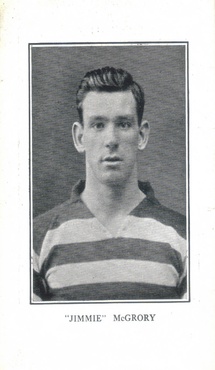 If anything, the Scottish Cup runs are where Jimmy McGrory is most often referenced as that is where Celtic’s greatest successes became during this period, as the club had become a cup specialist side rather than a league title winner. This is a sad mark on Celtic from that time. With the tally of goals, Willie Maley should have been able to build a formidable enough side with some like Jimmy McGrory to take on everything. Jimmy McGrory fulfilled his part, Willie Maley & the board didn’t.
Celtic’s decline was to resume and accelerate not long after the departure of Jimmy McGrory and Willie Buchan. Rangers and their sympathisers had their hands on the levers, and Celtic were to suffer. However, the board at Celtic were weak, meddling and incompetent, and this partially destroyed the great legacy left behind by men like Jimmy McGrory at Celtic.
In retrospect, the dark years between the late 1930’s to the brief revival in the mid-1950’s meant that supporters in those days were likely to hark back to the club’s glory days and great figures with more fondness than at any other point in the Club’s history, and this in itself built up Jimmy McGrory’s reputation as one of the game’s greats. Amongst the gloom of the war years and then the barren days, they really missed the joy that players like Jimmy McGrory brought them.
He remains the most prolific scorer in Celtic’s history and that is a title which seems safe for all eternity.
Jimmy McGrory – possibly the greatest Celtic player of them all.
Playing Career
| APPEARANCES |
LEAGUE | SCOTTISH CUP | LEAGUE CUP | EUROPE | TOTAL |
| 1922-37 | 378 | 67 | n/a | n/a | 445 |
| Goals: | 396 | 74 | – | – | 470 |
| APPEARANCES | LEAGUE | SCOTTISH CUP | GLASGOW CUP | GLASGOW CHARITY CUP | TOTAL |
| 1922–23 | 3 | 1 | 0 | 2 | 6 |
| Goals: | 1 | 0 | 0 | 1 | 2 |
| 1924–25 | 25 | 8 | 2 | 1 | 36 |
| Goals: | 17 | 11 | 2 | 0 | 30 |
| 1925–26 | 37 | 6 | 6 | 3 | 52 |
| Goals: | 35 | 6 | 6 | 2 | 49 |
| 1926–27 | 33 | 6 | 2 | 0 | 41 |
| Goals: | 49 | 9 | 2 | 0 | 60 |
| 1927–28 | 36 | 6 | 3 | 1 | 46 |
| Goals: | 47 | 6 | 9 | 0 | 62 |
| 1928–29 | 21 | 6 | 4 | 3 | 34 |
| Goals: | 21 | 10 | 3 | 8 | 42 |
| 1929–30 | 26 | 3 | 5 | 1 | 35 |
| Goals: | 32 | 4 | 4 | 1 | 41 |
| 1930–31 | 29 | 6 | 2 | 1 | 38 |
| Goals: | 36 | 8 | 1 | 2 | 47 |
| 1931–32 | 22 | 1 | 3 | 2 | 28 |
| Goals: | 28 | 0 | 2 | 0 | 30 |
| 1932–33 | 25 | 8 | 3 | 2 | 38 |
| Goals: | 22 | 8 | 2 | 3 | 35 |
| 1933–34 | 27 | 3 | 1 | 0 | 31 |
| Goals: | 17 | 1 | 1 | 0 | 19 |
| 1934–35 | 27 | 4 | 1 | 1 | 33 |
| Goals: | 18 | 2 | 0 | 1 | 21 |
| 1935–36 | 32 | 1 | 2 | 2 | 37 |
| Goals: | 50 | 0 | 0 | 1 | 51 |
| 1936–37 | 25 | 8 | 0 | 0 | 35 |
| Goals: | 18 | 9 | 0 | 0 | 28 |
| 1937–38 | 10 | 0 | 1 | 0 | 11 |
| Goals: | 5 | 0 | 1 | 0 | 6 |
| Total: | 378 | 67 | 35 | 19 | 501 |
| Goals: | 396 | 74 | 33 | 19 | 523 |
Honours with Celtic
Scottish League
Scottish Cup
Glasgow Cup
Glasgow Charity Cup
- 1926, 1936, 1937
Achievements
- Jimmy McGrory was the top League goalscorer in Europe in seasons 1926-27 (49 goals) and 1935-6 (50 goals)
- In 445 appearances in the two major domestic competitions he scored 472 goals (398 in the Scottish League, 74 in the Scottish Cup)
- He won 5 Scottish Cup winners medals
- He managed the Celtic team which won the 1957 League Cup final by a British record margin in a domestic cup final of 7-1 against Rangers
 Newspaper cuttings in an elastoplast tin |
One of the Greatest strikers ever (official):
In July 2007 IFFHS (International Federation of Football History & Statistics), produced a survey that put Jimmy McGrory as the 8th greatest striker of all time, a great great accolade and the highest ranking Briton.
| Goal Scorer | Top Division | Matches | Period | Goals | |
| 1 | Edson Arantes do Nascimento “Pelé” | Brasil / USA | 560 | 1957-1977 | 541 |
| 2 | Josef Bican | Österreich / Československo | 341 | 1931-1955 | 518 |
| 3 | Ferenc Puskás | Magyarország / España | 533 | 1943-1966 | 511 |
| 4 | Romário de Souza Farias | Brasil / Nederland / España / Australia | 612 | 1985-2007 | 489 |
| 5 | Carlos Roberto de Oliveira “Dinamite” | Brasil / España | 758 | 1971-1992 | 470 |
| 6 | Imre Schlosser | Magyarország / Österreich | 318 | 1905-1928 | 417 |
| 7 | Gyula Zsengéller | Magyarország / Italia / Colombia | 394 | 1935-1952 | 416 |
| 8 | James Edward McGrory | Scotland | 408 | 1922-1938 | 410 |
| 9 | Arthur Antunes Coimbra “Zico” | Brasil / Italia / Japan | 596 | 1971-1994 | 406 |
| 10 | Gerhard Müller | Deutschland / USA | 507 | 1965-1981 | 405 |
Manager 1945 – 1965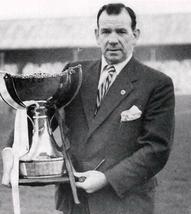
Jimmy McGrory was belatedly appointed as the new manager of Celtic. A prior favourite for the managerial position, Jimmy McStay was instead appointed in 1940 only to be dismissed unceremoniously in 1945 to be succeeded by Jimmy McGrory in relatively controversial circumstances.
So how was Jimmy McGrory’s reign to pan out? In retrospect, Jimmy McGrory should have reflected on how his predecessor’s tenure had been stunted by the board and learnt from McStay’s errors, but he didn’t and the club continued to be a waning institution. There were many parallels between their reigns, and it’s disturbing to see just how the same old misjudgements and errors were being blindly repeated over and over again.
Similar to Jimmy McStay, Jimmy McGrory had a fair record as a manager prior to arriving at Celtic, although notably, his first game in charge at Kilmarnock was against Celtic on Christmas Day in 1937 with Kilmarnock losing 8-0. He turned Kilmarnock around and guided them to the 1938 Scottish Cup final before the Second World War, which led many to assess that his phenomenal success as a player would rub off on the Celtic players. It wasn’t to be so simple at Celtic, and his first challenge was to revive the team and the club in a difficult social and financial climate.
Celtic suffered in the austerity years after the war, and it all culminated in 1947/48 where Celtic were perilously close to relegation, having been simply transplanted by Hibs and Hearts in the challenge against Rangers for the league titles. Over the coming years, despite having some great players throughout his time (e.g. Tully, Peacock, Evans etc), Celtic generally never really competed for the league title. As a giant name, Celtic retained affection but it was in the cup competitions that Celtic’s only really challenges emerged and even then there were embarrassments.
So what was wrong? The problems began with the similarities to the situation with Jimmy McStay, in that Jimmy McGrory was too gentlemanly to counter the unwanted mingling in team affairs by the board directors. Alex Dowell on his departure scathed that:
“Only when the manager McGrory and the directors can make a reasonably consistent first-team choice will they get consistent results.“
Jimmy McGrory was handicapped by a board who made the decisions above his head, and in effect made him a bit-part manager many a time. He was routinely humiliated, or as Bobby Evans scathed:
“He [i.e. the Celtic Captain] has no decisions to take about team changes or tactical changes. The answers to these problems come from the directors’ box [i.e. chairman Bob Kelly] to the track – and are passed to the field by the trainer!“.
Celtic Chairman Bob Kelly didn’t exactly help Jimmy McGrory by retorting to critics about watching his own youth scheme to take shape in years to come rather than see the problems right in front of him. In the meantime, the Club was losing quality players such as Paddy Crerand to Manchester Utd who has never lost his bitterness about his treatment and the set-up around Celtic back in those days.
So how was Jimmy McGrory to manage the first team side at the time? Actually, he became a secondary figure due to the board’s over-eager control of the first team and he wasn’t really in charge. Basically, his own good manners turned into an Achilles heel. He was a perfect fit for Celtic on paper but legendary players don’t generally make great managers.
The high points for Jimmy McGrory included the Coronation Cup victory in 1953 (which was a poke in the eye for the establishment), the Scottish League & Cup double in 1953/54 and the classic League Cup win in 1957 (“Hampden in the Sun”), so one great league title and three cup wins have rightly allowed McGrory to retain a certain affection historically as a manager. However, these victories glossed over the reality of the situation, and sorely after the classic 1957 League Cup victory the First Team never won a senior trophy again under Jimmy McGrory. In fairness, Celtic were mightily close to repeating the League & Cup double in 1954-55 but as ever the First Team underachieved.
After continual failure after the 1957 League Cup victory, the inevitable finally dawned on chairman Bob Kelly as he watched Jock Stein achieve far greater with more limited resources at Dunfermline. At the end, Jimmy McGrory was to lose his position and was unceremoniously put in place as “Public Relations Officer”. A sad end but his tenure as manager had become marked by repeated failure. The board were able to wash their hands of much of the responsibility and let him carry the can. Sadly, none of the board members were made accountable and not one moved on themselves immediately after Jimmy McGrory’s departure.
Jimmy McGrory was a popular figure and virtually represented the last of the hat-and-overcoat managers who were as much administrators as coaches. Notably, it can be simply too easy to just blame the manager and the board alone, as the players themselves should be criticised. Players like Charlie Tully, regardless of their undoubted talent, were slack at training and (many a time) lazy at helping others on the pitch (much to the chagrin of Jock Stein). Highly rated and legendary coach Jimmy Hogan (with all his wealth of experience) was very much disgracefully ignored by a number of players, so board intrusion wasn’t the only handicap for Jimmy McGrory. There were a number of great players during his time and they had collectively let Jimmy McGrory down no matter all else.
One of the saddest indictments of Jimmy McGrory’s time at Celtic is that despite being the manager of the club for around 20 years, in Celtic history tomes covering the period, his name can surprisingly be sparsely referred to when you would expect that as the manager he’d be heavily referenced. Simply another indicator to illustrate just how side-lined he had become in his position by the environment imposed by the board.
Overall, progress has no real cares for history and Celtic were in danger of being another illustrious name to add to the football scrapheap (along with Queen’s Park, Blackpool and Preston North End). The arrival of Jock Stein was to change everything, but Jock Stein’s first task was to tackle the stalemates that the previous managers were forced to work under, and that was the greatest tragedy that Jimmy McGrory’s managerial tenure left behind.
Post-Management
Following the end of his time on the frontline at Celtic, he was still very much in respect at the club especially from manager Jock Stein who still referred to him as the ‘Boss‘.
As part of his new role, Jimmy McGrory would conduct tours round Celtic Park amiably and happily, with children (and their parents) often in awe of who the great man was. He was always one to able to talk to supporters, occasionally amazing them by remembering them from years before. He talked happily about football, enjoyed the European triumph of Jock Stein and anything to do with his beloved Celtic, and stated how he burst into tears on the achievement of that incredible day in Lisbon.
He passed away in 1982 after a long life, having watched Celtic progress and achieve so much. Jimmy McGrory is a legend and will likely forever remain ranked as the greatest ever Celtic player.
Honours as manager
Coronation Cup
Scottish League
Scottish Cup
Scottish League Cup
Quotes
“Jimmy McGrory leaves memories of the finest and of deeds in our colours that will never fade.”
Willie Maley when McGrory left for the Kilmarnock manager’s position, 1938
“Shoulders like a young Clydesdale, neck like a prime Aberdeen Angus and a head the nightmare of every goalkeeper. He had the knack of connecting with his napper and directing the leather netwards with greater velocity and judgement than many a counterpart could accomplish with his feet.”
Bill Paterson on Jimmy McGrory, ex-Arsenal May 23 1953
“I felt McGrory of Arsenal did not sound right. It wasn’t like McGrory of Celtic”.
In 1928 Celtic’s greatest ever goal scorer Jimmy McGrory turned down the chance to sign for Arsenal. They had offered him a blank cheque.
John Thomson bemoaning on being called a “Fenian Bastard” by an opposition player (despite being a church going Protestant)
Jimmy McGrory: “John, I get called that every game I play.”
John Thomson: “I know. It’s all right for you. You are one!”
Banter between the great John Thomson & Jimmy McGrory
“I actually broke down in tears of joy that night, the first time in all my years in the game that I had cried. What a thrill it was to see young boys like Murdoch, McNeill, Johnstone, Gemmell, Clark and Lennox coming of age. What a thrill it was to see the club I had served all my life reach its pinnacle. My one ambition now is to live long enough to shed some more tears into that magnificent European Cup.”
Jimmy McGrory on Lisbon, from A Lifetime in Paradise, 1975
“I am not sure if two teams and two or three games make a world championship or what being able to say that a team are world champions is worth. For Celtic supporters, Celtic will always be the best team in the world and no trophy will prove that better or less. The idea is that if Celtic does not win, the team will win the next time. Football might be about winning, but it is more about the hope of winning. If Celtic were guaranteed to win every game there would not be much point in coming to watch games. Successful teams know that losing is not an end in itself but a lesson in how they might win. That probably is the biggest lesson to be learned form Celtic’s experience in South America in 1967. That is what I hope.”
Jimmy McGrory, on the Racing Club controversy, writing in 1977, quoted in Brian Belton’s ‘The Battle of Montevideo – Celtic Under Siege’
“Scotland would be a poorer nation without football. The men would all go mad, as they do in the close season.”
Jimmy McGrory
“Oh he was a great man. He was a gentleman really. Probably [too nice to be a manager], but you couldn’t meet a nicer bloke. He used to tell you just to go out and enjoy yourself. In fact the year we won the double we would head for Ferraris, we would get the old car to St Enoch square and then you would walk up Buchanan Street. And if we were on a winning streak and someone waved you would wave back. But if you were losing then rather than nod to them you would look in a shop window until they passed . That the difference between victory and defeat. We didn’t need team talks with the players we had , they were all good players. Mr McGrory was so nice that as we were running out he didn’t know what to say. If eleven players are running out, you’ve got to say something quick to each player. Mike Haughney used to be the last player out and all Jimmy McGrory could say to him was ‘Cheerio then son.”
Bobby Evans on Jimmy McGrory
A curious comment from 1924:
“Celtic supporters have now made up their minds that [Jimmy] McGrory is no [Jimmy] Quinn. The ex-St Roch’s junior is too one-footed.”

Pictures
Links
Songs
Articles
- McGrory, Chapman and the miracle of Lourdes
- The Hampden Roar
- Oxford Dictionary of National Biography Entry
- Eighth greatest striker ever (International football stats)
- Miscellaneous articles