P | Player Pics | A-Z of Players
Personal
Fullname: John Robert Peacock MBE
aka: Bertie Peacock, Robert Peacock
Nickname: The Little Ant
Born: 29 September 1928
Died: 22 July 2004
Birthplace: Coleraine, N Ireland
Signed: 28 May 1949 (from Glentoran)
Left: 18 May 1961 (to Coleraine as player manager)
Position: Defender, Left-half
Debut: Celtic 1-3 Aberdeen, League Cup, 31 Aug 1949
Internationals: N Ireland
International Caps: 32 (and captained them also).
International Goals: 0
Biog
| “You’re the Irish coffee, I’m the cream!” Charlie Tully to Bertie Peacock |
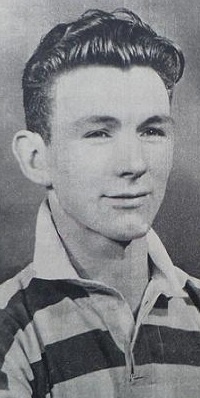
The immensely popular figure of Bertie Peacock was a huge favourite of the Celtic fans of the 1950s.
Coleraine born Bertie Peacock signed for the Bhoys in May 1949 from Glentoran and made his debut in a 3-1 League Cup defeat at home to Aberdeen in August that year. Prior to Celtic he had been a plumber by trade, and with the way the side was before his arrival there were a lot of leaks that needed treated.
Initially Bertie Peacock played as an inside left and formed an effective partnership with Charlie Tully, which Charlie Tully once described to Bertie Peacock as ‘If you’re the Irish coffee, I’m the cream‘.
However he was switched to left-half for the 1953/54 season and it was in this position that Bertie Peacock revelled, putting his great passing ability to the test as well as his unrivalled engine with Charlie Tully referring to Bertie Peacock as a ‘labourer‘ in reference to his workrate.
When he first came to Celtic he had a wiry frame, and to help out Chairman Bob Kelly ordered him to drink a bottle of Guinness every lunch time to add on some weight. It worked but surely there could have been better alternatives.
This most hard-working of players – he was nicknamed ‘The Little Ant’ due to his amazing workrate and his wee size – Bertie was a driving force within the Celtic team and his energy and tenacious tackling inspired team-mates and supporters alike. His excellent close control, good dribbling skills and cool head allowed him to dictate the play from deep and his fitness and stamina were second to none.
Bertie Peacock’s dedication and assured manners made him the perfect choice for Captain and it was no surprise when he eventually succeeded Jock Stein as skipper (actually Bertie Peacock was offered it on a ship going to the US for a tour). With his experience he helped to bring along the talented crop of youngsters at the club and all were said to have faith in him; the crop included such great Celtic luminaries such as McNeil, Crerand and Clark. He used to even take coaching for the pupils at the nearby London Road Primary School.
His first piece of great silverware was the Scottish Cup of 1951, which he won in the youngest Celtic side to win that Cup.
As a Celt he won the League and Scottish Cup double in 1954 and was also part of the famous Coronation Cup winning side the previous year. When in force, the defensive line of Bobby Evans, Jock Stein and Bertie Peacock was formidable and a bedrock for the success in the double season of 1953/54, Stein playing with two dynamos either side of him. In the Coronation Cup he scored with a booming drive in the semi-finals against Manchester Utd.
He also won two League Cups – including being skipper of that legendary team that thrashed Rangers 7-1 in October 1957, and was there for all the success over that brief golden period over the few years from 1953-1957.
In truth, Celtic were generally underachievers throughout much of Bertie Peacock’s time at Celtic and this was despite having such great players at their disposal such as Bertie Peacock, Charlie Tully and Bobby Collins. The first team was poorly managed by Jimmy McGrory (due to board mismanagement & tinkering) and the Huns had their hands on the levers of officialdom. Still, Bertie Peacock was a great performer, and we were richer for seeing him play for us. His contribution stretches beyond just football but socially too, something that contrasts us favourably against the Rangers’ bigotry.
On the international front, he was capped 31 times for Northern Ireland, and Peacock was also selected to represent a Great Britain side against the Rest of Europe in 1955. He was a key part of the Northern Ireland side which made the last eight of the 1958 World Cup in Sweden. The Swedish press actually referred to him as ‘The Little Black Ant‘ because his mop of black hair seemed to be all over the pitch in his matches.
An important note about Bertie Peacock is that he captained the N Ireland side, and taking in that he was a Celtic player who was of the Protestant faith, this was quite a mark to have made his way to take that role. When you look at what happened to Belfast Celtic and read about the tensions in the province over the years, then it takes a strong person to do as he did to face against the loyalist bigots, yet he more than won them over.
Bertie Peacock played 453 times for Celtic and scored 50 goals before finally departing in 1961, cut down by injuries. He had damaged his knee in the fourth round of the Scottish Cup against Hibs (the ground is said to have gone silent on this). He played to the last for Celtic which the support can all admire.
Post-Celtic
He became player-manager at his native Coleraine (taking them to their first ever Irish league Championship in 1974). Bertie Peacock went on to manage Northern Ireland and was also instrumental in starting the Milk Cup tournament which developed into one of youth football’s most prestigious competitions in the country.
He later managed a public house in Coleraine, but sold it in 1990 to retire & concentrate on golf. His pub was called Bertie’s Bar and due to the local clientèle ironically on one Northern Ireland site the pub was said to host a local Glasgow Rangers Supporters Club. However, various locals have confirmed that the claim was untrue. Bertie Peacock even had Celtic memorabilia from his time at the club hanging & displayed in his pub.
In 1986 he was awarded an MBE honours medal for his services to football.
Bertie Peacock was an idol to the Celtic fans and his death at the age of 75 in 2004 was mourned by Celtic supporters and all football followers. He has never been forgotten, and a statue was raised in his home town of Coleraine in recognition of his achievements.
This humble and dedicated man is a true Celtic hero.
Playing Career
| APPEARANCES | LEAGUE | SCOTTISH CUP | LEAGUE CUP | EUROPE | TOTAL |
| 1949-61 | 318 | 56 | 79 | – | 453 |
| Goals: | 33 | 7 | 10 | – | 50 |
Honours with Celtic
Scottish League Division 1
Scottish League Cup
Scottish Cup
Quotes & Anecdotes
“When he arrived in Paradise not long after me he was my inside-left partner (I was shifted to the wing to make room for him!!!) But the club pulled him back to left-half where he immediately monopolised all the caps for Northern Ireland.A great man to have behind you – a tireless and unselfish worker.When he was inside-left between McPhail and me we used to call him our labourer, the best fetch and carry man in the business.He was left-half for Great Britain against The Rest of Europe in Belfast two years back (1955).Bertie works out shies and corner kicks with me and generally puts in a lot of time improving his game…..”
Charlie Tully on Bertie Peacock (Extracted from “Passed to You” – Charlie Tully)
“You’re the Irish coffee, I’m the cream!”
Charlie Tully to Bertie Peacock
Anecdote: Bertie Trains The Weans From London Road Primary School
A story from past pupils from the nearby London Road School at the bottom of Kerrydale Street reveals that Bertie used to train and take the weans on a Saturday morning, a lot of the older locals around Parkhead still talk about the days when “The Little Ant” was in charge of their school football team.
Pictures
Articles
Articles
Herald and the Sunday Herald, The (Glasgow, Scotland)
July 23, 2004
BERTIE PEACOCK will be remembered as a footballing great who not only participated in some of the greatest moments of Celtic’s history but also contributed hugely to the game he loved.
Peacock was a gentleman first and, almost incidentally, a player of great talents. His death at the age of 75 at a hospital in Belfast will be mourned by supporters all over the world. His legacy is an enduring one. He served the game with distinction as a player, manager and administrator.
As a player, he contributed to iconic moments in Celtic’s history. The Celtic sides of the 1950s were adorned by the talents of such as Charlie Tully, Willie Fernie, Bobby Evans and Peacock. Yet they were considered by many at the time to be an under-achieving group. They did win the domestic double of league and cup in 1954 after a Scottish Cup1951. But it is other triumphs that have lingered in the the consciousness of generations of victory in Celtic fans.
Peacock was a mainstay in the side that won the St Mungo Cup in 1951, the Coronation Cup in 1953 and, most famously, the League Cup in 1957, beating Rangers 7-1 in the final.
Peacock made more than 450 appearances for the club, playing in a half-back line that also included Jock Stein and Bobby Evans. He scored more than 50 goals from the club and was a commanding presence in the middle of the park.
His career began at his home town team of Coleraine and moved on to Glentoran before joining Celtic in 1949. He played in Glasgow for more than a decade, earning 32 caps for Northern Ireland and playing in the 1958 World Cup in Sweden. Northern
Ireland reached the quarter-finals of that tournament and Peacock was nicknamed the Little Ant because of his industry in midfield.
On his return to Northern Ireland, he took over the management of the national side in 1962, immediately giving George Best his debut against Wales in Swansea. He finally managed Coleraine for 12 years until 1984. He was also involved in the backroom staff when Northern Ireland went to Spain in 1982 for the World Cup.
But Peacock was greater than mere footballing triumphs. He had a great warmth and compassion that led him to give rather than simply receive. His love of the game and his innate personal gifts prompted him in the bar of the pub he owned in Coleraine to help devise the Milk Cup international youth tournament. This tourney began 22 years ago and prospers today, holding the reputation as one of the most important youth competitions in the world.
Peacock quietly but passionately promoted youth football but, in truth, was an a personal exemplar of all that was best in the game.
As a Northern Ireland Protestant, Peacock was questioned on his relationship with supporters in his home land and at Parkhead in wake of the death threats that Neil Lennon, a Roman Catholic from Lurgan, received when he played for the province.
He said then: ”Life has changed a lot in Northern Ireland but it only goes to show that the morons are still around. I hope and I believe they are just a small minority.
”It certainly didn’t go on in my day, I can tell you that.”
Peacock had no time for such narrow sectarianism. His interests and his popularity were widespread. He was heavily involved in community projects in Coleraine, campaigning to set up a drop-in centre for the town. He engaged in life as energetically as he once battled in midfield.
A Celtic spokesman said: ”He was a true Celtic hero and he will be sorely missed by everyone who knew him.”
Victor Leonard, chairman of the Milk Cup committee, said: ”Bertie Peacock could walk into any supporters’ club and receive a rousing reception.”
He unwittingly served as a reminder of a time when footballers would cover the heroic status conferred by the public with a layer of genuine, personal humility .
Evening Times:
EVERY PICTURE TELLS A STORY;BERTIE PEACOCK;
THE FORMER CELTIC ST AR WHO BEGAN AND FINISHED HIS CAREER WITH COLERAINE AND ENJOYED GREAT SUCCESS AT PARKHEAD
Evening Times (Glasgow, Scotland)
June 22, 2004
Author: Matthew Lindsay
I played football for anybody that asked me when I was a kid; my school, the YMCA or a local boys club. I was spotted by a local scout and was asked to go for a trial with Glentoran.
I must have done well as they asked me to join and play for them in the Irish League.
I jumped at the chance and soon found myself in a fantastic team with the likes of Billy Bingham and Danny Blanchflower. I arrived just before they left for England.
Glentoran were situated in the east end of Belfast, near the biggest shipyard in the city, and were always well supported.
After playing in the first team for a season, a Scottish scout called Peter O’Connor came to have a word with me.
He asked me: ‘Would you be interested in a trial with Celtic?’ No surprise that I replied: ‘Very definitely.’
So, he arranged for me to meet Jimmy McGrory, the manager of Celtic, at the Royal Avenue Hotel in Belfast one Saturday.
I was very impressed with the man and quickly agreed to move to Glasgow.
I had been an amateur with Glentoran and here was I with the opportunity to turn professional.
I arrived at Parkhead, aged 19, for pre-season training on July 1, 1949. Jimmy Hogan took the younger lads for training when I joined Celtic. Everything we did centred around ball-skills.
This picture shows me looking very youthful early on in my career.
However, it took me a while to get into the team. My first really big match was the Glasgow Charity Cup Final in 1950.
The Hollywood actor, Danny Kaye – a popular turn at the Empire theatre – was guest of honour at Hampden.
There was a bit of razzmatazz about that game, and we ran out 3-2 winners.
2+3 No welding
I WAS a plumber to trade in Northern Ireland. And, when I joined Celtic, I enrolled in night classes to become a welder, just in case the football side of things failed to work out.
You used to have a hand shield to protect your eyes. However, one Friday night, it must have slipped as the next morning, when I woke up, I couldn’t see a thing. I was totally blind.
I was due to play that afternoon. I had to call the manager to tell him what had happened. Fortunately, my eyesight returned and I was able to recover in time to play.
We took on Queen of the South in a Scottish Cup tie on that afternoon, and I scored a couple in our victory.
But I was called into the manager’s office a few days later and told I had to give up welding. I understood their situation and was happy to oblige.
This first picture shows me leading the team out with our goalkeeper, Frank Haffey, behind me. He was a lovely big lad.
I originally played centre-half for my school. But, as I grew older, I failed to fill out and so I moved up the field and played inside-forward.
I scored the odd goal or two and pretty much stayed in that position.
In this second picture here, you can see me netting for Celtic in a match against Partick Thistle.
Then, in one league game against Airdrie at Broomfield, our left half, Joe Baillie, got injured. Our captain, John McPhail, told me to go back and play in his position. I did quite well in what was a difficult game.
The Diamonds had some wonderful players – guys like Ian McMillan and Jimmy Welsh. I stayed in that position and Joe ended up getting transferred to Wolves. He was a great player, too.
4 What a team
CELTIC enjoyed some success in my time there. I picked up League Cup, Scottish Cup and League Championship winners’ medals.
But neither we nor Rangers dominated in the way the Old Firm teams do today. Aberdeen were a force to be reckoned with, Dundee had some great players and even Raith Rovers were difficult to beat.
In my humble opinion, players in my day had far more freedom to do what they wanted on the pitch.
Now, a manager has a great deal of influence, and the emphasis is placed very much on tactics.
Back when I played, you had to know how the game was played and be able to read matches or you had no chance of getting in the first team.
I always feel the Celtic chairman, Sir Robert Kelly, was never really given the credit he deserved for the success of the club. Sure, he was a hard man, but needed to be in order to run an organisation like that. He made tough decisions and stuck to them.
People sometimes say he picked the team and not the manager, Jimmy McGrory. What rubbish! Bob idolised Jimmy, who had been his hero when he was a kid. Everything with Bob was: ‘Jimmy this, Jimmy that.’ But the fact of the matter is that, if you have a winning team, then Ghandi or the Pope could pick it!
This picture shows Mr McGrory on the left along with (from left) Sean Fallon, Billy McPhail, the club trainer and Bobby Evans admiring the medal I picked up when Celtic won the League Cup courtesy of our historic 7-1 victory over Rangers.
People say the game has moved forward, is faster, more athletic. I am not so sure about that.
I was in awe of players like the Rangers’ winger, Willie Waddell. He would be down the wing in a blink of an eye. There were also players like Gordon Smith and Lawrie Reilly, of Hibs, and Jimmy Wardhaugh and Alfie Conn, of Hearts, who were exceptional talents.
I picked up a souvenir of Alfie Conn in a game against Raith Rovers at Stark’s Park. It was a freezing cold January day and a cross was played into the six-yard box. He jumped for it and I jumped for it. Now, Connie was brilliant in the air. He turned to reach the ball and I got clattered as a result.
I was lying prostate on the ground, water was coming flooding out of my eyes and two of my teeth were on the ground. In those days, you were given gold fillings and they could be a real pain. My team-mate, Charlie Tully, came over to me and said: ‘Well, Bertie, you’ll have no problem with your fillings now!’
If you got hit, then you got hit. You had to take your medicine.
5 Jock and me
ALEC Boden played centre-half for Celtic early on in my time at Parkhead. But he picked up an injury and our trainer, Jimmy Gribben, brought Jock Stein up from Llanelli.
He knew him from his Albion Rovers days and thought he could provide injury cover and help out with the coaching.
But, Jock being Jock, he stayed in the first team for five years after that.
Jock was a smashing player. He was terrific in the air. But, above all, he really understood the game. He could read matches well. It was no surprise when he enjoyed so much success in management.
This picture shows Jock and I in our training kit at Parkhead one day.
6 World Cup ’58
I ALWAYS enjoyed playing for Northern Ireland. They were great days. I played in 30-odd internationals for my country, but it could have been far, far more. Celtic had first claim on you if they were playing a match as they paid your wages.
This picture shows me with the great Danny Blanchflower in training with the national team. I always got on very well with Danny. He was a classy individual, on and off the park – a great organiser.
Peter Docherty, the former Manchester City and Derby County player, was the Northern Ireland manager and all his players thought he was brilliant.
He had been a great player and was held in high esteem by all the lads. He understood the game and, although he had retired many years before, could more than hold his own with us in training.
I played with Northern Ireland in the World Cup in Sweden in 1958. It was a fantastic experience. As a small nation, it does not happen very often. We were hammered by Argentina, drew with Germany and then beat Czechoslovakia.
That set up a play-off match with Germany again. We won that and qualified for the quarter-finals. Unfortunately, I bust my knee and missed out.
That was the World Cup that saw the emergence of Pele. Aged just 17, he was absolutely brilliant for Brazil in that competition. He was young, enthusiastic and scored a lot of goals as they romped to their first ever success with a 5-2 win over the host nation.
7+8 Great times
I STARTED to see the likes of Bertie Auld, John Hughes, Bobby Murdoch, Pat Crerand, John Clark, Stevie Chalmers and Billy McNeill – guys who would go on and help Celtic enjoy tremendous success for many years after I left – come through towards the end of my time at Celtic.
Jock had taken charge of the reserve team and brought in big Billy from Blantyre Victoria. It was obvious early on that he was a leader. But he was a good centre-half, too.
This first picture here shows the team line-up near the end of my spell at Parkhead. We are (back row, from left) Dunky McKay, Jim Kennedy, Frank Haffey, Pat, Billy and John. In the front row (from left) are Bobby Carroll, Stevie, myself, John Kelly and Neil Mochan.
I stayed in and around the first team from just after I joined in 1949 until the Scottish Cup Final against Dunfermline in 1961. I was left out and John Clark came in. I felt it was time to go. I had enjoyed a good 11 or so years at Celtic.
This second picture is an Evening Times cartoon of the day that outlines my career.
9 Happily retired
I UNDERTOOK my English FA coaching badges at Lilleshall towards the end of my career. The reason for that was because they were held in higher regard than the Scottish qualifications abroad, and I intended to go to America.
Later on, I went over to Canada to manage for a spell. I was on the course at the same time as Bobby Robson. I find it amazing that he is still managing Newcastle United.
I went back home and played on for Coleraine until I was 39. But I played football until I was 44. I used to play on the former players circuit, along with the likes of Jim Baxter, John Charles and George Cohen. I was lucky in that I had good legs and kept the weight off.
Despite being a countryman of Martin O’Neill – his home town is just 15 minutes along the road from where I live – our paths have not crossed much.
Of course, I have met him before. I live just around the corner from his brother. I think he has done a fantastic job at Celtic. He is very shrewd. Long may it continue.
I opened a pub and off licence in my home town and worked in it, along with my wife, for 25 years. I retired a few years ago.
I help to run the Milk Cup here now and have also set up a community centre for children in a deprived area.
I still keep very active and this picture shows me as I look today.
Before the Milk Cup Final last year, we arranged a promotional picture with some of the leading players who had taken part in the tournament. David Beckham came along and I found him to be a quite excellent young fellow. But you can hardly pick up a paper without reading some terrible story about him. I am not sure I would like to be involved in football any more.
Bertie: A king of Ballycastle – Record Breakers
Sun, The (London, England)
July 23, 2001
He said: “I left Glentoran for Celtic after the Irish Cup final in 1949.
“I made the first team by the end of my first year and had ten more good seasons.”
“The club taught me the value of discipline. The manager Jimmy McGrory was a decent man who understood people. Then we had a coach Jimmy Hogan who worked with young players like me, Willie Fernie and Bobby Collins.
“Some of the more senior players like Charlie Tully took me under their wing. It was a good time to go. We beat Motherwell to win the Scottish Cup in 1951. That was followed by a seven-match US tour.
“Then we were involved in matches as part of the Festival of Britain. We also won the Coronation Cup in 1953. That was very exciting because it involved the top four teams in England and Scotland. All played over eight days.
“We beat Arsenal 1-0 in the first game. Then defeated Manchester United 3-2 and I scored, courtesy of a pass from Charlie Tully. In the final we beat Hibs 3 2.
“Then we won the double in 1954. I had a little Morris Minor back then and became Charlie Tully’s unofficial chauffeur soon after I got into the team. He was the King of Glasgow at that time.
“The papers loved him. It was Tully and ten others as far as they were concerned. I remember one day before a big game at Hampden he said to us ‘Remember, they can’t score if they don’t have the ball, so give it to me.’
“He was brilliant. The crowd idolised him. But he loved turning it on for them. He used to tell me ‘If you’re the coffee, I’m the cream.’ I was delighted when I was made skipper in 1957. My big moment was that 7-1 win over Rangers in the League Cup final.
“By that stage Charlie and a lot of the others had gone. A new crop of young players were starting to come through. I was the old head helping to nurture them. I didn’t mind that. When I left, eight of the side who won the European Cup in 1967 were in the team.”
His international career hit the heights with the World Cup finals in Sweden in 1958 under the legendary Peter Doherty.
Bertie Peacock
Brian Glanville
Thursday 29 July 2004 01.25 BST
Bertie Peacock, who has died after a heart attack aged 75, was a member of the Northern Ireland team that eliminated Italy from the 1958 World Cup and went on to reach the quarter-finals. He was equally important to Celtic, in his dozen years in Glasgow, winning a championship medal in 1954, cup medals in 1951 and 1954, and league cup medals in 1957 and 1958.
Sturdy and compact, Peacock began and ended his career with his local Ulster club, Coleraine. He was an inside-left when he joined Celtic in the 1949-50 season, but was converted to left-half. He won the first of his 31 Northern Ireland caps in the 1951-52 season. In 1957-58 he made nine appearances, four of them in the World Cup finals in Sweden, though he was forced to miss the quarter-final against France, which Northern Ireland lost 4-0.
As a wing half, he was the ideal complement to Northern Ireland’s right-half, the elegant and inspirational Danny Blanchflower, captain of the team. Peacock was probably a better defensive player and a strong tackler. Having sensationally eliminated the Italians in Belfast from the qualifiers with a 2-1 win, they were badly hit by the loss of Danny’s brother, Jackie, a resourceful centre-half, gravely injured in Manchester United’s air crash at Munich. But the Czechs were beaten twice, once in the group play-off, the Germans were held to a draw, and though Argentina surprisingly beat the Irish 3-1, later losing 6-1 to Czechoslovakia, Northern Ireland reached the quarter-finals.
Peacock scored just 33 goals in his 318 appearances for Celtic, returned to Coleraine in 1961, and the following year became manager of the Northern Ireland team. He then returned to Coleraine for 12 years, during which time he guided the club to its only Irish League title, in 1974.
He then managed a public house, but sold it in 1990 to concentrate on golf. He is survived by his wife Ruby and his son Russell.
· Bertie Peacock, footballer and manager, born 1929; died July 22 2004