C | Player Pics | A-Z of Players | World War Two
Personal
Fullname: William Cook
aka: Willie Cook, Billy Cook
Born: 20 January 1909
Died: 11 December 1992, Liverpool (England)
Birthplace: Coleraine, N Ireland
Height: 5.07½ ft
Weight: 11.04 st
Signed: 13 Feb 1930 (signed from Port Glasgow Juniors)
Left: 30 Dec 1932 (to Everton)
Position: Full-Back, Defender
Debut: Celtic 4-0 Ayr Utd, League, 20 Feb 1930
Internationals: N Ireland
International Caps: 15 Caps
International Goals: 0
Biog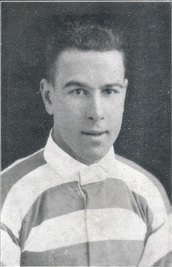
Coleraine-born Willie Cook was a hard tackling full-back who signed for Celtic in February 1930 from Port Glasgow Juniors, and was the answer to Celtic’s problem of being able to replace the great Willie McStay. He was a very gifted player.
Strong, fit and with an excellent touch, Cook made an instant impact at Parkhead following his debut in a 4-0 league victory at home to Ayr United on 20th February 1930. The talented defender quickly made the right-back berth his own and he soon became a key performer for the Bhoys. He was an integral part of the 1931 Scottish Cup winning side, a side that Jimmy McGrory ranked as the best he played in.
Willie Cook won 15 caps for N Ireland, his first cap was alongside Rangers legend Sam English. Both were to play against each other for Celtic v Rangers in the ill-fated match on the day of Johnny Thomson’s fatal accident (an accidental clash with Sam English) at Ibrox in September 1932. Willie Cook was the closest player to the incident as it sadly occurred.
One of the most curious matches he played in was the 2-2 draw with Rangers in the Charity Cup final in May 1930. Despite the equal scores, the honours were awarded to Rangers on a coin toss. To lose a cup by the toss of a coin was a bitter pill indeed for the Celtic fans to have to swallow especially as Rangers had swept all in the past season. Old school football could be bizarre. Penalty kicks as a decider didn’t really become established into the game until far later in the 1960s.
However, just when it seemed Celtic had at last found a long-term successor to Willie McStay the club agreed to sell Cook to Everton in December 1932. In his own words, it was a move designed “to better my position”; it was also said to be the first time an established player had left Celtic mid-season. The move was described to be a major shock to the Celtic support who were not used to seeing their best players being sold (although looking at the club’s history, that is debatable).
He was only 23 years of age when he left, and in retrospect can be seen to have been ahead of his time where many future young players used their clubs as a stepping stone. You could also note that he left only a few months after the tragic death of John Thomson on the pitch which could also have had an impact on his decision.
It was overall a big loss to Celtic, and possibly can be taken as another indicator for the then continuing decline in Celtic’s strength as a club challenging for the title, finishing 18pts behind title winners Motherwell in 1931/32. Celtic’s last title was in 1925/26 and manager Willie Maley’s form was in decline too.
It wasn’t the last the Celtic support were to see of him. In June 1938 he faced Celtic in the Empire Exhibition Trophy final at Ibrox, a rejuvenated Celtic triumphing 1-0.
A favoured player at Everton where he made 250 appearances, Stan Bentham, an Everton team-mate of Cook’s, said of him:
“Willie Cook, right full-back, Irish international, with the ball control of any inside-forward. A hard player he could pass the ball facing his own goal, find our outside-right, which he often did.”
Post-Celtic
Willie Cook – who had made 110 appearances for the Bhoys – was a great success at Everton and added a well-deserved FA Cup winners medal to his Scottish Cup gong. It’s a sad loss that he couldn’t have been with Celtic for far longer. The 1930’s was a hit & miss period for Celtic which saw the club slide. It then heralded in the nadir of the 1940’s for the club. Losing quality players like Willie Cook is another reason for the decline.
During the Second World War, Willie Cook guested for a number of clubs across the British Isles, including Wrexham. With the resumption of competitive football with a “transition season” in 1945/46, Cook signed with the Welsh club permanently. Age was obviously catching up with him by this stage, and with league football returning in 1946 he found his only options were in non-league football. In October 1946 he took the position of player-manager at Rhyl, thus beginning a coaching career which would take him across the globe.
In 1947 Cook became coach at SK Brann Bergen in Norway, returning to briefly coach Sunderland in February 1948. He returned to Bergen for 1949 to 1951, then from 1952 to 1953 he was national coach of Peru, before returning home as manager of Portadown (1954-55) and as Youth team manager of Northern Ireland. He was off on his travels again, when he spent a year as manager of Iraq’s national side before he was appointed manager at Wigan Athletic in 1956, then at Crewe in 1957, and as trainer-coach at Norwich in 1958. A man well-travelled!
He was said to be quite a coach and throughout his coaching career Cook took great pleasure in demonstrating his ball skills to his players.
With one young footballer who couldn’t trap the ball properly watching, Cook is reported to have booted the ball high into the air, and as it dropped he killed it stone dead on the ground just to show the young lad how it was done. Another favourite trick was to drop a half-crown onto his toe and flick it into the top pocket of his suit. He would also regale his players with stories of his tussles with Stanley Matthews and the like.
There are few former Celtic players who have had as varied an adventure in their football lives as Willie Cook, and he will be one for anybody keenly interested in footballing history.
He passed away in 1992.
Playing Career
| APPEARANCES (goals) |
LEAGUE | SCOTTISH CUP | LEAGUE CUP | EUROPE | TOTAL |
| 1930-32 | 100 | 10 | n/a | n/a | 110 |
| Goals: | 0 | 0 | n/a | n/a | 0 |
Honours with Celtic
Scottish Cup
Pictures
Links
Articles
Billy Cook – The Original ‘Secret Footballer’ and his Peruvian Adventure
Source: https://efcheritagesociety.com/billy-cook-the-original-secret-footballer-and-his-peruvian-adventure/
Rob Sawyer19 August 20240 Comments369710 Mins Read
HomeMembers WorkRob SawyerBilly Cook – The Original ‘Secret Footballer’ and his Peruvian Adventure
Rob Sawyer
Billy Cook circa 1933
The so-called ‘The Secret Footballer’ has been producing an anonymous column for The Guardian newspaper for over a decade. This, along with (to date) five books lifts the lid on the life of a professional soccer player. Speculation has been rife as to the identity of the author, with a former Reading and Stoke City forward being many amateur sleuths’ pick.
The concept is nothing new, however. Over 70 years before this mystery player submitted his first column to the Guardian, a top-flight footballer was doing something very similar for the weekly Topical Times magazine – and he played for Everton. The Player’s Weekly Diary ran from the autumn of 1937 to May 1939 – it might have continued, but for the outbreak of war.
The identity of the player was not hard to deduce, from the descriptions of matches and other events alluded to. Before long, many young members of the magazine’s readership were writing to Billy Cook, the Toffees’ Northern Irish full-back, demanding to know if it was him.
L-R Tommy Johnson Jimmy Stein Billy Cook
It was indeed, Cook, Coleraine by birth, but Clydeside by upbringing, who had had submitted his weekly reports on life as a footballer. Signed from Celtic in 1932 to fill the void left by an injury to Ben Williams, Cook (who signed autographs as both ‘Billy’ and ‘Willie’) was a tough defender, blessed with the fine touch of an inside-forward. He served as vice-captain to Jock Thomson when the Blues advanced on the league title in 1938/39 season – which forms the basis of my latest book: Broken Dreams, Everton, The War and Goodisons’s Lost Generation, the first output of the new Toffeeopolis imprint.
The magazine serial gave insights into Cook’s training regime at Goodison Park (he, literally, lived around the corner from the ground, on Goodison Avenue) and regular squad stays at Harrogate. It also included brief synopses of matches he played in for club and country, plus insights into his social life which, as the owner of a car (not common then, even for a footballer), included regular trips to the cinema, tea rooms, dances, golf courses, and along the Sefton and North Wales coasts. Inside Goodison’s main stand, he was a dab hand on the billiards table – with Tom White his closest rival for supremacy with the cue. Although the identities of clubmates were thinly veiled in his columns, the reader got a clear taste of the camaraderie in an Everton squad brimming with characters like Alex Stevenson, Wally Boyes, Tommy Lawton and Joe Mercer.
Cook was one of the few Everton first-teamers to serve abroad during the war (Ted Sagar and Archie Barber were two others), being based in India for some time. When domestic league football resumed in 1946, he was well into his thirties and was released by Everton after 250 competitive appearances (with all six of his goals coming in the 1938/39 season). He had a brief spell playing in North Wales and it was there that he embarked on a quite extraordinary coaching journey which took him to Asia, South America, Scandinavia, Ireland and around England. Most sensational was his appointment as coach of the Peruvian national team in 1952. A number of British coaches had tried their hand in Europe, but Latin America was largely unchartered territory for so-called ‘Misters’. One person that Cook did follow in the footsteps of was Jack Greenwell, who coached there in the 1930s.
Player’s Weekly Diary – Topical Times, 5 November 1938
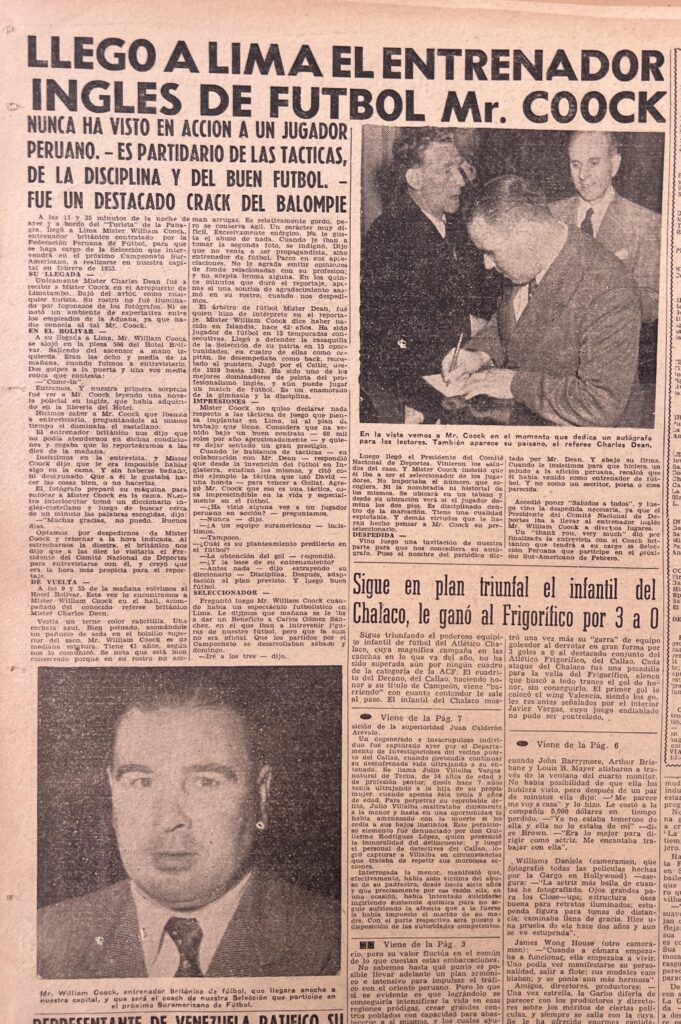
The mission, passed down from Major General Odria, who had acquired power in a coup, was to win the Copa America as a host nation, thereby bringing reflected glory on the military regime. That all said, Cook’s arrival, described below in a Peruvian newspaper, was decidedly low key (note: the original report misspelt his surname name as Coock, it’s been corrected here):
Billy Cook and Charles Dean watching a match
At 21:35 last night, Mr. William Cook, the British coach hired by the Peruvian F.A. to take charge of the national team in the build up to the next South American Championship to take place here in Lima in February 1953, landed on board the ‘Turista’ of Panagra Airways.
Mr. Charles Dean was the only one to meet Mr. Cook at Limatambo Airport. He left the aircraft like any other tourist, his face not lit up by photographer flashbulbs. There wasn’t even a note of excitement among the customs staff given that no one knew ‘Mr. Cook’.
Billy Cook in Peru
On his arrival in Lima, Mr. Cook took up residence in Suite 505 of The Hotel Bolivar. Leaving the lift and turning left, it was 08:30 in the morning when we went to interview him. We knocked twice and a semi-rough voice answered: ‘Come in’. We went in and our first surprise was to see Mr. Cook reading a crime novel in English that he had got from the hotel bookshop.
We informed Mr. Cook we wished to interview him, asking him at the same time if he spoke Spanish. The British coach told us that he could not receive us in such a state and asked that we do the interview at 10:00. We insisted on interviewing him and Mr. Cook said that it was impossible to talk in bed – without having bathed or having had breakfast. He liked to do things well, or not at all. The photographer prepared his camera to take a picture of Mr Cook in bed. He later picked up an English-Spanish dictionary and, after searching for the appropriate words for a minute said ‘Muchas gracias, no puedo. Buenos días.’
We chose to leave Mr. Cook to return at the revised time. On shaking our hands the British gentleman told us that at 10:00 he would be meeting with the president of the National Sports Committee and that this would, he believed, be the best time to carry out the interview.
At 09:55 in the morning we returned to the Hotel Bolivar. This time we found Mr. Cook in the lobby with the well-known British referee, Mr. Charles Dean. He wore a fawn suit with a blue tie, well-groomed with a silk handkerchief in his breast-pocket. Mr. William Cook is of medium stature. He is 42 years old. It’s worth noting he has aged well because his face is wrinkle free. He’s relatively fat, but still athletic. A very difficult person. Excessively energetic. He doesn’t put up with anything. When they tried to take a second photo he got annoyed saying he hadn’t come to be a ‘propagandista’ but to be a football coach. He does not like to give opinions related to his profession and does not like to joke about it. During the 15-minute duration of the interview there was just one smile of appreciation, when we said goodbye.
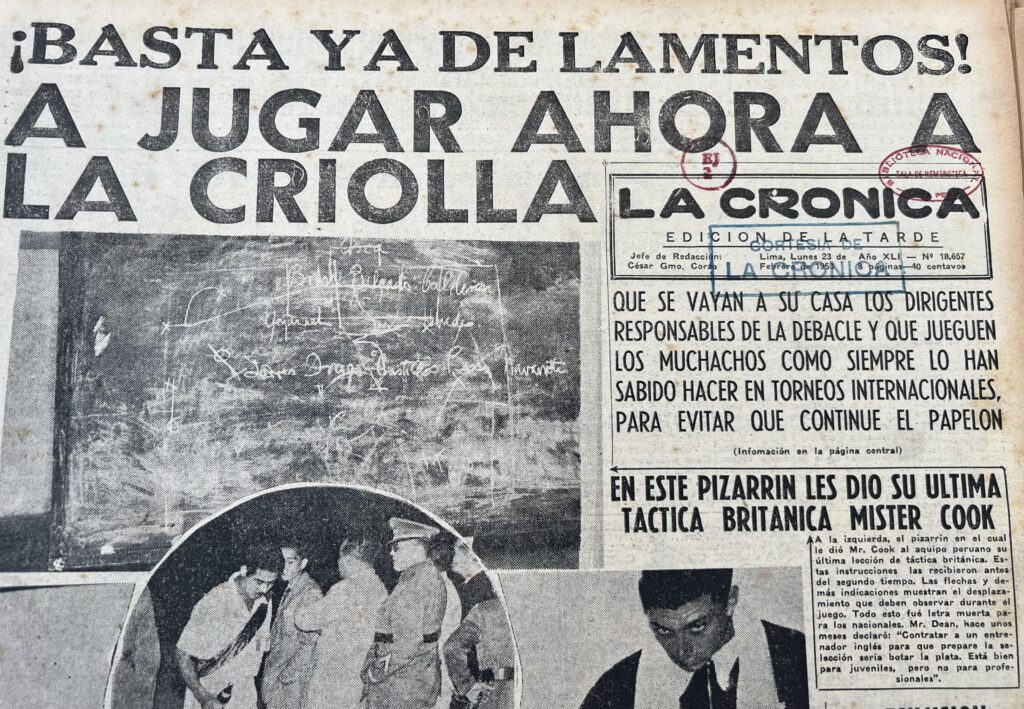
Enough of Regrets headline
The referee Mr. Dean served as translator during the interview. Mr. William Cook tells us he was born in Ireland 42 years ago. He has been a footballer during 13 consecutive seasons. He represented his country 13 times – 4 as captain. His position was full-back. He played for Celtic from 1929 to 1932. He has been one of the best ball-players in the English professional game and can still play a match. He is a big fan of both the gymnasium and discipline.
Cook joins Peru newspaper
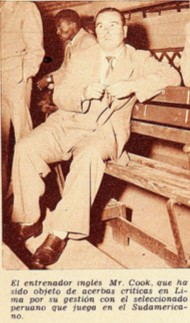
It was a short-lived sojourn in Peru, for multiple reasons. The language barrier was an issue for a non-Spanish speaker but Cook declined the services of an interpreter in training sessions. He later recalled: ‘I would communicate with the players in my own way, and it worked fine. Most of them could speak a bit of English, anyway.’ Then there were the tricky politics of football in a country ruled by a junta, coupled with Cook’s sometimes brusque manner and a tactical approach which won him few allies. Tensions rose when Angel Fernandez Roca, an Argentine, being parachuted in to work alongside Cook with the team.
Ultimately, the results were poor, a defeat to Uruguay confirming that Peru would not lift the Copa on home soil. This confirmed the end of the Irishman’s spell on the Pacific seaboard and he was soon on his way back to Merseyside. The Irishman’s professional coaching career was over when he resigned from his post at Norwich City in 1959.
Billy Cook and family at SK Brann
A man of contrasts, Cook could have a decidedly menacing air about him – notably after imbibing a few drinks – but he was something of a man of letters and would diligently respond to correspondence from football supporters. One example of his largesse was when he befriended George de Booij, a young Dutch man who was living period in Liverpool for a few months. Cook gave him some original club photos and other items to take back to the Netherlands (de Booij became an avid Evertonian and returned to watch the Blues at Goodison Park in 1985).
The former Irish international had an enduring passion for imparting his football knowledge on youngsters. In the immediate post-war years, he had been a coach for the local football association, taking training sessions at schools in the Liverpool and Cheshire region. By the 1960s, with time on his hands, he would voluntarily lead regular coaching sessions for youths in a Bootle park. His keynote trick was to boot the ball high into the air and trap it, dead, at the first attempt – amazing his pupils.
By the 1980s he was a fixture at local hostelries, dressed in tweet suit, often wearing a trilby hat, showing patrons his prized medals and photos in return for being stood a drink. Dr John Rowlands, a Formby-based football historian who had befriended one-time Toffees winger Albert Geldard, arranged for the former Everton pair to be reunited at a pub one evening. Ironically, the former outside-right had been petrified of his 1930s clubmate, but the evening went well. Cook was most disappointed when he turned up at the same venue the next week, only to discover that the get-together had been a one-off.
A 1980s reunion with Albert Geldard – organised by John Rowlands
In later life he would attend Everton matches but was non-plussed when the club failed to furnish him with complimentary tickets for some of the biggest matches (this was some years before the establishment of the Everton Former Players’ Foundation, which has helped to look after many old Toffeemen). He spent his final years living on Strafford Drive, before being admitted to hospital in his final months, quite possibly suffering from a form of dementia. One of the most feared yet admired full-backs of the 1930s died on 11 December 1992 at 83 years of age. He lies in an unmarked grave in Bootle Cemetery.
Billy Cook was not alone in facing difficult times after the fame and success – if not riches – enjoyed on the pitch at Goodison Park in the 1930s. Broken Dreams delves into lives of the entire Class of ’39 at the School of Science. These range from the famous names like Ted Sagar, Joe Mercer, Tommy Lawton and T.G. Jones to the tales less told, like those of Torry Gillick, Wally Boyes, Alex Stevenson, Stan Bentham, Norman Greenhalgh, Jock Thomson, Jimmy Cunliffe, Bob Bell, Gordon Watson, Archie Barber et al.