O | Player Pics | A-Z of Players
Personal
Fullname: Phillip O’Donnell
aka: Phil O’Donnell
Born: 25 March 1972
Died: 29 December 2007
Birthplace: Bellshill
Signed: 9 September 1994 (£1.75m from Motherwell)
Left: 29 June 1999 (free to Sheffield Wednesday)
Position: Central Midfielder
Debut: Partick Thistle 1-2 Celtic, League, 10 Sep 1994 (scored twice)
Internationals: Scotland
International Caps: 1
International Goals 0
Biog
| “Honestly, each game is special to me.” Phil O’Donnell (2007) |
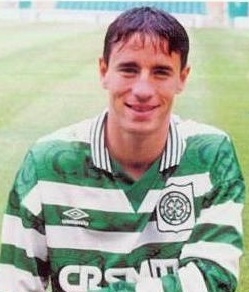
Phil O’Donnell was considered to be a dynamic young prospect at Fir Park, well before having scored one of Motherwell’s goals in their epic 4-3 Scottish Cup Final victory over Dundee United in 1991.
He became the first ‘proper’ signing Tommy Burns made as Celtic manager, the deal to bring back Andy Walker from Bolton having already been brokered by Lou Macari before his departure. £1.75m was handed over to Motherwell in a single payment, effectively funding the construction of a new stand at Fir Park.
Possessing a fantastic engine and a sweet left foot, Phil O’Donnell made his debut for Celtic on 10th September 1994 at Firhill versus Partick Thistle, where he scored both goals in a 2-1 victory from his central midfield berth. That was followed up by a typical Phil O’Donnell goal in a 2-0 win over Hibs at Celtic’s temporary home, Hampden, a lung-bursting rush from midfield beyond the strikers to lash home a lay off, and a position as a mainstay of Celtic’s ageing central midfield looked assured.
He’d arrived at Celtic, at a time when it was imperative to stop Rangers reaching ten-in-a-row league titles, so pressure was on with no leeway. The Celtic takeover had been completed, and the ramifications meant the whole environment was unsettled and in flux. New players were not going to find it easy as Phil O’Donnell found out soon enough.
His performances wilted with the rest of the team that first season, though he was spared the anguish of the infamous League Cup Final defeat to Raith Rovers by being cup-tied, along with the first occurrences of a niggling injury that was to dog his Celtic career. He recovered to head a clinching third goal in the Scottish Cup semi-final replay over Hibs at Ibrox, and came off the bench against Airdrie in the Final to earn a second Scottish Cup winners medal in four years in 1995. He has proven himself, and more than played his part. In this era, Celtic had gone through a trophy drought (“The Barren Years”) and there was a desperation for any major silverware.
A return to Parkhead and again a promising start to the season as Phil O’Donnell scored against his old side in the first league match at the half-built new stadium, but as was to be the pattern of his Celtic career, he found form to be patchy while it became a running joke among the support for his susceptibility to recurring injuries.
Much of the rest of his time at Celtic was much the same, in for a good run then out for a long run and repeat ad nauseum. It was difficult and frustrating for all. Everyone knew what he could add to a squad desperate for success, but he was too often out.
Following the departure of Tommy Burns, Phil O’Donnell looked to be blossoming again, this time as an energetic left-sided player under Wim Jansen, his natural athleticism and strength finding favour under him and Venglos the next season. He played his part brilliantly under Wim Jansen to help Celtic finally stop Rangers ten-in-row, and he had now won the coveted league winner’s medal he deserved. His goal v Dundee Utd was a valuable winner in a 2-1 victory (Sep 1997) with one report stating that as below:
“[He] scored with as good a first touch as seen in any game. Burley won possession on the right flank, found McNamara who swung the ball out to the other side and picked out O’Donnell ghosting into the box unseen by the defence. O’Donnell did not hesitate and took the cross first time on the run, blasting a left-foot volley past the goalkeeper.”
He was back for the final tranche of games to help push Celtic to the title, and started in the side on that final wonderful big day that sealed the league title. He was actually substituted off on the hour mark for Brattbakk who scored the second goal that cemented the victory. If O’Donnell had remained on, then maybe it could have been his glory to take.
Regardless, he celebrated on the pitch along with the others as he thoroughly deserved to, but in truth again as always due to injury he was missing for a large spell in the season as just a few games after his winning goal v Dundee Utd (Sep 1997) he was out for 4 months, and had even missed out on the League Cup triumph. So in some ways, he was likely relieved personally as much all else that he was still there able to be on the pitch on that last day with the rest of the team.
Things in some ways continued for the good under Jo Venglos, but still amid continuing injury and non-selection, he wasn’t reaching great heights. He actually had his best spell under Wim Jansen, scoring five goals over Nov 1998-Jan 1999. He also played in the 5-1 hammering of Rangers (Nov 1999) which was a Larsson burying a header from a Phil O’Donnell cross, whilst another move saw another Phil O’Donnell cross from the left cut a tantalising pass across the Rangers area for Larsson to dummied the ball, for Moravcik to score.
Despite the better form for Phil O’Donnell, both he and fellow contract rebel Simon Donnelly opted to take supposedly lucrative Bosman transfers to Sheffield Wednesday. Celtic were still struggling to find consistency, and with the new management coming in (again)
It wasn’t to be for Phil O’Donnell at Celtic, a fresh start possibly wasn’t a bad move. He played far less games than hoped but had a fair record in those he did and chipped in with around 20 goals.
However, he was liked and respected as a person, and despite the injuries he still played numerous times for the first team. Some put his own pressure to play for the first team as being a factor that exacerbated his injuries, arriving sooner into the first team rather than take his time.
Phil O’Donnell’s injury record, if anything worsened and he barely featured for the Hillsborough club in his tenure there, much to the frustration of the Wednesday support as well as himself. He never got to show his best form and ability.
Ironically, he had not been particularly susceptible to injuries when he was at Motherwell and actually played more league games in his first four seasons at Fir Park than he managed in the following decade at Celtic (and his following club Sheffield Wednesday). Torn groin muscles, a hernia, a ruptured thigh, a broken kneecap, ruptured ligaments in his right knee, ankle damage.
Eventually freed by the Yorkshire club, Phil O’Donnell returned to his roots at Motherwell as club captain, where he was very much welcome.
Tragic Early Death
On 29th December 2007, in the Motherwell v Dundee Utd game, Phil O’Donnell fell to the ground just as he was about to be replaced with Marc Fitzpatrick near the end of Motherwell’s 5-3 victory.
Phil O’Donnell was treated for around five minutes on the field before being taken to a waiting ambulance. But his death was later confirmed by the Fir Park club.
He was only 35.
He left behind at death a loving wife and four children. The world of football was stunned at his death.
His nephew was also playing in the same M’Well team on that day and scored twice in the match and had to be taken off.
RIP Phil O’Donnell, you’ll never be forgotten.
A tribute match was played between Motherwell & Celtic as a testimonial in memory of him (match), and those playing included many his playing days including Henrik Larsson.
Playing Career
| Club __________ |
From ___________ |
To ____________ |
Fee | League | Scottish Cup | League cup | Other | ||||
| Motherwell | 02/01/2004 | 30/12/2007 | Free | 66 (11) | 8 | 2 (2) | 0 | 7 (1) | 2 | 0 (0) | 0 |
| Sheff Wed | 29/06/1999 | 02/01/2004 | Free | 13 (7) | 0 | 0 (0) | 0 | 2 (3) | 1 | 0 (0) | 0 |
| Celtic | 09/09/1994 | 29/06/1999 | £1,750,000 | 77 (13) | 15 | 12 (4) | 4 | 6 (1) | 0 | 7 (1) | 1 |
| Motherwell | 30/06/1990 | 09/09/1994 | Youth | 123 (1) | 15 | 11 (1) | 2 | 6 (0) | 0 | 3 (0) | 0 |
| Totals | £1,750,000 | 279 (32) | 38 | 25 (7) | 6 | 21 (5) | 3 | 10 (1) | 1 | ||
| goals / game | 0.12 | 0.18 | 0.11 | 0.09 | |||||||
| Apps | Goals | Apps | Goals | Apps | Goals | Apps | Goals | ||||
Honours with Celtic
Scottish Cup
Scottish Premier League