K | Player Pics | A-Z of Players
Personal
Fullname: Robert David Keane
aka: Robbie Keane, Keano, Robert Keane
Born: 8 July 1980
Birthplace: Tallaght, Dublin, Ireland
Height: 5ft 8in, 1.73m
Signed: 1 Feb 2010 (on loan from Spurs)
Left: 1 Jun 2010 (end of loan)
Fee: 6mth loan deal
Position: Striker, Forward
Debut: Kilmarnock 1-0 Celtic, League, 2 Feb 2010
Internationals: Republic of Ireland
International Caps: 146
International Goals: 68
Biog
A vastly experienced and talented forward, Robbie Keane was a well travelled striker who began his professional career as a teenager with Wolverhampton Wanderers. After impressing with some fine performances for the Black Country side he moved across the Midlands in 1999 in a £6 million switch to Coventry. After a single season with the Sky Blues he moved to Inter Milan when Marcello Lippi splashed out £13m for this player now regarded by some commentators as one of the hottest properties in European football.
However that move turned sour when Lippi was sacked and Robbie Keane was loaned out to Leeds United. That deal became permanent in May 2001 when the Elland Road side paid out £12 million. With Leeds in deep financial trouble Robbie Keane signed for Spurs in 2002, making almost 200 appearances and scoring 80 goals for the Londoners.
Having established himself as one of the most accomplished forwards in the Premiership Robbie Keane was on the move again, this time Liverpool paid out £20m in July 2008. But Robbie Keane would only make 15 appearances for the Anfield club and in February 2009 he was back at Spurs for a relatively cut-price £12m.
Celtic Loan Period
Next thing you know, he signed for Celtic on 1st February 2010 agreeing to a 6-month loan deal with the Bhoys.
It was a stunning deadline day capture of the Tottenham man topping off a remarkably busy transfer window for the Hoops. Dublin-born Robbie Keane had long been touted as a possible Celtic target, so much so that the “Robbie Keane rumour” had become a transfer window tradition & joke among the Parkhead support.
Given this – and the fact that Robbie Keane’s reported £65,000 per week wages meant he was regarded out of Celtic’s price range – it was a massive surprise when news of the potential deal was revealed on Sky Sports News just seven hours before the closure of the window. He had though come on some cut-price deal.
With Celtic cyberspace in near meltdown the switch was finally confirmed a little after 8pm. A crowd of 5,000 Hoops fans gathered outside Celtic Park in freezing temperatures to greet their new ‘idol’ at just a little after midnight.
It was however to prove a rather bittersweet six months for all parties. Robbie Keane was to shine and he would prove to be every bit the star the Celtic support had long hoped for. Unfortunately though even the undoubted class of the Irishman couldn’t prevent a trophyless season which was punctuated by occasional moments of utter humiliation.
Robbie Keane’s debut came at Kilmarnock the day after his last-gasp signing and almost immediately it was clear the move would not be the fairytale all Celtic fans had hoped for.
In typical Celtic style the support soon came crashing to earth from high of the night before. Undoubtedly tired from the whirlwind events of the previous 24 hours Robbie Keane laboured to inspire a disjointed Celtic side as the hosts performed a smash and grab raid and took all three points with a 1-0 victory.
The next game, Robbie Keane came off the bench at half-time and he would net a penalty as Celtic claimed a 4-2 victory at Dunfermline in the Scottish Cup. Throughout the second half Keane had tormented the opposition backline. His excellent touch, vision and movement stood out in a performance which tantalised the Bhoys support.
Now in full stride Robbie Keane began to look like exactly what he was – a class above anything in the SPL. Despite Celtic’s league hopes seemingly being extinguished before Robbie had hardly kicked a ball in the Hoops the Irishman remained a joy to watch as he gave a lesson in top class forward play.
With Rangers’ Majid Bougherra shockingly allowed to cynically kick and hack Keane out of the clash with Rangers at Ibrox, Celtic were left with just the Scottish Cup to concentrate on. With a tough tie at Kilmarnock awaiting there was intense hope among the Scottish media that Keane and Celtic would once more come a cropper at Rugby Park.
Robbie Keane though had other ideas and produced a wonderful second-half hat-trick to seal a 3-0 triumph and keep Celtic’s season alive for at least a little while longer. That second-half display was now typical of the form Keane was showing in the Hoops as he bagged nine goals in nine games.
However, a disappointing season would then hit rock bottom. Celtic were thrashed 4-0 at St Mirren in the league – a result which meant the end for Celtic manager Tony Mowbray. Neil Lennon would be appointed interim manager and despite a couple of improved performances in the SPL the Bhoys crashed out of the Scottish Cup with a humiliating 2-0 Hampden semi-final defeat at the hands of Ross County.
Robbie Keane had played in both of these encounters but he was powerless to make the difference as tactical naivety, a lack of desire and defensive ineptitude combined to derail Celtic’s season.
Under Lennon, Celtic finally put together a good run of form and as ever Keane’s ability and goals were at the fore. However, as the Irishman’s loan spell came towards its conclusion the Celtic fans were left wondering “What If?“.
Robbie Keane had been a refreshing respite from the drudgery in much of the season. He’d scored numerous goals, most of which were of top class quality. However, it was notable that in each of the most important matches (few that they were) that he’d failed to score in any of them. He failed to score in either game again Rangers and in the Ross County Scottish Cup semi-final defeat. Add in the 4-0 defeat by St Mirren, then question marks can be hung above his head. On the other hand, in the Rangers matches he was hacked out the games, and he can hardly be made held culpable alone for the defeats in the St Mirren & Ross County games.
Post-Celtic Playing Career
After his loan at Celtic – a move which the player seemed to enjoy thoroughly despite the lack of silverware – Keane returned to Tottenham. But his return was a waste of time, mainly as an increasingly improving Spurs side did not need his services. He then moved to the US with a short stint at Aston Villa beforehand. It became a running joke by fans to mock that whenever he moved sides that he was proud to now be playing for his ‘childhood heroes’ etc etc….
At the end of it all, he chased the money, the move to Celtic possibly being an exception (Celtic didn’t have as much to offer in pay relative to the wealthier clubs in England). Sadly, he won’t be able to look back proudly on an enviable collection of well deserved medals from major competitions, but just a long CV of illustrious clubs and no more.
Away from the club game, with their options limited he remained the lynch pin of the Ireland national side’s attack, firing the side to Euro 2012. However, once there the side flopped and Robbie Keane’s reputation was tarnished following his poor displays. Shouldn’t take away from his overall record for his national side, for whom he is a record holder for goals scored and most caps, and he is actually one of the highest scorers ever in international football. Something to be proud of but not all are too impressed (especially with the decline of the prestige of international football).
Overall, Robbie Keane’s career was one of a very good talent with a very fine international record, lots of big transfer fees but surprisingly little much more to give credit on.
He never lost his Celtic roots, and played in front of 48,000 supporters for a ‘Celtic Legends‘ select side at Anfield v their Liverpool counterparts in a charity match in March 2023, and actually played a period in the match for both sides.
In 2023, he made a move to Israel to manage Maccabi Tel Aviv. It was criticised by some at the time, but once conflict and war blew up between Israel and the Palestine territories, his decision to go there proved very controversial. He left that managerial role in 2024 at the end of the season. Note, that on this site, out of respect to all, all discussion on related issues on the political situation around Israel/Palestine are deemed to be best left to a more appropriate site than this one.
He was appointed the manager of Ferencvaros in January 2025 leading them to the league title, but then had a dismal first full season losing the title in what many were deeming to be a one horse race league and his side was meant to be that one horse. He resigned/got sacked in May 2026.
In May 2026, he was dubbed the lead candidate to take over as the new Celtic manager to follow on from Martin O’Neill who had a successful season winning the league & Scottish Cup against the odds! Robbie Keane was deemed to be the preferred option for Dermot Desmond but not a popular choice for the general support firstly due to his lacklustre managerial career to date, but also for some due to his having managed in Israel during the conflict. It was no surprise with the protests from various groups that Robbie Keane was ultimately passed over for the role for Martin O’Neill.
[….]
Quotes
“I have thoroughly enjoyed my time here. I would have liked to go back down the road with a medal, but it is not to be the case. Personally, I’d have to say things have gone well because I have enjoyed my football and scored goals. But at the end of the day, as a footballer, you look at how the team is doing and that is how you judge things. I have never regretted anything I have ever done in football. You do things at the time for a reason and I always wanted to play for this club. It was a dream for me to put the jersey on and I would never change it.”
Robbie Keane (Apr 2010)
“(Celtic) was a good time for me. It was the right move. I haven’t had the chance to go back. It was an incredible time, although some of the pitches weren’t the best.”
Robbie Keane (2013)
Interviewer: “The big one ‘which team did you support as a boy?’ because there have been so many.”
Keane: “People forget in Ireland you support Celtic and that’s it. Then for me, it was Liverpool. That’s the norm over here.”
Robbie Keane (2014)
“Scoring goals when you are a striker, no matter where you are, you get that exciting feeling,” Ireland’s captain said. “But certainly, growing up and watching Celtic and having the privilege to play here, and managing to score a few goals while I was here was extra special. So of course it would be nice if that was the case (scoring again at Celtic Park).
“It would certainly be up there with my best moments. It’s very hard to predict that now but if that were the case then I’d obviously be delighted.
“Honestly, the whole experience of being a player here was fantastic. Coming from London and coming to Celtic Park late at night to find 5,000 people there waiting for me was one of the best feelings you can ever get as a player.
“Just walking out on to Celtic Park and putting on that green and white jersey, well, from start to finish the experience for me was great. I enjoyed every minute of it.”
Robbie Keane (2014)
Playing Career
| Club | From | To | Fee | League | Scottish/FA Cup | League cup | Other | ||||
| Celtic | 01/02/2010 | 01/06/2010 | Loan | 15 (1) | 12 | 2 (1) | 4 | 0 (0) | 0 | 0 (0) | 0 |
| Tottenham | 02/02/2009 | £ 12000000 | 29 (6) | 11 | 1 (1) | 1 | 2 (1) | 2 | 0 (1) | 0 | |
| Liverpool | 28/07/2008 | 02/02/2009 | £ 20300000 | 16 (3) | 5 | 1 (0) | 0 | 0 (1) | 0 | 6 (1) | 2 |
| Tottenham | 31/08/2002 | 28/07/2008 | £ 7000000 | 158 (39) | 80 | 15 (4) | 11 | 14 (5) | 7 | 15 (4) | 9 |
| Leeds | 21/05/2001 | 31/08/2002 | £ 12000000 | 16 (12) | 4 | 0 (0) | 0 | 2 (0) | 3 | 6 (0) | 3 |
| Leeds | 20/12/2000 | 20/05/2001 | Loan | 12 (6) | 9 | 2 (0) | 0 | 0 (0) | 0 | 0 (0) | 0 |
| Inter | 01/08/2000 | 21/05/2001 | £ 13000000 | 4 (2) | 0 | 0 (0) | 0 | 0 (0) | 0 | 0 (0) | 0 |
| Coventry | 18/08/1999 | 01/08/2000 | £ 6000000 | 30 (1) | 12 | 3 (0) | 0 | 0 (0) | 0 | 0 (0) | 0 |
| Wolves | 01/08/1997 | 18/08/1999 | Trainee | 67 (7) | 24 | 3 (2) | 2 | 7 (2) | 3 | 0 (0) | 0 |
| Totals | £70,300,000 | 347 (77) | 157 | 27 (8) | 18 | 25 (9) | 15 | 27 (6) | 14 | ||
| goals / game | 0.37 | 0.51 | 0.44 | 0.42 | |||||||
| Apps | Goals | Apps | Goals | Apps | Goals | Apps | Goals | ||||
| 2009/10 Statistics | |||||||||||
| TEAM | Competition | GS | SB | G | A | SH | SG | FC | FS | YC | RC |
| Celtic | Scottish Cup | 2 | 1 | 4 | 0 | 0 | 0 | 0 | 0 | 0 | 0 |
| Celtic | League | 15 | 1 | 12 | 3 | 38 | 23 | 5 | 14 | 1 | 0 |
GS: Games Started, SB: Used as Substitute, G: Goals, A: Assists, SH: Shots, SG: Shots on goal,
YC: Yellow Cards, RC: Red Cards, FC: Fouls Committed, FS: Fouls Suffered, SV: Saves, OF: Offsides,
W: Wins, D: Draws, L: Losses
Honours with Celtic
none
KDS Honours
| KDS Honours |
||
| MOTM Winners 2009-10 |
||
| 07-Mar-10 | Falkirk 0-2 Celtic | SPL |
| 13-Mar-10 |
Kilmarnock 0-3 Celtic |
SPL |
| 27-Mar-10 |
Celtic 3-1 Kilmarnock |
SPL |
| Mar- 10 |
Mar-10 Player of the Month |
|
Pictures
Articles
Colin Sheridan: In passing over Robbie Keane, the FAI can finally do something right
https://www.irishexaminer.com/sport-columnists/arid-41412862.html
There is literally no scenario I want to see Robbie Keane as the next manager of our national soccer team.
Colin Sheridan: In passing over Robbie Keane, the FAI can finally do something right
POLITICAL FOOTBALL: Robbie Keane left his job as Maccabi Tel Aviv manager last week. Pic: INPHO/Aleksandar Djorovic
Mon, 10 Jun, 2024 – 07:10
Colin Sheridan.png
Colin Sheridan
In case you haven’t heard, the FAI are looking for a manager of the men’s senior football team. If you’ve ever coached your son’s under-10 street leagues squad, there’s a chance you’ve gotten a call. Been “sounded out”. Added to the bookmakers’ long-list of potential candidates. The fact you’ve not been unveiled means that you too have rejected the offer. Congratulations, you’re in fair-to-middling company.
Lee Carsley. Anthony Barry. Sam Allardyce. Gus Poyet. Neil Lennon. Chris Coleman. Ole Gunnar Solskjær. Some chap called Anthony Hudson. The manager of your local Lidl. They’ve all – at some stage or another since Stephen Kenny’s departure in November – been attached to the vacant job. Every underwhelming rumour has ended the exact same way: in disappointment, mixed with relief. Most of the ‘options’ posited have been so uninspiring, the inevitable failure in their landing comes with the rather bittersweet sense of a bullet dodged.
Speaking of bullets, waiting in the long grass, like the deadly-ish striker he once was, is Robbie Keane. On Friday, the Tallaght man left his role as Maccabi Tel Aviv manager after a year in charge. He did so after guiding the club to the Israeli Premier League title in May and the last-16 of the Europa Conference League. The Tel Aviv gig was Keane’s first managerial post, and, given he’s uttered nothing to the contrary, he will likely see it as an unqualified triumph.
In a statement published on Maccabi Tel Aviv’s website, Keane said his decision to leave the club was “difficult”.
“I want to thank the owners, all the players, the coaches, and the fans for making this season unforgettable,” said Keane.
“I am very proud of everything we achieved together as a team and especially proud of the hard work and the dedication that led to winning the championship and the Toto Cup.”
When Keane was offered the role last June, the Palestinian Campaign for the Academic & Cultural Boycott of Israel (not an Irish entity) immediately urged him not to take it, issuing a statement through their social media highlighting the potential complicity of high profile, non-Israeli sportspeople enabling and legitimising an apartheid regime by choosing to work in a country hellbent on the continued persecution of the Palestinian people. To make their point, the PACBI spoke of Omar Qatin, a 24-year-old Palestinian footballer shot dead days before by the IDF as he defended his village in the Occupied West Bank against a mob of armed Israeli settlers.
Obviously, choosing the murder of a fellow footballer to amplify the moral delinquency of Keane’s ambivalence was strategic on the behalf of the PACBI. It was also ineffectual. We will never know how moved and conflicted Keane was by their plea. The only evidence we have are his actions. He took the job, and he stayed in it, despite everything that came before and since.
Whatever role Keane inevitably lands in the coming weeks, he will likely be asked about the “controversy” surrounding his time in Tel Aviv. When he is, he will offer some version of the “I’m just a football man” bullshit he proffered upon his appointment last summer.
In the aftermath of the October 7th attacks, Keane ‘fled’ to Greece. When he returned, he did so as a hero to Tel Aviv fans, which is instructive, as it illustrates why celebrity endorsement is so crucial to the normalisation of evil. If Keane was not conflicted last June, but became so in October, or December, or February, or April as the death toll rose while he sunned himself from his perch inside his sunny Zone of Interest, or even last week when making his fond farewells, we have heard none of it. He flagrantly chose profit over principle.
And let’s be clear. Keane was not in Tel Aviv as an indentured servant, earning much needed income to send home to his hungry family. He is an incredibly wealthy man. There is no comparison between him and the plumber in Dubai or the teacher in Qatar. On the most basic, human level, he had a choice. And even after he made it, he had countless opportunities to qualify that choice. Defend it. Regret it. Reverse it. He did none of it. All he did was compound it.
If we all accept that every child born in the world – from Ballycastle to the Hindu Kush – at some point plays with a ball at their feet, then they – like the murdered Omar Qatin – are all “footballers,” then we have to accept that every single one of the 15,000 children killed in Gaza by Israel was – past tense, remember, because they are dead – a footballer. In that context, there is literally no scenario I want to see Robbie Keane as the next manager of our national soccer team. They were all killed 50 miles from Tel Aviv.
Unless he breaks down on the podium, utterly bereft with grief and shame and regret, he is worthy of nothing more than our scorn. He is certainly not worthy of the support of a footballing public, many of whom brought their sons and daughters to Dalymount Park last month to witness an occasion so profound in its significance it transcended sport.
Stephen Kenny may not have been the most brilliant manager, but he was certainly a principled leader in a position of power. Cynics will point out that football is not a popularity contest. Nor is it a political one. But there is nothing “political” in ignoring the massacre of innocents while cashing in your pieces of silver. That, simply, is moral abdication. The FAI have done plenty wrong. In passing over Robbie Keane, they can finally do something right.
Robbie Keane’s Celtic managerial candidacy taken apart by Green Brigade in powerful statement
https://www.scotsman.com/sport/football/celtic/latest-celtic-news/robbie-keanes-celtic-managerial-candidacy-taken-apart-by-green-brigade-in-powerful-statement-8659260
Mark Atkinson
By Mark Atkinson
Head of Sport
Published 4th Jun 2026, 19:04 BST
Michael Stewart and Alan Hutton weigh in on the managers being linked with Celtic
Ultras group make feelings clear after tenure in Israel
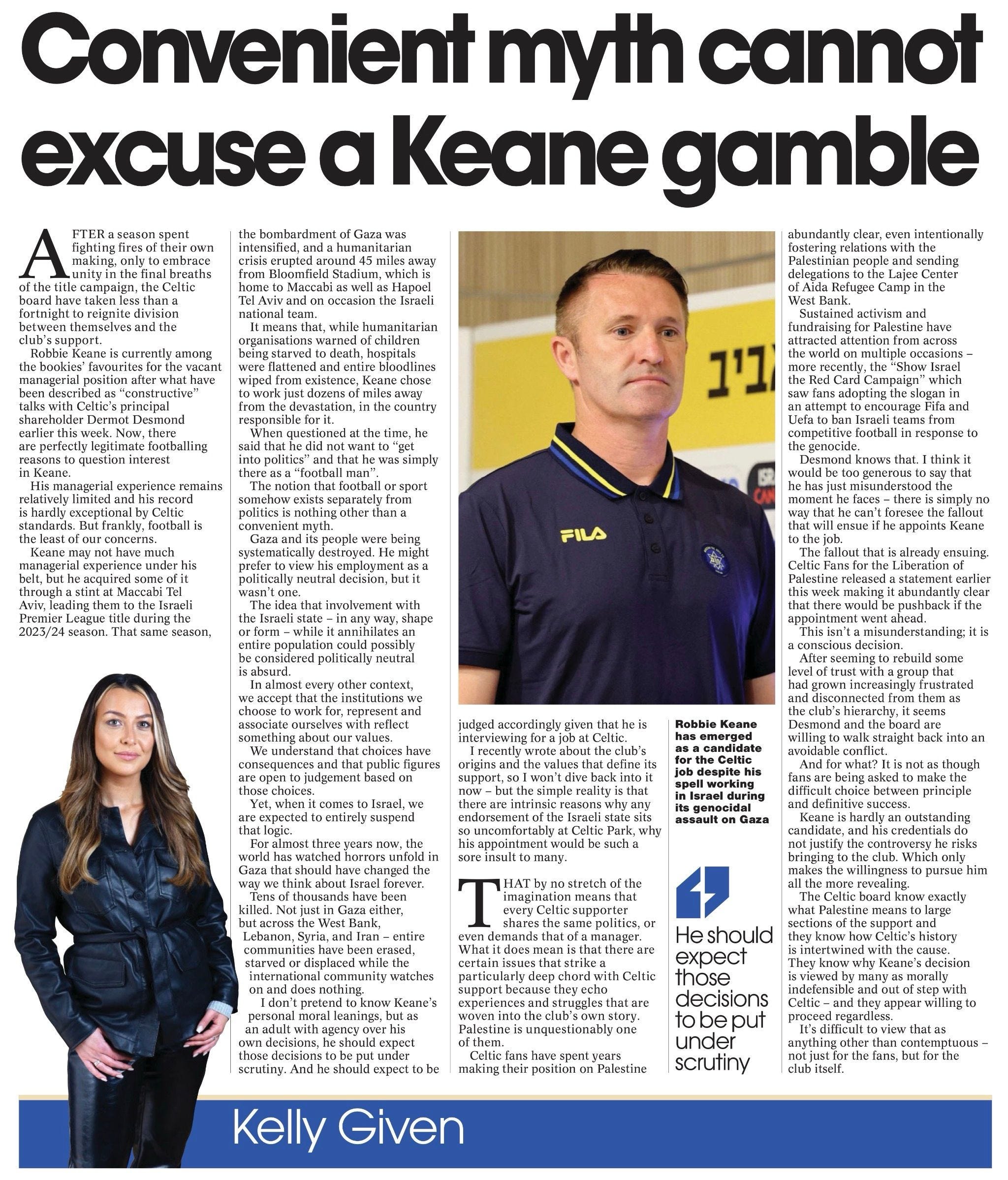
Prominent Celtic ultras group the Green Brigade have urged the club against making a “deeply divisive” managerial appointment in Robbie Keane.
The 45-year-old former Celtic striker, who recently left Hungarian side Ferencvaros, is a major contender for the vacancy at Parkhead and is understood to have held discussions with major shareholder Dermot Desmond on the role.
However, Keane would not be a universally popular choice with the Celtic supporters due to his tenure at Maccabi Tel Aviv. He remained in charge of the Israeli side during the outbreak of the nation’s war against Gaza – with some Celtic fans openly supporting Palestine in the conflict.
Banners and graffiti have been spotted at Celtic Park voicing displeasure at Keane’s potential arrival and the Green Brigade, who were permitted from attending home matches earlier in the season during a schism with the Celtic hierarchy, have made their feeling clear on the matter.
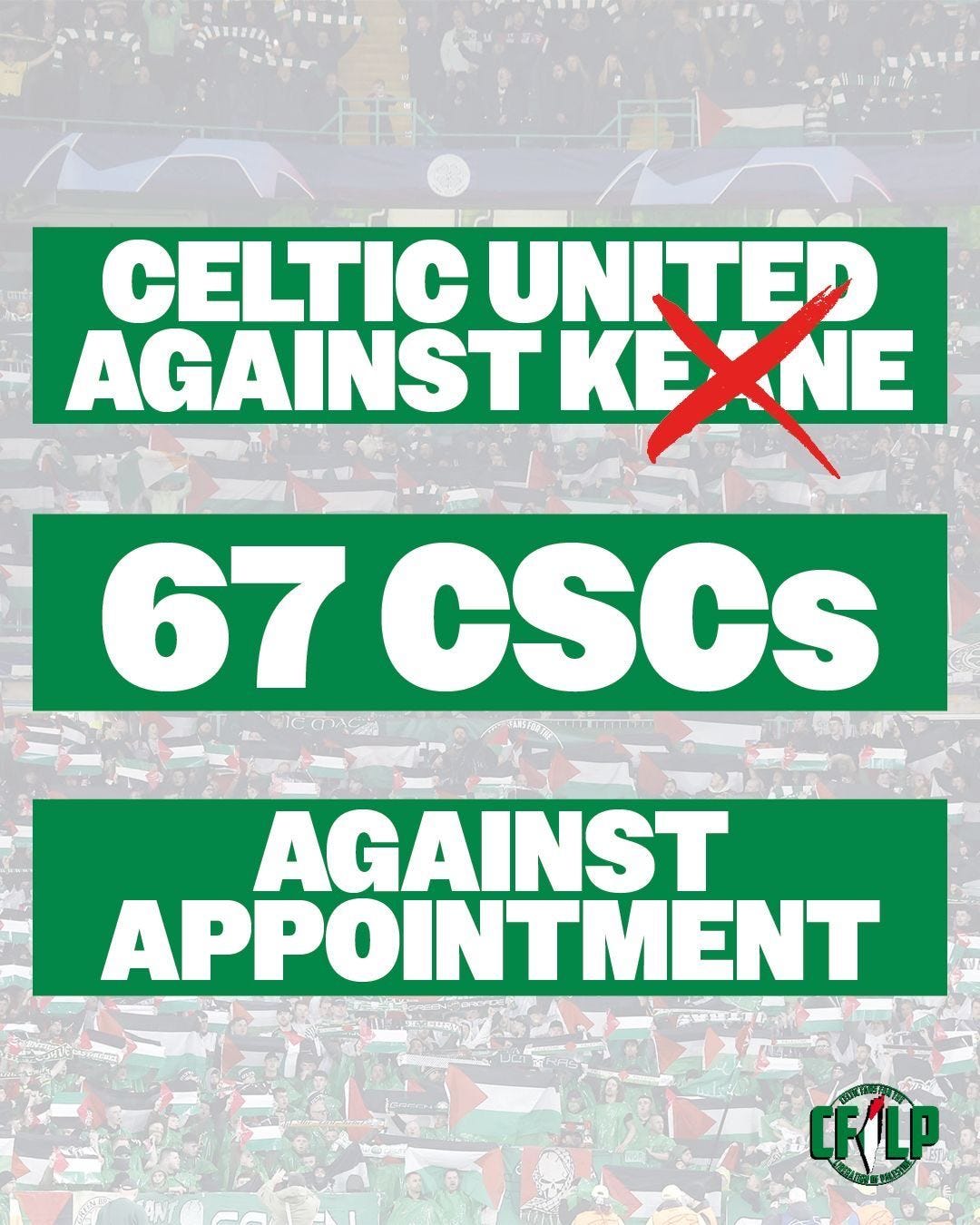
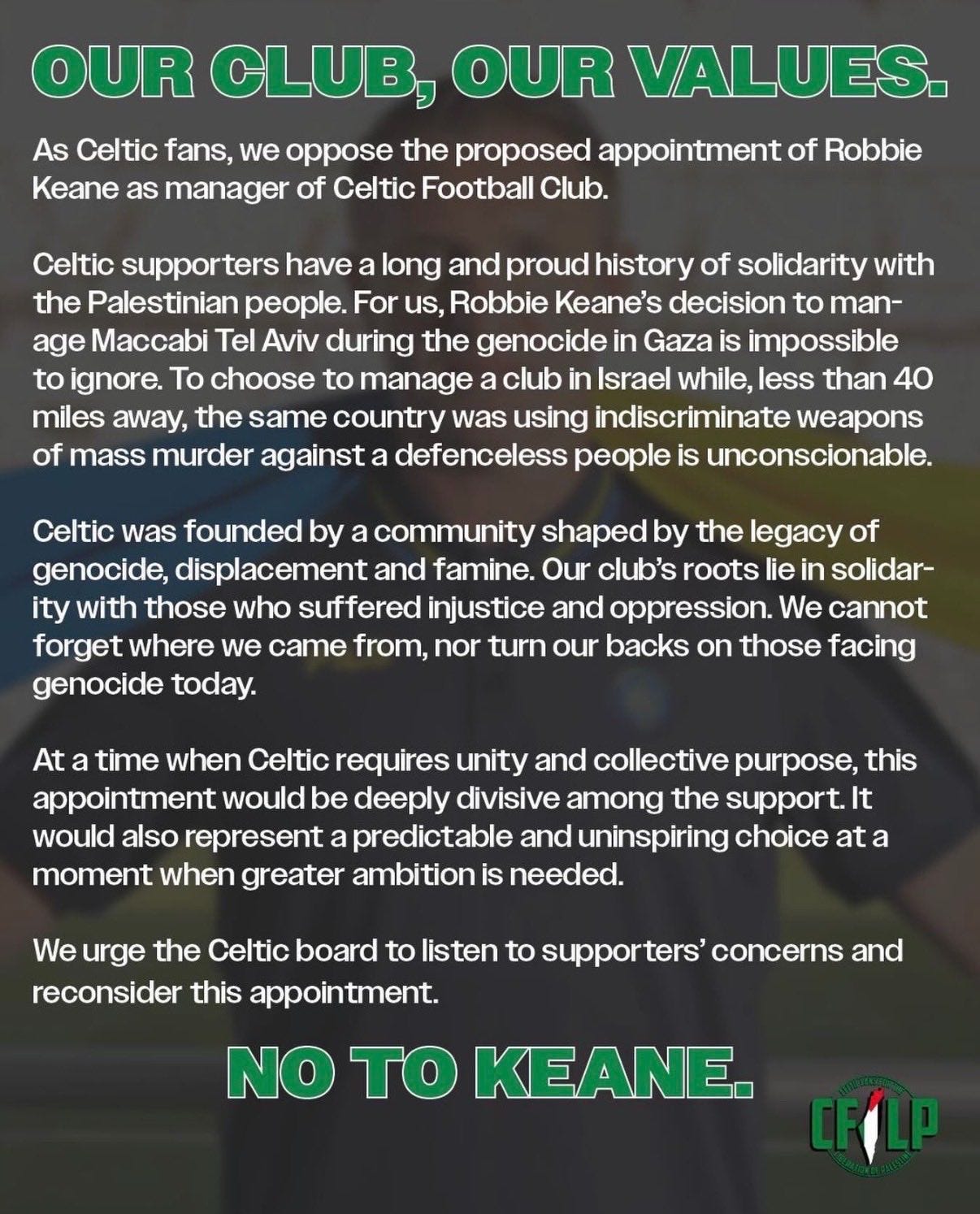
“As Celtic fans, we oppose the proposed appointment of Robbie Keane as manager of Celtic Football Club,” read the Green Brigade statement.
“Celtic supporters have a long and proud history of solidarity with the Palestinian people. For us, Robbie Keane’s decision to manage Maccabi Tel Aviv during the genocide in Gaza is impossible to ignore.
“To choose to manage a club in Israel while, less than 40 miles away, the same country was using indiscriminate weapons of mass murder against a defenceless people is unconscionable.
“Celtic was founded by a community shaped by the legacy of genocide, displacement and famine. Our club’s roots lie in solidarity with those who suffered injustice and oppression. We cannot forget where we came from, nor turn our backs on those facing genocide today.
“We urge the Celtic board to listen to supporters’ concerns and reconsider this appointment.”
Celtic powerbrokers are due to hold more managerial talks in the coming days, with Martin O’Neill – who took interim charge twice last season en route to winning the Premiership and Scottish Cup – also in the running.
Celtic are understood to favour an appointment in the coming days as they prepare for the upcoming 2026/27 campaign.
Why Celtic Supporters Saw Keane’s Israel Link as a Moral Red Line
https://www.andymuirhead.com/p/why-celtic-supporters-saw-keanes
Celtic fans saw a moral line in the sand over Robbie Keane, and they were entitled to draw it. This was about conscience, not bigotry, and the critics know it.
Andy Muirhead
Jun 08, 2026
There was a familiar simplicity to the way the latest Celtic fan protest was packaged by their critics. Angry fans, ugly optics, and a crowd apparently motivated by little more than tribal grievance. It is a neat story, the kind that drops easily into newspaper columns and panel-show talking points. It is also a deeply incomplete one.
Because if you strip away the lazy shorthand and actually look at why so many Celtic supporters reacted so strongly to Robbie Keane’s association with Israeli football, you get to the heart of the matter far more quickly than the critics ever do. This was not just about a manager, or a contract, or a footballing appointment, or simply because he coached in Israel. It was about Gaza. It was about the political and moral reality surrounding Israel’s war on Palestinians. And it was about a fanbase that has, for years, seen solidarity with Palestine not as an imported stunt but as part of its own identity.
That context matters. A lot.
The problem with the mainstream response is that it often treats political protest from football supporters as if it has to be irrational, performative, or sectarian by default. If Celtic fans object, it must be because they are Celtic fans. If they boo, it must be because they are looking for trouble. If they raise Palestinian flags, it must be some kind of coded provocation and support for terrorists. That mindset allows journalists and commentators to bypass the actual substance of what is being protested. Conveniently. But there was substance here. Serious substance.
Israel is not simply engaged in a normal military conflict. The scale of destruction in Gaza, the civilian death toll, the collapse of basic humanitarian conditions, and the public celebrations of violence by supporters and officials of the very club that Robbie Keane managed had already created a moral outrage that extended far beyond politics and into the realm of human conscience. Many people, including football supporters, looked at the situation and concluded that neutrality was no longer morally adequate. They saw a population under siege. They saw children being murdered. They saw hospitals, homes, schools, and entire neighbourhoods destroyed. They saw a state and a military apparatus – supported by the United States and many of the Western nations – acting with a level of impunity that ordinary people found intolerable and grotesque.
That is the background against which fans judged Keane’s presence there.
It is one thing to say that a football manager or coach is not personally responsible for every political act around him. Of course that is true. It is another thing entirely to pretend that the setting in which he works has no meaning at all. Football does not exist in a vacuum. It never has. Clubs are not abstract employment agencies floating above history. They are institutions embedded in society, affected by politics, identity, and the moral choices of those around them.
So when Celtic fans objected, they were not objecting to football in the narrowest possible sense. They were objecting to a larger political and ethical reality. They were saying that there is something profoundly wrong with treating business as usual as though business as usual were still defensible. That is the part many critics refuse to engage with, because once you do engage with it, the protest becomes harder to caricature.
Instead, the familiar response arrives almost immediately – bigotry, sectarianism, hysteria, mob rule. Sometimes the accusation is said outright. Sometimes it is merely implied. And if the issue is Israel, Palestine, or Gaza, the anti-semitism charge circles like a vulture, ready to be deployed whenever criticism becomes inconvenient to Israel and their sycophants worldwide.
That is precisely where careful language matters.
Antisemitism is real. It is ugly. It is dangerous. It must be condemned absolutely, without hesitation or excuse. But the word cannot be allowed to become a shield against all criticism of the Israeli state. It cannot be used to whitewash over Palestinian suffering or to silence people who are responding to mass civilian death with outrage.
Those are not the same thing.
A principled opposition to war crimes is not antisemitism. A refusal to sanitise the bombing of Gaza is not antisemitism. A demand that public figures, clubs, and institutions reckon honestly with the political implications of their associations is not antisemitism. The moment commentators collapse all of that into one lazy accusation, they stop arguing in good faith and start policing the boundaries of acceptable dissent.
That is why the silence on Gaza in so much of the reporting is so revealing.
Many supporters of the Zionist state are all too eager to frame protests through the lens of political influence, club politics, or supposedly irrational fan behaviour, while skipping over the foundational issue that made the protest resonate in the first place. You cannot honestly explain the reaction without naming the war. You cannot understand the anger without acknowledging the images and reports coming out of Gaza. You cannot discuss the protest and then act surprised that supporters saw Keane’s continued involvement in Israeli football as morally unacceptable.
That omission is not neutral. It is editorial. And it shapes public perception in exactly the way the establishment prefers.
For Celtic fans, solidarity with Palestine is not a recent trend. It has been visible in the terraces, in banners, in displays, and in the broader culture surrounding the club for decades. It has become bound up with the club’s self-image as more than just a football institution. Whether one agrees with every expression of that identity or not, it is undeniable that many Celtic supporters see their club as connected to causes of anti-colonial struggle, international solidarity, and resistance to oppression.
That makes the Gaza issue especially potent.
When those fans see civilians being killed in huge numbers, when they see public enthusiasm for military force, and when they see football figures continuing in that environment as if none of it matters, they do not interpret that as a minor discomfort. They interpret it as a moral test. And in their eyes, Keane failed it.
That is the part the detractors never seem to want to admit. They would rather reduce the protest to noise than concede that it had an ethical foundation. But if football fans are capable of mobilising over ticket prices, ownership disputes, kit colours, VAR decisions and club governance, why is it suddenly unthinkable that they might also mobilise over a genocide abroad?
The answer is that it is not unthinkable at all. It is simply inconvenient to those who prefer football to stay comfortably apolitical unless the politics happen to suit them.
There is also a striking asymmetry in how fan culture gets judged in Scotland. When one group of supporters expresses a position that aligns with international solidarity or anti-war protest, it is scrutinised for hidden motives, exaggerated, and often moralised against. When another group is associated with sectarian symbolism, political provocations, or overtly adversarial displays, the reaction is often far more forgiving. The standard is not applied evenly. Everyone can see that.
That does not mean every criticism of Celtic support is wrong, or that every protest is above reproach. It means context matters, and context is too often discarded when the subject is Palestine or Israel. The media can be remarkably expansive when explaining one club’s grievances, and remarkably cramped when explaining another club’s solidarity.
The result is predictable. Celtic supporters are treated as though they have wandered into politics by accident, when in fact many of them have chosen to stand in solidarity with Palestinians deliberately and consistently. They have attached meaning to that solidarity. They have made it part of the club’s fan culture. And because they have done so openly, they are then judged more harshly than those who avoid political questions altogether while still benefiting from them.
The other issue is this, it is not enough to say that people should be “above politics” when politics is already shaping the lives being destroyed on the ground. Neutrality is a luxury claim. It sounds balanced in a studio. It feels evasive in a war zone. When children are being buried in their thousands, when families are being displaced, when the scale of civilian death is staggering, the demand that football supporters keep quiet can sound less like moderation and more like complicity.
That is why the Celtic fan response resonated so strongly.
It was not because every supporter shares the same analysis of the Middle East. It was not because every chant or banner is perfectly phrased. It was because many fans saw the situation for what it was – a moral emergency. And once that judgment is made, you cannot expect people to clap politely at appointments, partnerships, or associations that seem to ignore the very crisis they are protesting.
The most frustrating part of the whole debate is how easily critics substitute character judgments for actual argument. Instead of grappling with Gaza, they label fans as “bigots.” Instead of discussing the genocide, they talk about fan behaviour. Instead of asking whether the protest speaks to a legitimate ethical concern, they talk about anti-semitism.
That tells you everything.
If the media wants to be taken seriously, it needs to report the full story. That means naming Gaza. It means acknowledging the deaths of civilians. It means understanding why fans around the world – not just Celtic fans – have chosen Palestinian solidarity as a moral line in the sand. It means resisting the temptation to reduce every expression of outrage to prejudice.
And yes, it also means being fair about the difference between criticism of a state and hatred of a people. That distinction is essential. Without it, the debate collapses into slogans, and slogans are the favourite language of those who would rather not confront the facts. Celtic fans don’t hate Jews, they hate the Zionist state of Israel.
Celtic supporters are entitled to their politics. They are entitled to protest. They are entitled to judge public figures through the lens of conscience, not just footballing competence. And they are entitled to ask why the coverage so often omits the very context that makes their protest intelligible.
The answer, bluntly, is that Gaza is too uncomfortable for many of the people writing the headlines. It forces moral clarity. It forces specificity. It forces them to say what they really think about genocide, rather than hiding behind vague phrases about “controversy” and “backlash.”
But football supporters, especially those who have long embraced solidarity politics, are not obliged to cooperate with that evasion. They saw what they saw. They heard the statements. They understood the symbolism. And they responded accordingly. That does not make them bigots. It makes them politically conscious.
The real question is whether the commentators who criticise them are prepared to be equally conscious, or whether they will continue to ignore the mounting dead toll in Gaza while lecturing living people about tone. That is the standard now. That is the choice.
And if the media refuses to meet it, the public will increasingly understand why so many fans no longer trust it to tell the full story.