C | Player Pics | Lisbon Lions | A-Z of Players | Coaching Staff
Note: There has been more than one player to have played for Celtic with the same name, so please check the other namesakes if need be.
Personal

Fullname: John Clark
aka: ‘The Brush’, ‘Luggie’, Clarky
Born: 13 March 1941
Birthplace: Bellshill, Lanarkshire
Died: 23 June 2025
Position: Defender, Sweeper (hence “The Brush” nickname)
Signed: 8 October 1958
Left (as player): 12 June 1971 to Morton
First game: Arbroath away 5-0 League 3 October 1959
Last game: Clyde home 6-1 League 1 May 1971
First goal: Hibernian away 1-0 Scottish Cup replay 15 March 1961
Last goal: Hamilton Academicals away 4-2 League Cup 25 September 1968
Internationals: Scotland
International Caps: 4 Caps
International Goals: 0
Biog
| “I was a Celtic supporter, a Celtic player, it’s been my life… I’ve really enjoyed my life, when I look back I couldn’t ask for any more.“ John Clark (2014) |
John Clark is a member of the glorious Lisbon Lions who won the European Cup back in 1967 and has one of the longest records of anyone with first team involvement with Celtic in playing and coaching.
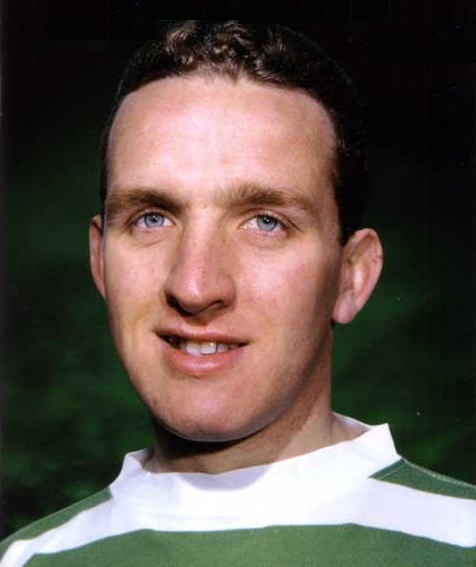
Raised in Chapelhall and Holytown (both in Lanarkshire), he grew up in a tough working-class environment in a large family which likely engrained in him a strong work ethic and a drive to succeed.
His young life was struck down by the premature death of his father in a railway accident, an event everyone else can only imagine the impact it will have had on him in his youth.
At seventeen, John Clark was approached by Celtic to sign him as a player: “I was fortunate enough that Celtic approached me to sign for the club. I was seventeen at the time and I felt as though I had won the pools!”. It was to become even greater than that.
He is perhaps the most unheralded player among the Lisbon Lions team by observers, but his subtle sweeping up in the half-back position beside Billy McNeill was integral to their success. Many people say that it was John Clark who made Billy McNeill the great player he was on the pitch, although fairer to say that they both complimented each other to bring out the best in themselves. Billy was king in the air, and John Clark was the main man on the ground for the defence.
John Clark played for Larkhall Thistle before moving to Parkhead in 1958. The early years of Clark’s playing career as a wing-half showed few signs of his later glory. He first attracted attention after scoring the only goal on his debut in a Cup tie replay against Hibernian in 1961 where he deputised for the injured Celtic Captain Bertie Peacock. Sadly the injury took it’s toll and Bertie didn’t play for Celtic again. John’s performance won him a place in the Cup Final but the task of taking over from the great Bertie Peacock was a hard one for any player, and it wasn’t at all easy for John, especially as Celtic were mostly underwhelming for much of his early years at Celtic. 1960-61 was the season that John made his mark in the first team and towards the end of the season he took over as the regular left half.
He was out of the first team for much of the 1962/63 season after missing a penalty v Valencia in the Inter-Fairs Cup (2-2 draw, 4-6 loss in aggregate). He was back in as a regular in season 1963/64, but Celtic were still underachieving, and much had to change in an era marked by poor management at both board & team level.
Jock Stein Era
It was the arrival of Jock Stein at Celtic Park that marked a transformation in fortunes for John’s career. Stein employed him as sweeper behind Billy McNeill and he never looked back. Clark was a quiet, down-to-earth character and his cool head was one of his best attributes. He used to read the game very well. A defender through and through, some even joked that he needed a map any time he crossed the half-way line.
His role as Celtic’s sweeper earned him the nickname ‘The Brush‘! Also known sometimes as ‘Luggy’, a name that John didn’t really like and came about after he ended up with a cauliflower ear after an accidental collision with Billy McNeill in training.
If ever anyone wanted evidence of his commitment to the first team and his desire to see the club turnaround, then they only need look to the glorious Scottish Cup final v Dunfermline in 1965. This match saw the club win some silverware for the first time since 1957, but it was the performances and effort that showed a marked change in the players’ outlook. John Clark received a nasty facial knock after 50 minutes that would undoubtedly have forced him off the park in today’s football, he soldiered on. Celebration pictures from the day show his jersey saturated in blood. He literally bled for the cause you could say.
From there on in, it was onwards and upwards for John. The quadruple in 1967 was the high-mark for John, but he also played an important role in the European Cup final, a day not to forget for anyone. Not an easy task to play Inter Milan at that point, and it was likely a lesson on defence from the masters in the opposition for Clark as much as anything else. Celtic won and he got to get his hands on the trophy. He may be overshadowed by the other greats in the side, but John Clark was about the last man who the manager would have replaced in that side. John Clark was integral to the set up of the side, and was a very underestimated player who was a lynchpin of the Lions’ defence.
He was a constant in the side, and played a total of 140 consecutive matches between April 1965 and September 1967. So he was ever present in all the matches throughout the high-mark season of 1966-67. Only Tommy Gemmell was ever-present in that glorious season too.
He scored only a few goals but treasured those he did. For example, he’ll tell you that he scored one of the strikes of the century: “I always say that I scored the best goal ever,” he said in a Celtic View interview. “It was in a Scottish Cup replay at Easter Road against Hibs [15th March 1961] and I beat a defender at the byline, cut in and poked the ball through [future Celtic keeper] Ronnie Simpson’s legs and said to him: ‘You couldn’t get any better than that could you!’”. It was a vital goal in a 1-0 victory, although sadly Celtic lost in the final to Dunfermline that season.
Funnily despite correctly having the persona of a good gentleman, possibly one of his most celebrated moments was from the despicable World Club Championship match play-off against Racing Club. After sending-offs and complete commotions, with the referee totally out of his depth to control the match, one of the Racing Club players decided to try to take John Clark on, and in retaliation John Clark raised his dukes to the guy who simply scarpered off quick time. Admittedly he got a bit fed up of it being brought up by so many in conversation with him as it’s not his usual character, but due to the events of that day, Celtic supporters’ all still privately admire him for that moment and love him even more for it.
John Clark had it particularly difficult to keep his place with young whipper snappers from the ‘Quality Street Gang‘ behind him. A cartilage injury in 1968 began the decline, and he was thereafter in & out of the first team picture.
He was to lose his regular place to Jim Brogan (the first of the Lisbon Lions to do so) and with the other competition following behind, John Clark was pushed down in the pecking order but was still a valued, respected and regularly called-upon member of the first team squad until his departure in 1971.
Post-Celtic Playing Career and beyond
In the summer of 1971, John Clark left Celtic for Morton with team-mate Stevie Chalmers, where he retired two years later. Curiously, when John Clark returned in 1971 as a Morton player, he was among the Celtic goalscorers, netting an own goal in a 3-1 defeat.
He played for the Scottish League XI sides twice and won four caps for Scotland which included a memorable game against Brazil at Hampden in 1966, where he marked Pele out of much of the game. In 1973 Jock Stein tried unsuccessfully to bring him back as a player but Morton chairman Hal Stewart was looking for a fee which was totally unreasonable given he had signed John for free.
Post-Playing Career

In the summer of 1973, John returned to Celtic as a coach where he assisted with the youths and reserves. He then teamed up with Billy McNeill as his assistant manager at Aberdeen and Celtic, reflecting the respect and due that Billy McNeill had for John Clark for their time playing together.
John Clark enjoyed a managerial career with Cowdenbeath, Stranraer and Clyde in the 1980s and early 1990s. Notably, John Clark worked as a driver/van man for Strathclyde Fire Brigade delivering kit, tools & other essentials when he was the manager of Shotts Bon Accord. His cousin was as the Chief Fire Officer of Strathclyde.
Since then he returned to Celtic as a kit-man for the first team and was to be a very popular member of the Celtic backroom team. He worked alongside manager Martin O’Neill and one of his main requests was for John to tell old tales about the Lisbon Lions and in particular about Jimmy ‘Jinky’ Johnstone. He continued to work alongside successive incumbent managers, being a welcome and popular addition to the first team staff.
Only Willie Maley has given more years to Celtic in terms of length of service on the front line at Celtic. A truly remarkable Celtic man whom more should recognise for all the time and effort he has put into the club without asking for anything in return. Possibly (but probably incalcuably) he has attended more Celtic first team matches than any other man in the club’s history to date, with the possible exception of ex-Celtic chairman Kevin Kelly.
Outwith of Scotland, his talent didn’t get unnoticed either. A fine debut performance for Scotland in the aforementioned match v Brazil in 1966 left such a good impression on one of the opposition, that on bumping into John Clark again a few years later, the player recognised him at once and went to speak to him. The Brazilian player in question? None other than the legendary Pele. Curiously on this later meeting, John Clark has said:
“Do you know, I was just being polite. I’ve no flamin’ idea who that was!”
Football was in the blood, and his son Martin also became a professional footballer, with Clyde, Nottingham Forest and Partick Thistle in the 1990s.
At the Celtic Player of the Year Awards in May 2004, Martin O’Neill presented John Clark with the Lifetime Achievement Award for his services to Celtic. Yet he still had a lot of life in him, and was still on the staff at Celtic for long after.
One poignant moment was in May 2019, Billy McNeill had been awarded a One Man (Club) award by Athletic Bilbao and was to be presented this at a following match in Spain. However, Billy McNeill passed away a week later, and in his place long-term friend John Clark and Susan Chalmers (daughter of Billy McNeill) received the award in his honour. It was a great tribute.
He passed away in June 2025 after a long life aged 84. In the eyes of a number in the support, he has a strong case for being deemed as the club’s greatest ever servant, having served in so many key roles over his lifetime.
There have been lots of great people attached to Celtic Football Club in some way or another over the years. Very, very few of them can claim to have been greater than John Clark.
Playing Career
| APPEARANCES |
LEAGUE | SCOTTISH CUP | LEAGUE CUP | EUROPE | TOTAL |
| 1958-71 | 185 | 31 | 62 | 40 | 318 |
| Goals | 1 | 1 | 1 | 0 | 3 |
Honours with Celtic
(Honours are marked below in which the player has played in at least one of the matches in the campaign.)
European Cup
Scottish League
Scottish Cup
Scottish League Cup
NB: What league medals he “won” will be down to the interpretation that he needed to have made around 25% of match appearances. In Season 1968-69, he made 9 plus one 1 sub appearances. So should be classed as having won a medal. Down to interpretation, but as he played also nine games in season 1969-70, he should be classed as a league winner in that season too. Our process on this site, is that if a player has played any part on field for Celtic in a match on the road to the title, then they should be marked with that honour.
Quotes
“Celtic has been my life and I have worked here in every decade over 50 years, around 37 years in total. It meant a great deal to me as a youngster, because you can only thrive if you are a Celtic supporter, who gets the opportunity to play for the club, it’s every supporter’s ambition. I am just so fortunate that I have had the opportunity to play and work here, but I never thought that I would I enjoy such a long association with the club and could never have imagined, when I signed, the success we would have under such a great manager as Jock Stein. He pushed us to be the best we could be and drove us to the greatest honour that any club can win. It’s been a major part of my life and as I said, I always attach that word ‘luck’ to me and Celtic.”
John Clark (2008)
“I was a Celtic supporter, a Celtic player, it’s been my life. I get a lot of satisfaction when I think that I started my working life with Celtic and I’ll finish it with them. I’ve really enjoyed my life, when I look back I couldn’t ask for any more. I’ve been a really lucky guy.“
John Clark (2014)
“John Clark was always there when you needed him. He read the game very, very well and, like all the guys in that defence, was calm and collected.”
Jim Craig on John Clark
“I never wanted any of that [fame or celebrity]. It wasn’t me. I preferred being in the background.”
John Clark
“Coming back to Celtic Park made up for the presentation. Streets were lined with people all the way from the centre of Glasgow.”
John Clark
“Players come and go but some achievements live forever. The thing about the Lisbon Lions is we stick together for everything in the bad times and the good times, we’re always there.”
John Clark on Lisbon Lions
“It wasn’t a game of football, it was horrible. I must say that I am fed up looking at footage of me in that John L Sullivan pose, boxing. You would have thought there was another clip of me in action, but it seems to me that you guys in the media department like that one! Looking back to that moment, the guy ran away and I never saw him again. In fact, I couldn’t see him for dust!”
John Clark on the Racing Club v Celtic World Championship match (2009)
“I’ve known wee John [Clark] since the first day I signed at the club. That was 1961.He’s a really great guy and he was the best player in the European Cup Final.”
Bobby Lennox on John Clark (2018)
“Along with the Lisbon Lions, they changed the course of travel of this club and what they were thought of – and John himself, the humility that he had, for being such a great player and such a humble man.”
Brendan Rodgers on John Clark
Pictures
Links
Forums
Articles
Anecdotes
Jock Stein and John Clark – The Morton Signing On Fee.
When Lisbon Lion John Clark left Celtic to play out his final footballing years with Morton it was agreed that John would receive a small signing on fee from Morton as a thank you for his services to Celtic.
Hal Stewart the then Morton Chairman reneged on this agreement and Morton wouldn’t pay John the agreed sum.
Eventually Jock Stein got wind of this and was far from happy about the treatment of one of his players. When Morton drew Celtic in a Cup game at Celtic Park as was the way for Cup games in those days the gate receipts were halved and Jock utilised this opportunity to sort out matters.Jock arranged that John Clark’s signing on fee be deducted from Morton’s share of the gate and John was subsequently paid the money he was due by Morton albeit it came from Celtic
Hal Stewart could do nothing about it and had to accept that Jock had put him in his place and got one over on him..
They didn’t come much shrewder than Jock Stein and his morals and deep seated Lanarkshire mining roots ensured that he was looking after one of his own.
Articles
John Clark of Celtic – Just One of Us from Holytown & Chapelhall
By JoeBloggsCity 27 June 2025…
John Clark, Celtic FC
John Clark, Celtic FC. Photo The Celtic Wiki
John Clark of Celtic – Just one of us from Holytown and Chapelhall
With the sad passing of John Clark, it has had a stronger hit on the hearts of certain sections of the Celtic support than others. To his family and friends, we can only imagine the loss that they now feel with his passing away (and I pass my sincere condolences on to his family). To the rest of us who have never had the good fortune to have met to speak to him personally or little knew him, his aura and achievements are what first stand out to him, but also his incredible achievements which have been heavily documented in the various write-ups this week across the online Celtic forums and sites.
There is though another section of the support who will have been heavily struck by his death, and the main thing I wanted to address is something here I find very difficult to explain to those of you who have been more fortunate to have been brought up in either metropolitan or suburban areas.
A little background to the wee villages…
John Clark was raised and lived in Chapelhall and Holytown, both small mining villages in North Lanarkshire, which both hold relatively small populations of around 5-7000 each. In these places, for most unless you’ve got a good car and can afford the time and petrol, then you most often are cut-off from everything, stuck with little to do (especially in the days before the internet). There used to be around six pubs on the Main Street in Holytown with little else except council tele (later videos), and even buses out to town were really infrequent. These places are often ignored even by those in the neighbouring large towns let alone on a wider national scale.
With such small populations, it meant that there have been few opportunities for the youth to really stand out to make their name in greater spheres, and sport has been one of the few outlets for people in the Lanarkshire villages and towns to achieve some great national recognition. In no way, am I saying that sport is the only way, with a number having done very well academically/professionally and in politics, but sport is a notable road with often far wider recognition for those who achieve great success.
It helps to explain in part without digging in much deeper, the roots of the attachment that these communities have to their sporting team, especially to Celtic for those of Irish Catholic descent. It also helps to explain why those who succeed at the clubs are held in such esteem, and John Clark achieved so much.
John Clark of Celtic
John Clark came from this background, and football played a part to be able to elevate him to a better more fulfilling life and career. In light of the tragic circumstances, with the premature death of his father when he was still a young boy, nobody could ever begrudge the success he achieved after overcoming the circumstances he had to endure. He stuck to his roots and lived in Holytown (marrying a local lady) throughout being a Celtic player, which in the modern age would be unthinkable that a football player would live in such a blue-collar area and not stuck out in some rich fenced off estate or expensive West End flat!
To add to the challenge was that John Clark may have been a resident in Holytown, BUT actually the town was far from Celtic-centric. On John Clark’s passing, journalist Hugh Keevins came out with the baffling line that: “[John Clark] came from a background in Holytown, where Celtic was a big thing in people’s lives and it never left him”. He clearly had never visited the place! Celtic might be a big thing to some but certainly not to the bulk of the rest! Yes the town has a small Catholic community, church and school, but the town is historically culturally a Presbyterian town with the July marches through the town arguably the biggest occasions in the year (the marches were massive and seemed to be endless when I was a kid). So it’s obvious where the general sympathies lie.
However, don’t get me wrong, I’m not going to get into any divides, this isn’t the place, but living in the town seemed to add to the respect that many had for John Clark from the local Celtic support, who remained overwhelmed that he lived amongst them when he possibly could have chosen to move out to more affluent areas (as admittedly he did many years later after he had left Celtic). One old time resident once told me that in contrast to his teammates in more Celtic-centric towns, there was relatively far less of a crowd/fan-fare for him on his return from Lisbon in 1967 due to the make-up of the village.
Despite that, old timers reflected warmly on John Clark, and even brought colleagues to the village! One occasion was when he was awarded the Holytown Club’s Player of the Year trophy in 1966, bringing over future Lisbon Lions Cesar, Jinky, Chalmers, Gemmell and Yogi! This was done in the White House Pub which has been the centre for the Celtic support in the town over the years, and the location for the supporters bus. It is almost unthinkable now for this to happen as the links between the players and supporters on the ground have distanced, although I do concede it has become complicated with the risks from social media in particular playing a part in this distancing.
Neighbouring towns overshadowing the small towns…
Nearby Bellshill and further out Motherwell due to their far larger size, as well as the maternity hospital in Bellshil, have far more names to link to them to give the local Celtic supporting residents great pride to take in (most notably McNeill and Gemmell respectively). For us in the smaller villages, we have far fewer local heroes, which is why we still cherish John Clark so much.
Added to this, was John Clark’s humble and quiet nature. The villages are full of a cross-section of characters, but communities have their traits too, and John Clark personified the best of those qualities which further endeared him to even those outwith of the Celtic support, and made many look up to him. It reinforced the link to Celtic, and what we could achieve. One of us had made it to the top with Celtic, and was a legend, but he was still always just one of us and kept that ethos with him to final days.
Without meaning to be too melodramatic, football was all that many of us really had to follow or latch on to, and we loved the game: playing it, reading about it, watching it and following it despite the often downtrodden treatment by certain sections with exaggerated beliefs in their self-importance. It gives us fun, laughter, tears and hope (admittedly sometime misplaced too!), and we keep coming back for more. Having someone from your community so successfully involved whilst retaining the character of his upbringing really elevated the experience of being a Celtic fan for us.
The only other major connection that I can think of linking Celtic to Holytown, was that the inaugural Celtic match side included a player born in the village, Eddie Pearson! That’s quite a gap in time, but another landmark link for the village to Celtic. The club has very strong Lanarkshire links, you just need to look at the debt the club owes to the area for the Lisbon Lions contingent.
John Clark’s Legacy
So, I hope at least in part it can help to explain to some of those from more fortunate backgrounds, why there is such an incredibly strong link and fondness for John Clark in some parts beyond just the football, and why it has seriously hit hard home for some than others. Auld, Gemmell and Jinky were far more popular across due to their gregarious natures, but that wasn’t John Clark. Yet he was our own main hero as he was “one of us”, whilst they were main heroes to their town and village communities.
As a former resident of one of the mining villages, it definitely to me brought back to light the past, even though I’ve long gone. John Clark actually left our village before I even was born, so I don’t recall having ever met him when resident there (maybe I did when very young without knowing who he was on any occasion he may have returned). I did have the good fortune to see him in person at a Lisbon Lion dinner and I only wish I had gone up to speak to him for a good chat.
His passing helped remind me of the old supporters bus I travelled on and those I met on those trips, and what I learned from it and I was reminded on his passing of what he meant to them. He was that rarity, a guy from our locale who really made it big, from just next door to us, without any big expense or fat cat academies (like now). A guy who likely would have been with us on the supporters’ bus if circumstances had been different and he’d not gone into football. Someone whose story we could relate to, even for those of us who weren’t even born when he played for Celtic. His time at Celtic, just helped to reinforce why we from the mining villages supported Celtic.
His past time with us should also emphasise why it is important to maintain the Celtic youth development schemes and outreaches throughout the West of Scotland. These efforts help to bring in young talent, and foster goodwill towards the club and within the communities which is an intangible asset that really can’t be quanitified. Also importantly, they should be supported within the working class communities as much as the more affluent areas.
John Clark may have passed on now, but his achievements and memory will survive for generations and for as long as Celtic develops. John Clark embodied what was best about Celtic, and helped push the club to reach the summit of the sport, and he did whilst remaining working and living amongst us on the ground. That in itself is what was most special about him. His legacy in part is Celtic but also the incredible links he has helped further reinforce between the club, its support and these old mining communities.
John Clark, RIP.