Managers | Manager Pictures | The Road to Seville
Personal
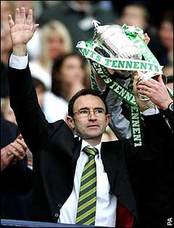 Full name: Martin Hugh Michael O’Neill
aka: Martin O’Neill
Nicknames: MoN, ‘Martin the Magnificent’, ‘The Blessed Martin’
Born: 1 March 1952
Birthplace: Kilrea, Northern Ireland
Position (as a player): Midfielder (didn’t play for Celtic though)
Internationals: Northern Ireland
International Caps: 64 caps
International Goals: 8 goals
Manager (1st stint): 1 June 2000 – 28 May 2005
Succeeding: John Barnes / Kenny Dalglish (interim)
Successor: Gordon Strachan
Interim Manager (2nd stint): 27 Oct 2025 – 3 Dec 2025
Succeeding: Brendan Rodgers
Successor: Wilifried Nancy
Interim Manager (3rd stint): 5 Jan 2026 – 5 Jun 2026
Permanent Manager (3rd stint): 5 Jun 2026 – Present [rolled on from interim to perm]
Succeeding: Wilifried Nancy
Successor: […]
Trivia
- First Celtic manager since Jock Stein to win a domestic treble.
- First Celtic manager to take the club to a UEFA Cup final.
- His Celtic side won a record 25 league games in a row in 2003-04.
- From 2001-2004, Celtic remained undefeated at home until Aberdeen won in Apr 2004. A remarkable record under Martin O’Neill.
- Seven domestic trophies won under Martin O’Neill.
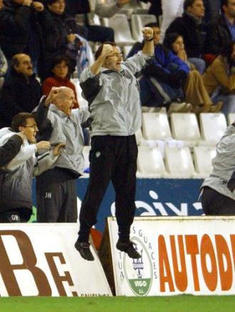
- Trademark: after any major Celtic goal, he had a famous habit of jumping in the air with his fists raised. A little humorous but illustrated his wonderful character and emotion to all.
- Stood up against bigotry when Neil Lennon was barracked all 90 mins in matches v Rangers for his Irish Catholic background.
- He was a legal student until he gave his studies when offered to become a footballer.
- Double European Cup winner as a player with Nottingham Forest, playing under legendary Brian Clough.
- He was not a former Celtic player, but a supporter when growing up.
- Made Rep of Ireland manager in 2013, with ex-Celtic player Roy Keane as his assistant.
- Celtic won a record seven in a row victories over Rangers under his charge.
- Returned to Celtic as interim manager in two spells in 2025/26 season and won the league & Scottish Cup double against all the odds.
Manager 2000 – 2005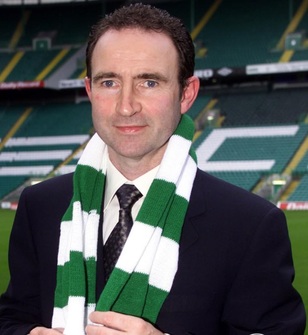
“You can’t afford to rely on history – you have to make it.”
Martin O’Neill
Extraordinary salvage job transformed Celtic from isolated runners-up to instant treble winners. Continued success, including a Uefa Cup final, made him Celtic’s most influential figure since Jock Stein. Intense, intelligent and highly-coveted, Martin O’Neill left Celtic in 2005 to look after his sick wife, Geraldine.
When Martin O’Neill arrived at Celtic, compared to his predecessor there wasn’t as large a crowd to greet him, nor was there the usual overblown fanfare you often get when any new incumbent arrives at the helm of a club of Celtic’s size. There was a fairly large crowd of people welcoming him, but truth be told expectations were conservative.
The prior season to his arrival can be best described as amongst the worst the club had endured post-takeover with the John Barnes/Kenny Dalglish managerial reign falling as low as can be. Rangers were in the ascendency and were arrogantly believing that this was a season where they were going to push forward in Europe and have Celtic by the jugular under their spiky shoes (as per the writings of one of their more prominent fanzine writers).
How things were to turn out differently. Nobody could ever be said to believe what was to happen over the next few years, and the following only covers partially the true emotion of Martin O’Neill’s reign in brief for the whole Celtic support.
2000-01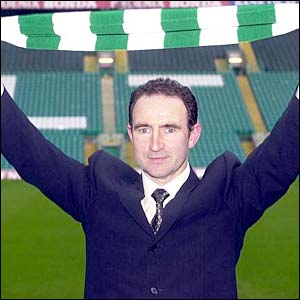
So how was Martin O’Neill to begin to turnaround the whole club? Some thought that it was equivalent to turning the Titanic around in light of Rangers’ then hegemony. His first task was to rebuild the squad, and after losing Mark Viduka (the highest profile loss) he brought in players such as Sutton, Thompson and Agathe, and later Lennon (in Dec 2000) to change both the dynamic and atmosphere surrounding the whole squad. Add in the recovery of Henrik Larsson, after his horrendous injury the previous year, and he had the nucleus of a great team, a blessing for any manager.
The first league game began well with a comfortable win against Dundee Utd which saw both Sutton & Larsson score to get off the starting blocks for the season. An encouraging start followed with six wins on the trot (2 in the UEFA cup) and Celtic were to next face their biggest challenge, the first game of the season against Rangers. Martin O’Neill’s first game v Rangers was expected to be a real test of his nerve and ability. Rangers were arrogant and bloated from their spending over the prior couple of years. The match was set to play a part in how the season was to go, and overall there was only one team in the game, Celtic running out 6-2 victors (dubbed “Demolition Derby”).
The game has become legendary and Henrik Larsson stands out in this game more than anyone else. For Martin, this set things off perfectly for the rest of his time at Celtic. Passing his first test with flying colours put both his squad and the fans right behind him and effectively won us the psychological battle against Rangers. The match was a turning point in Scottish football and heralded a beginning to the end of Ranger’s domestic dominance. Important was the contribution of his new signings, especially Sutton, and this surely gave the board greater confidence to back the manager in any of his demands.
During the season, Larsson cemented a perfect partnership with Chris Sutton, and with their single-minded determination to see Celtic achieve the best and put Rangers in their place, each played well off of each other, banging in the goals taking us further ahead of Rangers. Celtic won the league by 15pts, with Henrik scoring a phenomenal 35 goals in 37 games. In contrast, Tore Andre Flo scored just 11 goals to be Rangers’ highest scorer and he cost Rangers a fortune (around £12m).
Martin O’Neill’s inspired team completed an exceptional Treble that season (league, Scottish cup & league cup), something that even the most optimistic Celtic fan at the start of the season could not believe would happen.
Martin O’Neill had transformed Celtic in his first season. His hope to bring success to the club had been surpassed already. He became the first Celtic manager since Jock Stein to achieve the treble. Even he surely could not have believed that such an incredible first season was possible. Celtic blew the opposition away, played some great football and his man management allowed for a settled squad, the first the club had for a very long time.
An interesting anecdote from Matt McGlone (ex-Celtic View columnist) on Martin O’Neill highlighted his level of involvement at all levels. After a critical article by McGlone on the first team after losing 5-1 to Rangers, Martin O’Neill stormed in to see Matt McGlone and castigate him over the article. According to McGlone, Martin O’Neill was comprehensive in his role at Celtic and had a view and look at everything going on, and ensured that all was well set-up as he required for his players benefit. An important point that highlights just how thorough Martin O’Neill was, and it played a part to transform the team and club environment to get the foundations laid for future success.
2001-02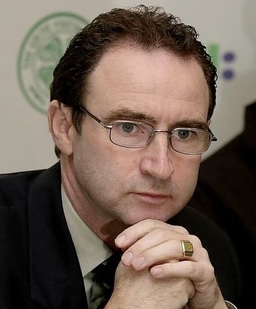
How was Martin O’Neill to advance Celtic from the previous season’s stellar campaign? Celtic were way ahead of where all expected the club to be (helped admittedly by Rangers imploding), so season 2001-02 was to see the next stage by testing European waters.
A poor start in his first season saw Celtic go out very early doors in the UEFA Cup, and this time for this foray into the Champions league Celtic had to go begin the journey by overcoming Ajax in the preliminary round. To everyone’s shock, Celtic won comfortably over the two legs, a three-two aggregate, with a wonderful 3-1 away in the first game, and Celtic were into the Champions League group stages for the first time.
A tough group awaited Celtic with Juventus in pot one, and for Martin O’Neill it was quite a step up in a short space of time for management at Celtic. A double European Cup winner with Notts Forest, Martin O’Neill knew what it takes to compete in the tournament but times had changed and Celtic were entering with some trepidation.
worked his best but famously the team failed to go through even though the side had amassed 9pts (just one behind Porto who came second), then a joint record points tally to not go qualify through, but it was Celtic’s first run in the Champs League group stages and it was a good learning experience for all. In many ways, there was little more Martin O’Neill could do more but he made the difference for the players to believe in themselves to be able to compete toe-to-toe with the best, and it was agonising to see us fall at the final hurdle. Celtic ended up dropping down into the UEFA cup, where the first team were to be knocked out on penalties.
Domestically, Martin O’Neill was again on track. Things just couldn’t go wrong for the first team in the league, which was won convincingly with 97pts, 15pts above Rangers who were second, and a goal difference of -61. A 3-0 win against Rangers away at Ibrox sealed Celtic’s dominance for the season, the only blip being losing the Cups. The football was excellent, Larsson & Sutton were banging in the goals and Martin O’Neill was in his ascendancy. It really was a magical time.
His transfers had shored up the squad with John Hartson being the most notable in the season. In many ways, Hartson’s transfer reflected Martin O’Neill’s attitude to football the most. A no nonsense back-to-basics forward, he definitely did not epitomise the modern footballer, but he was very effective and did the job in hand (his goal tally showed that clearly). Not a signing that initially got the fans applauding, but Martin O’Neill’s thinking on Hartson paid off and showed his general shrewdness in buying certain players.
2002-03
A season never to be forgotten by any Celtic fan (or anyone else who was there to witness any of it!).
Some analysts like to talk about “Creative Destruction”, the idea that once a disaster occurs it enables the entity to rebuild better than if it were trying to rebuild from being at the top. This can be applied to this season. Hopes were high, and the players were now fully accustomed to each other and more importantly to the manager. Martin O’Neill’s imprint on the side was unmistakable, moulding the squad into an efficient side, and all was heading in the right direction.
Then the disaster struck. In the qualifying round for the Champions league Celtic lost to FC Basel (Swiss). A poor away performance cost us dearly and Celtic could not make up for it in the return, conceding an unnecessary goal which cost us qualification to the group stages. Celtic came close, and should have got it but didn’t. What went wrong? Martin O’Neill was broken more than anyone, but it was his responsibility to turn it all around. All had gone his way to date but now was a new challenge, and this was to test his ability as a manager to the limit.
Europe was the benchmark, and so had Celtic failed? Actually, turned out to be the best thing that had ever happened to the club, and it began what has been gloriously dubbed “The Road to Seville“, the march to the UEFA Cup final in 2003 (Seville, Spain). Martin O’Neill took the whole run in his stride, and as each match raised the bar that Celtic had to jump over, he ensured that Celtic were prepared for the challenges. When Celtic played Blackburn, that was deemed a huge challenge, and even though Celtic won the first leg, a consensus from the press agreed with the Blackburn manager (ex-Rangers manager Souness) that it was “Men against Boys” that the Celtic first team were played off the park. How Martin O’Neill made them eat their words as he out-thought them tactically as Celtic won the return leg in Blackburn as well.
From then on, Martin O’Neill’s teams had to battle and overcome Celta Vigo (violent players and incompetent referees), the highly rated Stuttgart (Germans) and then the big one, Liverpool, the biggest name to date.
For Martin O’Neill (who formerly had played in England for a long period) if ever there was a chance to cement Celtic’s reputation then this was it. Liverpool were very well fancied to easily win both games, and even though they had the better of the first game, Martin O’Neill won the battles against his Liverpool counterpart and took the game to Liverpool at their own ground, getting tactics and formations correct, winning 2-0 in what can be said to have been in a manner that made it look easier for us than it was. In Neil Lennon’s biography, he noted how Martin O’Neill gave a rousing pre-match talk which set the players up. It looks to have made the difference. Martin O’Neill was now a respected name throughout even England, not only for his work at lower league levels with Leicester but acknowledgement that he had the nous to manage at the highest level with the biggest sides.
The penultimate challenge in the semi-finals was against Boavista; a tough set of matches which saw Celtic come from behind (in aggregate terms) to win and make it to the final (overcoming much of the opposition’s antics). It was a nervy affair, but it was thanks to Larsson’s late winner that Celtic got through. Martin O’Neill was there all the way, and with his team had overcome all challenges to get to the final.
The final against Porto, sadly, did not work out as all had hoped. In truth, Porto were the better team on the day, however, Celtic fought to the bitter end with a fabulous performance from Henrik Larsson. Celtic had a strong side but also certain weaknesses too, and Porto out-thought Martin O’Neill. Cetlic’s tactics played into their hands, and Martin O’Neill in this case should have adjusted the tactics to suit the opposition more, where any tackles led to diving and rolling about by Porto. Nevertheless, Celtic fans never loss any respect for Martin O’Neill, and he had taken us further than any of us could ever have hoped. Jose Mourinho (the Porto manager) later said in an interview that he was the lucky one that day and always brings up that match whenever he sees Martin O’Neill.
Domestically, Celtic threw much of it away, knocked out by Inv Caley in the Scottish Cup and losing to Rangers in the League Cup Final, snuffed out the cup competitions. However, in the league it was too much to battle on two fronts, for the league and the UEFA Cup at the same time. It was a hard slog and there was no league extension (as Rangers got in 2008), but the Celtic side fought to the bitter end and lost the league on the last day. Martin O’Neill surprisingly found it hard to get his way against Alex McLeish in the games v Rangers, but nevertheless it was the UEFA cup run that got both his and the support’s full attention, and in that Martin O’Neill excelled, and an almost dream season for Martin O’Neill as much as for the support.
A season never to be forgotten, and Martin O’Neill’s place in this experience can never be downplayed.
2003-04
Never easy for any manager to follow a successful season. Regardless, Celtic hadn’t won a trophy last season and the Celtic first team had to recover on this front no matter how successful Celtic were regarded in 2002-03. The Celtic first team had to win back the league and prove themselves again in Europe to show it was no flash in the pan, and that they could do it under Martin O’Neill’s management. Much of the season was overshadowed by the announcement that Larsson was not to renew his contract and had decided to move on. However, as the true professional he was, Larsson continued to work just as hard as ever to help the team reclaim the league.
The league turned out to be less of a challenge than expected. Rangers thought they were revitalised but weren’t. Celtic won the title comfortably, and Martin O’Neill could celebrate a third SPL title in four seasons (and his last as it turned out). Completing the League & Scottish Cup double piled on the agony for Rangers, but the quality of the play and the number of quality goals, really showed Martin O’Neill’s ability to fashion a consistently winning side. Celtic almost made it through the season undefeated in the league, but lost two games late in the season which spoiled the record. Up until Aberdeen’s win at Parkhead, Celtic had gone 77 games undefeated at home.
For Celtic, Europe had become the benchmark to measure themselves, and taking confidence from the UEFA cup run of the previous season, the belief was that this time Celtic could make it through the group stages in the Champions League. Qualifying easily into the group stages, Celtic then again fell agonisingly short of qualifying into the knockout stages with 7 pts for third place against 9pts for the second place.
Martin O’Neill deserves credit but also criticism: 0 away wins in six games is a poor return, and it was building in a mental block into the players which the Celtic first team has since found hard to shake off in later seasons. Must add about the wonder goal at home v Lyon scored by Liam Miller following a 20 pass move, a sublime piece of teamwork fashioned by Martin O’Neill’s men. If ever there were any quandaries about Martin O’Neill’s style of play, then they should be shown that goal. It was a tribute to his coaching team and the good spirit within the club at the time.
The best was still to come – this time in the UEFA Cup – and Martin O’Neill’s greatest triumph as Celtic manager. Celtic had drawn in-form Barcelona, and so were written off from the start. With players of the calibre of Ronaldinho to face, there was little hope that the Celtic players were going to match them. Yet, Martin O’Neill’s men under his management sealed a famous 1-0 victory at home, and then drew in a hard-fought away match in Barcelona. Competing against Barcelona was hard enough, but losing Bobo Balde & Rab Douglas for the away leg was something that made it ever so more difficult. Martin O’Neill though took the brave decision with playing youngsters John Kennedy & David Marshall, and it paid up trumps. The triumph was greater than the UEFA Cup final, and Celtic’s first team had proven by knocking out Barcelona that Celtic were no flash in the pan. Celtic could compete with the best in this era.
A second quarter-final in the UEFA cup beckoned, but alas Celtic lost over the two legs to Villarreal, so hopes for a second UEFA cup final in a row were put to bed.
The highlight of the season for many though was surprisingly not the Barca win, the league victory or the Scottish cup final double. The best moment was the whitewash of five wins out of five against Rangers. The finale of this came from Martin O’Neill’s best signing, Chris Sutton, who in injury time scored a long range goal to win us the final game of the season against Rangers. The torment for the Rangers fans was unmeasurable, and the joy for all Celtic fans was sky-high. Martin O’Neill simply had the upper hand in all the encounters, and his charges did all the good work for him.
O’Neill also helped to give some good young players their first steps. Kennedy and Marshall outstanding at the Nou Camp, Liam Miller’s (ultimately brief) purple patch, before he got snatched by old purple nose, McManus and McGeady both made debuts, while the likes of Jamie Smith, Ross Wallace and Craig Beattie all looked like they had something to offer. However, over time, excluding McGeady none of them have hit the major heights, but they mostly all had good solid careers at a decent level.
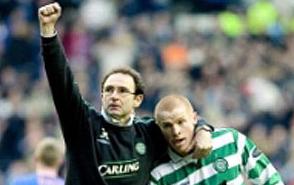 An important incident from this season showed the greatest aspect of Martin O’Neill. This was when at the end of a game v Rangers (link), he took midfielder Neil Lennon over to the Celtic fans and proudly paraded him shoulder-to-shoulder after Lennon was racially & verbally abused for the 90mins by the Rangers fans.
“Neil Lennon, for whatever reasons, suffers dogs abuse at every single away ground and in particular here obviously,” Martin O’Neill said. “He is well thought of by the Celtic fans for what he has done for us over the last four-and-a-half years. It was to show that Neil Lennon is very popular with our fans and I didn’t want anyone to forget that.”
It was more than anyone has ever asked of Martin O’Neill and showed that he was more than a manager, and took the well-being of his players as a priority above all. He cared, and in return the Celtic support cared for him too. See Link.
2004-05
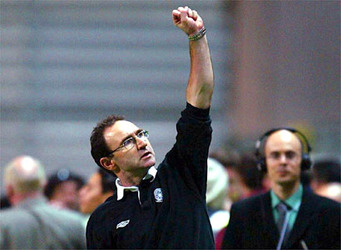 His last season was the most difficult, and in many ways should not be seen in any way as being representative of his reign.
Rumours abounded about his personal family circumstances, and at the year it was made publicly know that his wife was suffering from lymphoma. In effect, he was hardly around and it showed. Didn’t help that this was Celtic’s first season without Larsson (as he’d left for Barcelona), but Celtic really should still have won the league and disturbingly lost with only a few minutes left of the last game of the season, allowing a poor Rangers side to gloat forever more (albeit the title is now tainted and should be scrubbed due to the EBT scandal revelations).
The Champions League run was a big disappointment as Celtic finished bottom of the group for the first time. If results had gone a bit differently in the last round Celtic could have gone 3rd and into the UEFA cup, but there’s a point where Celtic should be thinking beyond that. Didn’t help that Celtic had to face Larsson’s Barcelona in the group stages, and as expected he scored against Celtic at Parkhead (but didn’t celebrate his goal). In any case, the best moment was seeing the First Team go away to Barcelona for the second time in two years and again come away unbeaten, this time with a one each draw. Fabulous, but more of a “What if?” situation.
The football was generally poorer than what the support had become accustomed to (during his tenure) in this last season and Hartson was way overweight, overpaid and over here. Hartson scored a number of goals but was in a really poor state for a professional footballer. Add in that replacing Larsson was never going to be easy, Martin O’Neill did not find a good replacement in Camara. Bringing in Brazilian playmaker Juninho also didn’t work out either, and criticisms resurfaced questioning Martin O’Neill’s ability to handle flare players (resurrecting criticisms some unfairly made of him with respect to Lubo).
If it wasn’t for his family situation, Martin O’Neill likely would have noticed the cracks in the side that the rest of the support could see. The First Team required one or two new players, Petrov was better in the centre than on the wing, the young goalkeeper (David Marshall) was not coping with being first choice and the centre of defence was as slow as any side could get and so on.
Understandably his priority was his family, and with hindsight the club should have managed things differently to work as best as possible in the circumstances but then again who wanted to lose Martin O’Neill? The club tried to accommodate him as best as anyone could.
Regardless, Martin O’Neill’s Celtic career ended on a high as Celtic won the Scottish Cup at the end of the season but it could have been a double winning season. He left the club with all the Celtic support hoping him the very best for the future. The Celtic support was going to miss him. He gave the club its pride back, and he made Celtic the club the support always knew it could be. His human touch was incredible and no player spoke ill of him.
The glory moments are something none of the support will ever forget, and he will forever be a Celtic man first & foremost.
Interim period 2005-2025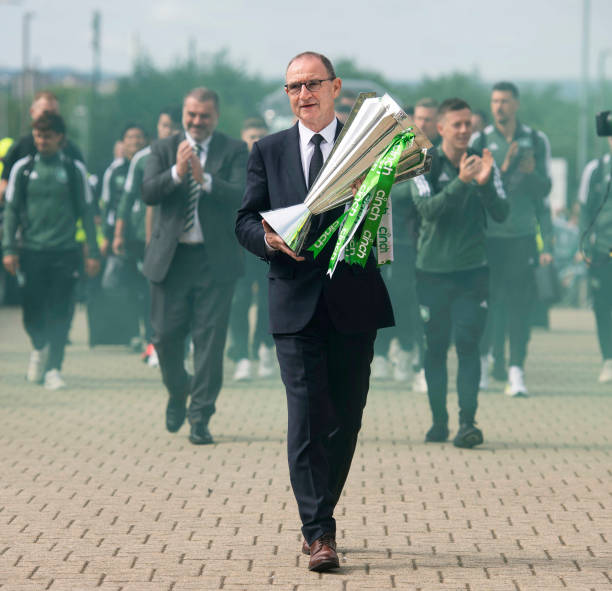
After a period out, Martin O’Neill took on the manager’s role at Aston Villa, with his biggest success being on taking over Petrov from Celtic down to the club. Martin O’Neill’s time at the club was mixed and he left after a few seasons.
In 2013, Martin O’Neill was announced as the Republic of Ireland manager with ex-Celtic player Roy Keane as his assistant. An interesting combination. There was to be added spice for the Celtic fans. If you ever read back to the old match threads, reports and reviews by Celtic fans from the 2000’s, a common argument was “MoN v WGS“, as who was the better manager: Martin O’Neill or Gordon Strachan?
The comparisons were difficult, and the arguments at times nauseating, but in 2014 both Martin O’Neill and Gordon Strachan were drawn to face each other in competitive matches for the Euro 2016 Championships. The first match was actually played at Celtic Park as Hampden was being renovated, and Scotland triumphed 1-0; the return leg was 1-1 with ex-Celt Maloney (who had played under both managers at Celtic) the scorer for Scotland in both games. Nobody was going to truly believe this would settle any old arguments. Time had passed by for the old debaters, and both managers should be respected for their time at Celtic.
Both sides were arguably poor, and Martin O’Neill came out the worse in that the performance demonstrated by that Martin O’Neill’s old methods were now seen as out of date, especially with the poor personnel he had at hand with Ireland. Critics had thought he had lost his fire probably ten years ago and was seeming to now be living off his laurels from his Celtic tenure. However, Martin O’Neill led Ireland through to the last 16 of the Euros (2016) where they lost to France 2-1, beating a second-string Italy side who still should have been too strong for Ireland. A great achievement and showed he still had the making of a good coach but the cracks were showing.
Martin O’Neill almost pulled off a second trick in the World Cup 2018 qualifiers but were thrashed in the second leg play-off matches to Denmark. You can fault Martin O’Neill for this result, but actually Ireland had overachieved as they were going through a lull with their poorest set of players for a few generations. He left the post with ex-Celt Roy Keane in November 2018 as confidence declined in his side.
In 2019, he moved to Nottingham Forrest for the managerial role again along with Roy Keane, but the stint was short, just five months, in what was a no-win situation at a faltering club.
In effect, his time as a manager of a major club was now thought to be over despite his protests to the contrary. Chasing past glories and being a hostage to hope & nostalgia is never a successful plan to manage any side, yet as with everything else he was to buck the trend!
He later wrote his own well-received autobiography, and in 2023 he was given the honour to bring the Scottish League trophy onto the pitch to be presented to Celtic manager Ange Postecoglu on the presentation day at the end of the season.
Interim Manager first stint (Nov-Dec 2025)
In what was a very unexpected situation, as Celtic floundered with havoc across the board from fan protests, humiliating defeats on-field, team mismanagement to boardroom strife, Brendan Rodgers ‘departed’ Celtic as manager in October 2025, to be replaced by Martin O’Neill for an interim period. No-one seemed to be more surprised than Martin O’Neill himself, who said:
“I got a call yesterday, late afternoon or early evening, from Dermot Desmond, asking would I step in because Brendan had resigned from the football club. It was shock news as much as anything else, it shocked me too. He asked me to step into the breach on a short-term deal for them until a manager is appointed. Like everything else, I took a gasp of breath, and thought ‘is this real? Or surreal?’ It’s difficult to turn down the man who gave me the job in the first place 25 years ago. By the time I’d pulled myself off the floor, I thought then maybe I should do it.”
Martin O’Neill (Oct 2025)
For the more dewy-eyed older supporter, this was pure nostalgia, but to the more cynical it was seen as a sop by the underfire board in what was a very strained relationship between both sides. For the younger supporters, it was an introduction to the world of Martin O’Neill who at this point may have been a bit greyer but his mind was still as sharp as ever.
No-one was expecting much and if anything it just allowed for the ‘Celtic Da’s‘ to reminisce. Up front, what was needed was for Martin O’Neill to shore up the squad, revitalise morale and get the team to start playing again.
His first match was a league match v Falkirk which was on paper an easy 4-0 victory, but that underplays the match. Going in having been humiliated & outfought in the last two matches, there were genuine concerns, and the attacking line had a poor return in converting chances. The players looked more comfortable in even just this first game and were more freely playing, albeit Falkirk were the only team even under Rodgers that Celtic had defeated comfortably to date this season.
The big ask was facing an admittedly similarly underfire TheRangers in the League Cup semi-final. TheRangers had fired their manager, appointing Danny Rohl newly in charge, with their performances & results to date even poorer than Celtic’s this season to date. Celtic were to triumph but despite being on top in first half, the second half was anxious even though TheRangers were down to ten men. Celtic came through in extra-time, and Martin O’Neill was jumping as high as he could.
Most notably, some of the key men in this and the last match were players that Rodgers had either sidelined, ignored or overlooked this season, most notably: Engels, Kenny, Osmand and Trusty. Funnily enough, Johnny Kenny – who was finding new form under Martin O’Neill – was only born two weeks after the 2023 UEFA Cup final involving Celtic! For Tierney and Forrest, it was a dream for their fathers to see their sons being managed by Martin O’Neill!
As if to further parallel his first stint as manager, his greatest highs & lows came in Europe. First, his side came unstuck in Europe with a humbling defeat to FC Midtjylland from Denmark, who admittedly were having an excellent campaign, but the fact that this Celtic side could hardly even lay a finger on them with a score that should have been wider, it was quite a humiliation and a flashback to some difficulty times in Europe under Martin O’Neill back in his heyday as manager. This result was not Martin O’Neill’s fault but at least dampened down those few amongst the support who were pushing for him to be given the role to the end of season.
At his age, he was never going to be the appropriate choice for an entire campaign, and this was further demonstrated when a few months later, when John Robertson, his former assistant manager at Celtic, passed away.
However, into the final European competition match, his side faced Feyenoord, a tough ask and many supporters were apathetic, yet again Martin O’Neill was to defy all expectations, a 3-1 away victory, coming from one down after only the first ten minutes. Something special from a side most of us thought were underpar for what was needed. For the older supporters & likely Martin O’Neill himself, it rekindled memories of Martin O’Neill’s key 3-1 in the Netherlands v Ajax. This is a long way from that, but it was great to have a good victory away in Europe with a fine performance. Very proud tonight all.
His final matches were in the league, with two wins v Hibs & Dundee. His stay was extended due to finalising the paperwork for his successor, and it sealed a 100% domestic record. The league gap was eight points when he made his surprise return, and Celtic ended his stint joint top on pts albeit second on goal difference but with a game in hand. His final match was a fitting & emotional evening at Celtic Park, with Martin O’Neill reflecting :
“These players have been absolutely fantastic. It’s been a privilege. I’ve had the time of my life…. To get a reception like that was pretty special… The bottom line is not only have the players done it, they’ve made me feel very young, which I’m not.”
Martin O’Neill
Martin O’Neil’s period as interim manager may have been brief but it was significant. There was a return of morale, with players appearing to feel more comfortable on the pitch as if a weight had been lifted off of their shoulders. If anything, what Martin O’Neill did was just go back to basics. He was never one for modern statistical analysis, but back to basics man management. He gave overlooked players a chance, and some took their opportunities well, repaying the interim manager in kind.
Since taking charge, he had given the support some weeks of nostalgia, magical moments and a breath of fresh air when it was so badly needed. Care, belief and pride were injected back into Celtic Park, with some remarkable marks:
- Knocked Rangers out of the cup,
- Won away in Europe for the first time in 4 years,
- Won more than 3 games in a row for the first time since November 2024,
- Kept a 100% domestic winning record,
- Closed the gap to Hearts to just 2 points with a game in hand [only to see it squandered by his successor!],
- Done all without key players such as CCV, AJ, Jota & Iheanacho, whilst Celtic were hampered by a decimated squad.
A key point was that maybe, as some debated, if players like Kuhn and Kyogo (who had left under Rodgers) would have thrived under the style that Martin O’Neill was playing. It was arguably another dig at the previous manager and/or the board by some critics. A debate for another day.
It was always going to be a bittersweet moment as Martin O’Neill left the role, for what was thought to be for the last time, but even he was to be dumbfounded to be recalled once again very soon.
Interim Manager second stint (Jan – May 2026)
Whilst the first return this season was a surprise, the next move was very much expected as the Nancy managerial reign self-destructed. Ironically, Martin O’Neill had spent longer in his first interim spell than Nancy did in his brief permanent spell. The first team was now in shambles, having lost six out of eight matches since O’Neill had handed over the reins to Nancy. So, O’Neill was likely feeling a sense of déjà vu, being handed a poor squad with the aim of turning them around. But even he was not expecting this spell to be as successful as his first interim stint. Lightning doesn’t strike in the same place twice—or could it?
His first match was a relief, with an incredibly positive and entertaining 4-0 victory over Dundee United. This win helped lift the team’s and supporters’ low morale, as O’Neill put it: “This season has been narrowed down now; we’re well into the second part of the season, so there’s a task ahead for us to try and overcome.”
However, the team quickly came back down to earth in the following league matches. Firstly, a dreadful performance on a dreadful pitch saw a very fortuitous goal saving Celtic’s blushes in a 1-0 victory over Falkirk, further demonstrating the lack of talent in the side. Then came a key away match against Hearts. If any game could be deemed to epitomise the season to date, it was this one. Celtic started well and took the lead before Hearts took control. Celtic reclaimed the lead twice, only to let Hearts steal a point. It was another dropped point that allowed rivals to leapfrog Celtic in the league, and once again, the Celtic support deemed the title challenge over.
Talk had begun to focus on strengthening the squad, with O’Neill repeatedly stating this in interviews. Araujo was already on loan, but if the supporters were hoping for new spending, frustration boiled over when the squad was only supplemented by new loan players: Alex Oxlade-Chamberlain, Cvancara, Adamu, Arthur, and Mvuka. Adding insult to injury, Stephen Welsh was recalled from Motherwell, only to be sent back at the last minute. It was another shambles of a transfer window. The problem was that the injury list was not improving either.
In the UEFA Europa League, a respite from domestic struggles saw Martin O’Neill and Celtic still with a shot at qualifying past the group stages—and a chance for O’Neill to relive old glories. Firstly, Celtic drew 2-2 with Bologna in a topsy-turvy match, riding the emotional rollercoaster that only sport can create. Then, it all came down to the final group match: a home game against Utrecht. You couldn’t have scripted how this match would unfold, as Celtic desperately needed the win to ensure qualification to the knockout stages. The concern was that an out-of-sorts Utrecht, featuring ex-Celtic goalkeeper Barkas, would prove difficult. Yet, Celtic dominated the first half, and an early goal by Nygren settled the nerves. This was soon followed by an own goal from Barkas, putting the game entirely in Celtic’s hands. The match ended 4-2 in Celtic’s favour, securing their place in the next round despite a late fightback from Utrecht.
O’Neill deserved all the credit for this. He had raised morale and made an underpar squad believe in themselves again. However, the knockout stages were a step too far for O’Neill, and any fantasies of rekindling memories of 2003 ended with a whimper after a 4-1 defeat to Stuttgart at home (Feb 2026). This was a humiliating defeat, but it came as little surprise to anyone and further highlighted just how poor Celtic’s squad was at this point. Respect to O’Neill, who came out in defence of Schmeichel after his disastrous performance in the first leg, demonstrating decent man-management to help dampen the fury against the goalkeeper.
O’Neill was never afraid to speak his mind, even when it frustrated sections of the support—most notably when he criticised the fans’ protest at the Stuttgart game, which held up the match for five minutes (with tennis balls and other objects thrown onto the pitch). Some criticised him for it, but many backed him. He stood up for his employers, and fans should respect him for that. However, Celtic incredibly won the return leg 1-0 in what was admittedly a dead rubber. More importantly, it was likely O’Neill’s last ever game on the frontline in Europe, but what a wonderful way for him to end it—by creating history with a 1-0 win in Germany, Celtic’s first victory in UEFA competitions in Germany.
Another incredible landmark achievement on a personal level was when he was inducted into the League Managers Association Hall of Fame 1000 Club after taking charge in one of the matches against Stuttgart. It just added further to what a special person Celtic had currently under their charge.
Back to the domestic setup, and Celtic just seemed to grind out results (mostly unconvincingly), but with late, late winners. It just kept on happening, but it wasn’t good for the heart (least of all for the aged Martin O’Neill). When Celtic went behind, it just seemed to be another match signalling the end for the league campaign challenge—only for an incredible twist in the tale. The most notable of these was a 3-2 away win v Kilmarnock, with Araujo scoring the winner! It has to be said that Araujo was a blessing for Martin O’Neill, and the only unarguable successful loanee from the January transfer spell.
Celtic were living off their luck a little, reflected by three last-minute winners in three domestic matches, but it had dragged Celtic back into contention for the league title challenge. Some were hubristically deeming Celtic as favourites—only to then come crashing back to earth with a 2-1 defeat to Hibs at Celtic Park after a very inept display. Some dubious VAR decision-making didn’t help, but really that couldn’t overshadow a lacklustre performance. On the other hand, it proved the difference that Martin O’Neill was making, embedding a play-to-the-whistle and fight-for-the-team mentality.
The real hard challenge was now at hand, with Celtic facing four away games in two weeks: twice v Rangers (once in the Scottish Cup), Stuttgart away, and Aberdeen in a rearranged league match. Despite the lack of confidence from many commentators in Celtic’s chances, incredibly Martin O’Neill managed four away wins for Celtic in what one forum described as Celtic’s Event Horizon for the season! It was truly unimaginable.
The key issue remained squad issues. Injuries were stacking up, and as each game finished, there were further concerns. In time, Araujo ended up out, Johnston was delayed in his return, whilst Jota and Carter-Vickers were ruled out till next season. The new arrivals were proving to be no better than what was already at hand, and actually players like Adamu and Mvuka were left out after only scant appearances. Alex Oxlade-Chamberlain was probably the highest-profile transferee, but age and lack of match time in recent seasons had blunted his talent. All could appreciate his pedigree in the game and his good start at Celtic, but even Martin O’Neill likely expected this experienced player to do far more than he had done to date. He needed to take some authority in games. Seemed to be anonymous too often.
Celtic hit the wall with a massive thud in a 2-0 away defeat to Dundee Utd (Mar 2026) in a dismal display that set every expectation back, pushing Celtic back to third, and really once again demonstrated the lack of talent in the squad. With Araujo out injured for the rest of the season, Martin O’Neill must have thought that Celtic were cursed with the long injury list. Further, despite Hearts also beginning to slip, the real momentum was with Sevco.
Worst was that Celtic had by far the poorest goal difference, and really Celtic had no real recognised reliable goal scorer. It just didn’t help matters, and some players really needed to step up. The supporters were praying for a swift return for players like Engels and Johnston, but as with Johnston earlier, when he was rushed back into the first team, it led to a greater injury and time out. Martin O’Neill had to rotate teams every week due to the number of games but also due to the injury crisis, adding an issue of team selection consistency.
One prime example of Martin O’Neill’s difficulty at Celtic was the goalkeeping situation. Kasper Schmeichel was clearly not fully fit and had been carrying an injury for too long. Yet he carried on the same error by continuing to play him rather than using Sinisalo or looking to bring in someone new. It cost Celtic dearly, and only belatedly did Sinisalo get the no. 1 jersey. Martin O’Neill defended Schmeichel, and even played him after what should have been his final appearance, 4-1 defeat to Stuttgart (Feb 2026), and this was testing for Martin O’Neill. On the one hand, as a manager, it was decent man-management to help pick Schmeichel up and play him in the following match and defend him, but on the other hand, it irked many in the support, as all could see he needed dropping, and playing him was a risk too far.
To the split, Martin O’Neill’s side dragged themselves by the margins with a 1-0 and 2-1 win v Dundee and St Mirren, to keep in touch, but neither were convincing victories. If anything, the side were struggling to win in matches that Celtic should have been looking to win at a canter. St Mirren in particular had rapidly declined in the season, yet were cutting up the Celtic side with ease at points in the match.
When you look back at the post-match split, it is incredible to believe how low the general expectations were. Despite the tight race for the title, Rangers had the momentum and placed just 1pt behind Hearts with a superior goal difference; they were the bookies’ favourite. Their manager was responding bullishly, stating publicly that the next five games were cup finals for them to win the title. Hearts had their nose in front on 70pts, 1pt above Rangers, so were well in the hunt, but were expected to dip at one point or another—albeit they’d dumbfounded all those expectations to date. Celtic were third, 3pts behind Hearts, but with far inferior goal difference to either. Add in no real reliable strike force at this moment, there was no confidence that Celtic could catch up on that front, but they were still in with a shout for the title.
Martin O’Neill, therefore, was in probably his toughest spell at Celtic. One benefit, though, was the return to a more reasonable squad with Iheanacho, Johnston, and Engels back from long injury spells, and the first team was mostly picking itself now as various loanees were now sidelined, having not proven their worth. Cvancara was to leave prematurely due to injury, compounding the striker problem.
For Martin O’Neill, this would test, undeniably, his man-management and motivational skills to the fore, but that was asking a lot. Practically every serious commentator dismissed outright Celtic’s chances (including ex-Celt Chris Sutton, who was never shy of voicing his opinion). Respected journalist Graham Spiers even stated that he felt that Celtic were possibly the weakest side out of the top four, so fourth place was not out of the question. It didn’t help that the schedule was set with the three hardest matches to be played in seven days at the end of the season; therefore, it was asking a lot of the coaching staff and team, and in truth, luck was needed…
…and incredibly, luck was to come Celtic’s way in a way that could little have been scripted.
The first two rounds of matches saw Celtic defeat Falkirk (3-1) and Hibernian (2-1), the positives being the victories but also finally scoring a number of goals. The return to form of Maeda was a big boost, as the first team really missed his efforts, but also Iheanacho grabbed the winner v Hibernian after the opposition had grabbed an equaliser. The Hibs fans might have wanted a Celtic victory to stop Hearts, but their players—with all respect to them—were professional on-field. We could not expect or demand any favours. Celtic had to win every point on their own merits. Martin O’Neill echoed what many were thinking after the Falkirk game:
“We’ve got flaws like anybody else, but you can’t dispute the character of the team. We have to battle for everything. There were times today when we pressed strongly, we were great.”
The real bonus was the welcome but very much surprise defeats for Rangers by Motherwell and Hearts; it pulled the Ibrox side down and gave Martin O’Neill breathing room in his challenge, albeit to the credit of Hearts, they kept winning, maintaining the gap to Celtic at least.
The real challenge, though, was the final week: playing Rangers at Celtic Park, a resurgent and well-managed Motherwell away, before the potential title decider v Hearts at Celtic Park.
The match v Rangers was dubbed as “The Battle for Second Place” at the time, and actually, it was not a dead rubber game for Rangers, as second place was vital to win the coveted second Champions League qualifiers spot. Once again coming from behind, after losing an early goal, Celtic went on to command the match, with an incredible overhead kick by Maeda sealing a Celtic win within a point of the league. For Martin O’Neill, there were double celebrations, as it meant he was undefeated v Rangers all season in his matches in charge, and many started to debate the Maeda goal on a par with that of the famous Larsson chip goal from his first season in charge from the 6-2 ‘Demolition Derby’. Desire and determination had gotten Celtic over the line in the second half, after an indifferent first half. It was testament to the man-management skills of Martin O’Neill.
The night before, Hearts had dropped two points to Motherwell, claiming VAR should have awarded them a penalty, but that was dismissed after post-match analysis. For Martin O’Neill, it now meant that he could truly dream of potentially lifting the league title, despite not having led the league table since the first week.
However, surprising as it may sound in retrospect, many had actually pinpointed the Motherwell game as the key toughest match, as firstly it was away and Motherwell had more than punched their weight over the season. An unbelievably stressful evening that you would not believe. Celtic needed to win to keep their title hopes alive, but Motherwell took the lead and everyone at Celtic was deflated. A Maeda goal dragged Celtic back into the reckoning, but it took a VAR-awarded penalty in the 97th minute to take the points. It took nerves of steel for Iheanacho to take the penalty and score! The support was in raptures. The penalty was much disputed, but clearly the Motherwell player had elbowed Trusty; his hand was above his head and he handled the ball!
Hearts won their game convincingly, so had a very comfortable advantage over Celtic in goal difference; so effectively, it was a situation that Celtic had to win to take the league title—anything less would hand the title to Hearts. Martin O’Neill had some heavy, stressful matches in his career, but this was surely up there with the toughest.
The title decider was do-or-die, and Martin O’Neill stuck by his main charges for this match. The support was out in force but nervous, and that was reflected on-field as a sub-par first half helped Hearts take the lead from a corner kick. A get-out-of-jail card with Celtic equalising from a penalty after a bit of idiocy by a Hearts player—but really more was needed.
Martin O’Neill duly delivered. He made key, notable substitutions over the second half which helped to tip the balance on-field, with Iheanacho on at half-time, Sarrachi and Osmand brought on later. Celtic even went down to a risky back three to chase for the win, but it was a case of win or bust! Iheanacho and Nygren had notable chances which went close, and everyone was on the edge of their seats.
Then, incredibly, with only three minutes left in normal time, Maeda scored—but it was initially ruled out for offside, followed by an anxious wait for VAR to overrule the erroneous decision. If ever a moment proved VAR was necessary and must remain, then it was this one! The drama wasn’t over, with Hearts gifted a late free-kick to try to steal a goal with the final kick, but a lame effort returned the gift to the Celtic front line players, who ran with the ball to the other end to score a clinching 3-1 victory. Miraculously, Martin O’Neill had led Celtic to one of their most improbable league titles ever!
The entire support was emotional, and a ‘pitch invasion’ by a number of fans was a bit premature, but post-match analysis proved that the final whistle had been blown with the Hearts manager agreeing to end the match.
If anyone disputes how incredible and fairy-tale this league title achievement was, then well, this is a summary set of challenges that Martin O’Neill had to overcome:
- Decimated squad from injuries to so many
- Failed transfer windows
- Four managerial spells
- Worst manager in club’s history
- Aged manager who plenty had argued was out of date for the current environment
- Forecast to end up 4th at one point by commentators (including the respected Graham Spiers), with all commentators dismissing Celtic’s chances of a title win
- Partisan media coverage, across-the-board media backing Hearts for the title!
- Third behind top two on points and goal difference at the split
- Lost League Cup final
- Played most games this season, further exhausting an over-stretched squad
- No real strike force
- First-choice goalkeeper played with an injury
- Only early in the season were Celtic top of the league until the very, very end!
- Section of fans banned for long duration (Green Brigade), denting the atmosphere at the ground
- Off-field protests and turmoil across the club
- Scheduled to play the toughest three opponents in seven days at the end
- Had to win all post-split games to have a chance to win the title (never done before)
To add to this, Celtic were incredibly to end up on course for a League & Scottish Cup double!
The Scottish Cup run like the league run was stressful, with an extra-time winner v Dundee by the unlikely source of Mvuka, followed by a tough away quarter-final v TheRangers at Ibrox. A goalless match mostly dominated by the home side left the support on tenterhooks, but the tension was punctuated by two goals ruled out by VAR (one for each side). So it was onto penalty kicks, and Celtic incredibly triumphed, with the celebrations sadly marred by some post-match pitch invasions, Celtic fans in celebration, the Sevco fans coming on mostly to start a rampage! If that wasn’t enough drama, then Celtic were pulled back from a two goal lead v St Mirren in the semi-finals to 2-2, so extra-time. Incredibly, the players then found their shooting boots 6-2! For a side struggling for goals much of the season, this was a welcome surprise.
The final was surprisingly the least stressful match of the season! Martin O’Neill managing Celtic for what was expected to be his last ever match in the senior game; but some reports/online rumours already claimed he may be given another season. The opposition manager for Dunfermline was ex-Celtic manager & player Neil Lennon with whom MoN has an almost symbiotic relationship. A relatively straightforward 3-1 victory started off all the celebrations! The most improbable double in Scottish football history!
Martin O’Neill was simply the architect, the strategist and genius behind this incredible achievement. It really showed up the demeaning “Honda Civic” remark by his predecessor describing the poor state of the squad. Admittedly, it was a common remark that this was the poorest Celtic squad since the early 1990s, but still under Martin O’Neill had achieved qualification out of the group stages in Europe, a league & Scottish Cup double and rejuvenated the careers of many players. He had an old-school management style and it demonstrated that the obsession with football statistics like xG was over-stressed. Not to deny its value but the pendulum had swung too far in its favour and had to come back now.
Permanent Manager (3rd stint)
Season 2026/27
[…]
Martin O’Neill and his Legal background
One theory that has been spun about Martin O’Neill on why he was such a good manager is because he was an avid legal eagle, having done a law degree and that it was in the family and so on. There is some truth in it but it has been way over-blown.
After leaving school, Martin O’Neill began a law degree at Queen’s University in Belfast but left after around a year in order to pursue a career as a footballer (so hardly qualifies him as a lawyer in any shape or form, or anything legal really).
Nevertheless, he has been known to have a keen fascination for legal stories, and has remained an avid follower of criminology, having attended some of Britain’s most infamous trials including that of the Yorkshire Ripper. His fascination apparently began with the James Hanratty case of 1961, and he has been said to take his family on legal trail hunts for his personal interest.
You can take from this what you like on its influence on his managerial ability.
Honours with Celtic
Domestic Treble (League, Scottish Cup, League Cup)
UEFA Cup runners-up
Scottish Cup
Scottish Premier League
Scottish League Cup
Managerial Awards (in Scotland)
SPL Manager of the Month (9):
- August 2000,
- December 2000,
- February 2001,
- August 2001,
- April 2002,
- November 2002,
- October 2003,
- November 2003,
- January 2005
SPL Manager of the Year (1):
- 2003-04
SFWA Manager of the Year (3):
- 2000-01, 2001-02, 2003-04
Managerial Record
| Team |
From | To |
Record | ||||
| Games | W |
D |
L |
Win % | |||
| Celtic | 01 Jun 1 2000 | 31 May 2005 | 282 | 213 | 29 | 40 | 75.5 |
| Celtic | 27 Oct 2025 | 03 Dec 2025 | 8 | 7 | 0 | 1 | 87.5 |
| Celtic | 05 Jan 2026 | 05 Jun 2026 | 27 | 21 | 3 | 3 | 77.8 |
| Celtic | 05 Jun 2026 | […] |
| P | W | D | L | F | A | GD | |
| 1st Stint | |||||||
| League | 190 | 156 | 19 | 15 | 472 | 133 | 339 |
| League Cup | 15 | 10 | 1 | 4 | 47 | 15 | 32 |
| Scottish Cup | 24 | 21 | 1 | 2 | 62 | 13 | 49 |
| Domestic Total | 229 | 187 | 21 | 21 | 581 | 161 | 420 |
| Europe | 53 | 26 | 8 | 19 | 85 | 55 | 30 |
| Total | 282 | 213 | 29 | 40 | 666 | 215 | 450 |
| 2nd Stint (interim) | |||||||
| League | 5 | 5 | 0 | 0 | 12 | 1 | 11 |
| League Cup | 1 | 1 | 0 | 0 | 3 | 1 | 2 |
| Scottish Cup | 0 | 0 | 0 | 0 | 0 | 0 | 0 |
| Domestic Total | 6 | 6 | 0 | 0 | 15 | 2 | 13 |
| Europe | 2 | 1 | 0 | 1 | 4 | 4 | 0 |
| Total | 8 | 7 | 0 | 1 | 19 | 6 | 13 |
| 3rd Stint (interim era) | |||||||
| League | 18 | 14 | 2 | 2 | 39 | 20 | 19 |
| League Cup | 0 | 0 | 0 | 0 | 0 | 0 | 0 |
| Scottish Cup | 5 | 5 | 0 | 0 | 17 | 4 | 13 |
| Domestic Total | 23 | 19 | 2 | 2 | 46 | 24 | 42 |
| Europe | 4 | 2 | 1 | 1 | 8 | 8 | 0 |
| Total | 27 | 21 | 3 | 3 | 54 | 32 | 42 |
| 3rd Stint (perm era) | |||||||
| League | |||||||
| League Cup | |||||||
| Scottish Cup | |||||||
| Domestic Total | |||||||
| Europe | |||||||
| Total | |||||||
Pictures
- Picture Gallery – Manager
- Pictures Gallery – Interim Manager spells (2025/26)
- Pictures Gallery – Permanent Manager spell (2026 on)
Videos
Books
- The Biography (2007)
- The Martin O’Neill Story (2001)
- Martin O’Neill (2010)
- Martin O’Neill: On Days Like These (2022)
Articles
Links
Timeline
- 1952: Born Kilrea, Northern Ireland, March 1.
- 1971: Makes international debut as a substitute against USSR. Joins Nottingham Forest from Distillery in October.
- 1978: Member of Nottingham Forest’s league and League Cup double-winning side.
- 1979: Wins a second League Cup winner’s medal as Forest retain trophy with 3-2 victory over Southampton.
- 1980: Wins European Cup winner’s medal as Forest beat German champions Hamburg 1-0 in Madrid.
- 1981: After 285 league appearances for Forest, with 48 goals, joins Norwich in February for the first of two spells as a player at Carrow Road. After 11 league appearances (one goal), transfers to Manchester City.
- 1982: Returns to Norwich in January after playing just 13 league games for City.
- 1983: Returns to Nottingham in August, joining Notts County.
- 1984: Wins last of 64 international caps in 2-1 win over Finland.
- 1987 First steps into management with Grantham Town
- 1989 Becomes manager of Shepshed Charterhouse.
- 1990: Appointed manager of non-league Wycombe Wanderers.
- 1991: Guides Wycombe to FA Trophy glory.
- 1993: Wycombe win GM Vauxhall Conference title to achieve promotion to the Football League and clinch another FA Trophy success.
- 1994: Claims promotion from division three at the first attempt.
- 1994: Rejects approaches by Leicester and Nottingham Forest to become their manager.
- 1995: Becomes manager of Norwich in June.
- 1995: Resigns on December 17 after a series of clashes with chairman Robert Chase over money for team-building. Appointed manager of Leicester on December 21.
- 1996: Leicester beat Crystal Palace 2-1 at Wembley in the first division play-off final, winning promotion back to the Premiership at first attempt.
- 1997: Won Coca-Cola Cup final, beating Middlesbrough in a replay at Hillsborough to clinch a place in Europe for the first time in 35 years.
- 1998: Finished tenth in Premiership, but O’Neill frequently voiced concern over lack of funds. Linked with vacant managerial post at Leeds following George Graham’s move to Tottenham Hotspur but elects to remain at Filbert Street.
- 1999: Leads Leicester to Worthington Cup final, where they are beaten by Tottenham.
- 1999 March – O’Neill’s long-term future remains unresolved after the club denied reports he is set to sign new contract.
- 1999 June – Ends months of speculation and commits himself to Leicester until 2002.
- 1999 September – O’Neill gives his support to club chairman John Elsom in the wake of the Filbert Street power struggle.
- 1999 December – Angrily dismisses reports he is on the verge of quitting Leicester for a bigger club. Rules himself out of Everton job.
- 2000, January: Rules himself out of contention for the role as Northern Ireland manager.
- 2000 February – In quiet he is approached by Dermot Desmond and sounded out about becoming Manager at Celtic. Rejects offer. Leads Leicester to their third Worthington Cup final in four years after a 1-0 aggregate win over Aston Villa in the semi-finals.
- 2000 February 27; Leads Leicester to another Worthington Cup win when they defeat Tranmere 2-1.
- 2000 May – Leicester finish eighth in the Premiership, their highest placing, and qualify for the UEFA Cup.
- 2000 June – Celtic Chairman Dermot Desmond approaches him again and offer is accepted
- 2001 March: Wins first trophy in Scotland with a 3-0 CIS Insurance Cup final victory over Kilmarnock. April: Celtic win Scottish Premier League title. May: Beat Hibernian 3-0 to win Scottish Cup final and complete a domestic treble. August: Celtic book their place in the Champions League group stages by beating Ajax 3-2 on aggregate.
- 2002 April: Celtic secure the Scottish Premier League title. May: Celtic are beaten in the Scottish Cup final by Rangers.
- 2003 January: Signs new 12-month rolling contract. March: Celtic beaten 2-1 by Rangers in CIS Cup final. May: Celtic lose 3-2 in extra-time to Porto in the Uefa Cup final in Seville. Celtic lose SPL title to Rangers on thrilling final day.
- 2004 April: Regains SPL title with six games to spare. May: Earns second double in four years with 3-1 win over Dunfermline in Scottish Cup final. July: Delays arrival in America for pre-season trip to care for his sick wife, Geraldine.
- 2005 22 May: Celtic lose 2-1 at Motherwell and O’Neill’s hopes of a fourth title in five years disappear as Rangers win 1-0 at Hibernian. 25May: Club announce O’Neill will step down after Scottish Cup final to look after his wife. 28May: Ends career at Celtic with 1-0 win over Dundee United in Scottish Cup final.
- 2006 July: Appointed manager of Aston Villa.
- 2009 May: Villa finish sixth again, a run of nine games without a win costing them Champions League place. August: Fails to take Villa into the group stages of the Europa League as Rapid Vienna progress on away goals.
- 2010 February: Reaches his first final with Villa, in the Carling Cup against Manchester United, but they lose 2-1. 10April: Villa lose 3-0 to Chelsea in the FA Cup semi-final. May: Villa finish sixth for a third successive year. 9August: Villa announce O’Neill has resigned as manager with immediate effect.
- 2013 – Becomes Ireland manager with ex-Celt Roy Keane as his assistance.
- 2016 – Takes Ireland thru to Euro 2016.
- 2018 – Resigned from role as Ireland manager as results decline.
- 2019 – Takes on role as manager of Notts Forrest, but leaves after only five months.
- 2025 – Returns to Celtic as interim manager for short spell (Nov-Dec 2025).
- 2026 – Returns once again to Celtic as interim manager for another spell (Jan – May 2026), wins the league & Scottish Cup double against all the odds.
- 2026 – Takes up the managerial role on permanent basis in June 2026.
- […]