M | Player Pics, part 2 | A-Z of Players | Coaching Staff
Person
Fullname: Daniel Fergus McGrain
aka; Danny McGrain, Danny Bhoy
Born: 1 May 1950
Birthplace: Finnieston, Scotland
Signed: 13 May 1967
Left: 12 May 1987
Position: Defence: Right Back/Full Back
First game : Dundee United away 2-2 league cup 15 August 1970
Last game : Hearts away 0-1 league 9 May 1987
First goal : Clyde home 5-0 league 8 September 1973
Last goal : Kilmarnock away 5-0 league 30 April 1983
Internationals: Scotland
International caps: 62
International Goals: 0
| “Anybody who saw him at his best had the unmistakeable impression of watching a great player, probably one who had no superior anywhere in the world.” Esteemed sports journalist Hugh McIlvanney on Danny McGrain |
Biog 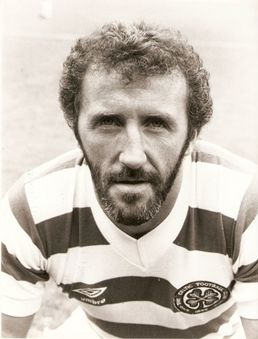
There are many great players in the club’s history, and there are few other more recognisable (due to his bushy beard) or fondly remembered than the great Danny McGrain. His name is said with as much reverence now as when he played.
A great stalwart in the Celtic sides of the 1970’s, he was a truly world class player, whom the support are fortunate to be able to say that he was a Celt. Yet it wasn’t meant to be like this. Danny McGrain was actually brought up a bluenose and was a self-confessed died-in-the-wool Rangers supporter in his youth. How did he end up then with Celtic? It’s a bitter story which he has himself recounted endlessly and detailed in his biographies. A Rangers’ scout is said to have visited his junior club to see or sign him, only to then turn around on hearing his surname in the mistaken belief that Danny McGrain was of Irish Catholic descent [not that it should have mattered].
Bigotry reared its head, and disgracefully cost a good man (wrongly) to not be allowed to join his boyhood club. If ever there was a point that the Hun’s sectarianism policies paid off for us, then it was here. Celtic has always been an ecumenical club, and Celtic signed Danny McGrain on the basis of his football alone [as per Willie Maley’s famous quote]. For that the Celtic support can be forever grateful to Rangers in mistakenly & wrongly passing him over. Although note, in some later interviews Danny McGrain did question the story in later years (he had related it previously in two biographies), as hadn’t received any confirmation from an official source that Rangers had scouted him at one time.
Danny McGrain signed for us on 13th May 1967, just a couple of weeks before the European Cup win, and for him it was a case of looking on to see what he could become a part of. Little did the Lisbon Lions know as they were celebrating their win that already within Celtic was a player [Danny McGrain] who would soon be snapping at their heels.
His main position was as right-back but he was able to easily flit between the right-back and the left-back positions, or centre-half if and when needed. He may have been an affable gentleman off the pitch, but on the pitch he was an unforgiving tackler. Built out of granite, he never shirked a tackle and every opposing player knew his presence on the pitch; “a real cruel tackler” as Billy McNeill described him.
Another great facet of his game was his pace. A speedy player, it was like as if a rhino was charging up the field with the ball for crossing and passing. Any weaknesses? He was too tough for any of that, but admittedly he has said himself that he wasn’t an attacking penalty box player and goal scoring wasn’t his forte, feeling a bit out of place away from the defence.
Regardless, consistent and level headed, he managed to more than make himself known to all, and his reputation was international. He truly was world class, and many commentators from the 1970’s have said that he was the best in the world in his position. A great accolade. Celtic fans always knew about his ability, and in a poll to find out Celtic’s greatest XI, McGrain easily found a place in this alongside Jinky, McNeill and Larsson.
He was also a member of the lauded “Quality Street” gang of players, which included Dalglish, Hay, Connelly and Macari amongst others. Of the group of players, only Connelly was more highly regarded, which is some feat, and in many people’s eyes he was held in the same stature as Dalglish. Kenny Dalglish though was a forward with all the glory and attention that comes with scoring goals; Danny McGrain was a solid defender, and that is why attention is usually centred more on Dalglish than McGrain.
Must add a point on his great sportsmanship. For such a solid unforgiving player on the pitch, he actually had a heart of gold and was not unknown to ask after his opposing player after a game [likely to make sure he hadn’t damaged them].
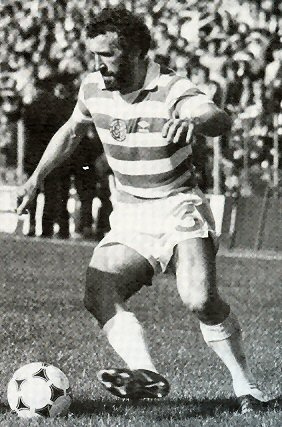 It wasn’t all plain sailing, and in 1974 Danny McGrain was diagnosed with diabetes, which can hinder many a person’s life never mind a sporting career. However, he didn’t let that put him down and worked around it, and he became a role model for others who had to live with the condition. You wouldn’t have believed he actually had any such issues.
Along the way there was also a fractured jaw (1972) which lost him time at the peak of his career, but more seriously he also suffered a mystery ankle injury after what some thought was an innocuous challenge in a league match (1977) which ended up laying him out from first team action for 16 months.
Thankfully for himself and his career he recovered to return to join the side. All were relieved for him and the attachment the support had for Danny was immense. Amazingly, he returned as strong as ever but sadly with less pace as time caught up with him. Didn’t hinder him as he captained the side to the league title culminating in the magnificent “Ten men who won the league” match against Rangers in 1979.
In his career at Celtic, Danny McGrain amassed a grand haul of trophies, medals and memories. He was deserving of each and every one of them. McGrain stayed at the club till 1987, a phenomenally long time for any footballer to stay at a single club. Whilst the other great players in the Quality Street gang had left to make a go in England, McGrain was not interested and for a man who had grown up in the blue corner of Glasgow, he had come to fall in love with Celtic and was as steeped in the history of the green as any man on the terracing. His ego was non-existent, and all was secondary to the benefit of the club. A great man deserving of all accolades that come his way.
Sadly, it didn’t end amicably between Celtic and McGrain. On his retirement, he was hoping for a position amongst the coaching staff with Celtic but an agreement did not materialise between the board and him, and Danny McGrain walked out and not to return for around three years. It was a sad indictment of the old board’s management that they couldn’t handle this situation with Danny McGrain, his talent and experience would have been invaluable with the youths.
Thankfully, the torn relationship was repaired, and McGrain came back in later years and worked again for Celtic as a reserve team coach. His influence and persona are simply priceless.
One of the true greats of all football.
Internationals
One of the great breakthroughs for Celtic with respect to Danny McGrain, which is little commented on, was in the international game. Up until Danny McGrain, many Celtic players over the previous 50 years had been paid lip service, with many great Celtic players (such as Jimmy Johnstone) earning only a fraction of the number of caps they otherwise should have earned, all due to the partisan nature of Scottish football. The Lisbon Lions were pitifully treated by the committees who picked the squads. Danny McGrain though was a player that couldn’t be overlooked (or messed with), and in doing so became a stalwart in the Scottish national side during a time when they had some degree of respectability (excluding Argentina 1978).
Internationals gave Danny the opportunity to further test his abilities at another level, and many Celtic supporters who had been indifferent to the national side began to turn and support the national team when they saw he was playing.
In all, Danny McGrain managed to gain 62 caps for Scotland, and captained the national side 10 times which included the 1-0 victory over England in 1981 at Wembley and captaining Scotland in the 1982 World Cup campaign. Danny McGrain ended up winning a then record number of caps for a player playing in Scotland (it was Dalglish who ended up taking his place with more caps). It was for the time a great leap for Celtic and the players.
Thankfully, injury caused him to miss the calamity that was the World Cup in Argentina (1978). On the other hand, if he was there maybe things potentially could have turned out differently and in Scotland’s favour. Who knows, but with someone like him present things could have only been better not worse.
Notable bits of trivia:
- 1) In the early 1980’s the whole Scotland team on the pitch were playing for English Clubs, with one exception: Danny McGrain,
- 2) Danny McGrain played five times for Scotland in World Cup final games and never lost one.
Post-Celtic & club management
He managed Hamilton and Arbroath after leaving Celtic, including being manager of Arbroath as Celtic skelped them big time. It never worked out for him at managerial level, and journalist Glenn Gibbons told a tale in one of his columns possibly illustrating why. On the first training session with Hamilton, Danny McGrain told the players in his strong Glaswegian brogue: “The reason why you are all here, is cause you’re all no good enough!” Hardly going to win ‘Coach of the Year’ awards for that comment, but it was more due to that great players are sometimes way too ahead of average players and can’t work at their level. Hamilton are a small club, Danny was an international institution.
He likely didn’t realise what he was really saying to them. A bit funny in some ways in reflection.
However, in later years he was as active as ever being a senior coach with the Celtic Development Squad (reserve sides), and at the age of 62 he was promoted to the Celtic first team coach position (vacated by Alan Thompson) to assist manager Neil Lennon and assistant manager Johan Mjallby.
Celtic manager Brendan Rodgers put Danny McGrain in an embarrassing situation, with a bit of manipulation of the Celtic support which was proven to be fabricated but had us all applauding at the time. Recalling a conversation, Rodgers in front of a large audience with Danny McGrain in attendance, Danny had asked about his position at Celtic, with Rodgers responding in kind as below:
McGrain:”And he said: ‘listen, I just want to know if you still want me?’.
Rodgers: “I said: ‘as long as I’m here, you’re here!’.”
In 2026, his family announced that Danny McGrain had been diagnosed with Alzheimer’s disease.
[….]
Quotes And Tributes
“My mentor was Danny McGrain—he looked after me like a father figure. Like plenty other young Celtic players you would get caught up in the emotions of Irish history and the rebellious nature. The Rangers boys I grew up with from the barracks [in Maryhill] went through that too. We didn’t do it in front of each other—some of the songs would attract a glance of the eye from a player like Danny as if to say ‘why are you singing that?’ It was funny but there was a point of principle, we understood and respected that it wasn’t for them.
Danny used to pick me up because I wasn’t old enough to drive. From Monday to Friday he would fit in at least three hospital visits or supporter functions. After training he would ask me what I was doing. My response was not a lot. He’d say, ‘ok, we’re going on a hospital visit, this guy’s lost a leg in an accident.’
“We would turn up and you’d see someone for an hour. I’ll tell you, it’s not easy when you walk into a situation like that but Danny would be straight over to talk to the patient, answer any questions about himself and the fabric of the club. I would sit there and listen to him and eventually you would pick up what Celtic really and truly was about.
“In those moments you would come outside and feel cleansed for just going in and saying hello to someone. When I close my eyes and think about what Celtic is, I think of Danny. I can see the statues of Jock, Billy, Jimmy and Brother Walfrid but I also think Danny has had a hand in those values in terms of his teaching and the ambassadorial role he has played at the club.
“Danny McGrain had it all and a true understanding of everything: that’s why he’s still there to this day.”
Charlie Nicholas on Danny McGrain (2017)
“If you’re scared of anybody then you shouldn’t be involved in football.”
Danny McGrain
“One major change over past 20yrs is that the full-back has almost become an extinct position. We’ll soon be as extinct as dinosaurs.”
Danny McGrain on full-backs (he was proved to be very wrong) (1987)
Early Celtic Memories
McGrain cannot recall his precise Celtic debut, but he remembers an early first team experience in August 1970 when he replaced Harry Hood in a League Cup tie against Dundee United at Tannadice.
He revealed: “I came on for Harry at half-time and Bobby Murdoch played a pass to give me an early touch to calm any nerves. But I allowed the ball to run under my foot and it went out for a throw-in.
“But, thankfully, Bobby didn’t give me a hard time. He could see I was nervous and told me it was OK. His encouragement boosted my confidence.”
In July 1967, when, together with Kenny Dalglish, his great friend, he dared to ask Stein if they could go full-time at the club. The pair were miserable as respectively a trainee mechanical engineer and an apprentice joiner. “Football was the easy option. Kenny and I thought the real world was too hard.”
McGrain and Kenny Dalglish, two of the most outstanding members of Celtic’s “Quality Street” gang, had accompanied the squad to Milan for the European Cup final against Feyenoord as kit boys.
Danny on The Manager
“Mr Stein was an imposing figure. I was in awe when I first met Mr Stein, and I thought I was all through my playing career.
“He meant something to every player. Whether or not they liked him as a person he was loved for what he did for their careers.
“How big an influence was he? How long is a piece of string? He was a nice man. A nice, nice man. You don’t remember the things your dad did to you that were bad. You remember the nice things like Christmas or your birthday. Maybe Mr Stein could give you stick, but it was forgotten outside the dressing room. He taught me so much. He hurried things up for me.”
McGrain had been signed from Queen’s Park Strollers on the recommendation of Jock Stein’s assistant, Sean Fallon.
“But it was Sean who wanted to sign me and Kenny and I owe him a lot. To this day whenever I meet Sean I want to thank him.”
Commenting on the 4-2 game
“At the start of the season it looked as if I didn’t have a football future. I suffered an ankle injury which kept me out of the World Cup and I was told I wouldn’t play again. Now I was the skipper of the title winners; it was some turn-around.”
Best Moment With Celtic
It’s difficult to pick one moment from all that time, but beating St Mirren 5-0 at Love Street to win the championship in 1986 was a great moment.
Worst
When Mr Stein left, he was missed around the club and there was a void left by his absence.
Favourite Away Ground
I loved the whole atmosphere and the love/hate thing at Ibrox. There was more blood and thunder in those days, but that was more acceptable then.
Favourite Goal Scored
Mine were quite forgettable. My biggest was probably against Partick Thistle in the Glasgow Cup, when I scored the winner to take us to the final!
“My bottle just went in the box. I just couldn’t score.”
Discipline
McGrain, despite the ferocity of his talking, was not a dirty player. He received only one red card in his career of 650 games for Celtic and 62 for Scotland. It came against Aberdeen at Celtic Park on October 9, 1982, for two fouls on Peter Weir. The second was worthy of a yellow card, the first was not. “I was late for the second one, unfortunately I only realised that when I was in mid-air. It’s always like that when you are late.”
Tackling is a “lost art”
“You can’t tackle now and I do see more young guys copying professional players by feigning injury. We used to laugh at the Italians for doing it, now we copy them.”
“My tackling was good because my timing was good. Okay, not every tackle was inch-perfect, but I never went in to hurt anybody.”
Injuries and Illness
He sustained a fractured skull after a clash with Doug Somner at Brockville on March 25, 1972, and then there was the discovery that he suffered from diabetes after the 1974 World Cup.
“The fracture wasn’t that severe,” says McGrain, touching his forehead. “Wee Louie (Macari) didn’t want to go on because it was a cold day at Brockville, but I said I felt okay and then I collapsed as I tried to leave the dressing room. I woke up in an ambulance on my way to hospital.”
After an anxious three months when double vision persisted, McGrain’s rehabilitation started sitting at home heading a balloon and was completed when Bertie Miller, of Aberdeen, blootered him with ball at the beginning of the 1972-73 season.
It was the searing heat of Frankfurt, Scotland’s base at the 1974 World Cup, that made McGrain realise he was again seriously ill. He lost two stones in weight during the tournament and his nights were spent on a depressing cycle of drinking pints of orange juice and then going to the toilet. On his return, his wife, Laraine, insisted that he visited the doctor and he was diagnosed diabetic. If Scotland had progressed, as they came agonisingly close to doing, he could have suffered a diabetic coma.
Later injuries, such as a broken leg and the mysterious ankle injury which he sustained when he and John Blackley clattered into each other at Celtic Park in 1977.The ankle problem, finally cured by acupuncture, meant McGrain missed Argentina, but he played against New Zealand and the USSR in Spain four years later.
Danny Versus . . .
Jairzinho, who had scored in every game of the 1970 finals and tormented Giacinto Facchetti, the legendary Italian left-back, in Brazil’s 4-1 final victory, hardly got a kick when he faced McGrain in Scotland’s 0-0 draw with the world champions.
Jairzinho, he insists, “wasn’t the same player” he had gaped at on television four years previously and was hardly as troublesome as Arthur Graham, of Aberdeen. “You would be allowed one hard tackle at the start of the game, but Arthur could take it and when you had the ball he would tackle you. Davie Cooper was tough to pin down, but if you tackled him hard he would drift back deeper where he was less dangerous. Arthur just kept coming.”
Teammates on Danny
Billy McNeill, “a real cruel tackler at times”.
Tommy Burns still winces at the memory of their Celtic training sessions together.
“He came through you like a ton of bricks. There was never any going through the motions for Danny. He was consistently phenomenal, the greatest player I played with.”
Jim Craig:
After I got married, I picked up Danny at Canniesburn Toll. Evan Williams, our goalkeeper, used to live out that way too and he would give Danny lifts as well. One day we decided to play a trick on him. Evan drove past Danny and said: ‘Don’t worry, Jim will be along in a minute’. Then I drove past and shouted: ‘Evan will pick you up today, Danny’. We watched from behind some bushes as he looked around frantically for a taxi.”
Jim McLean on Danny
Stein had just told McGrain, who had captained the Scots to a 5-2 win in the opening game against New Zealand, he was being dropped.
Liverpool skipper Graeme Souness was handed the armband at the expense of his vastly-experienced colleague, then 32 and a veteran of the 1974 World Cup.
Ultimately McGrain would win the last of his 62 caps in the final game against the USSR in Malaga, a 2-2 draw, but it was not unreasonable to believe he feared he’d already played his last game when Stein read out the team.
McLean said: “A lot of players at international level do have big egos but Danny’s reaction that day was the act of a true professional.
“He must have been shattered when Jock announced the starting 11 in a team meeting a few hours before the game.
“But as soon as Jock finished listing the team and addressing the squad Danny was the first player on his feet to roar encouragement to the others.
“I’d never seen that side of Danny. He was not an out-and-out motivator because he preferred to set his examples quietly and was enormously respected by the rest of the players as a result.
“Football is a team game but we’re still all selfish at times and in that situation every player was sitting nervously, hoping he’d be picked.
“Danny was a fixture in the side and must have been so disappointed not to be listed.
“But his first thought was for the team and I will never forget his reaction.
Ally Dawson on Danny
The one [game v Celtic] that stands out for me was the second game I played after I returned from a fractured skull. I made my comeback in an Anglo-Scottish Cup tie against Chesterfield and then it was straight into a match against Celtic. We won that game 1-0 at Ibrox.
But what sticks out in my mind was that after that match Danny McGrain made a point of coming up to me to ask how I was. He had suffered a fractured skull himself and wished me all the best with my recovery. That speaks volumes.
Hugh McIlvanney on Danny
“When great racehorse trainers talk about the best thoroughbreds, they emphasise not only talent but attitude. In addition to the obvious qualities of pace and skill that Danny brought to football, there was the priceless asset of his approach to the game. He encountered all kinds of problems through injury and difficulties with his health, but nothing could prevent him from being prodigious on the field.
“Anybody who saw him at his best had the unmistakeable impression of watching a great player, probably one who had no superior anywhere in the world.”
Playing Career
| LEAGUE | LEAGUE CUP | SCOTTISH CUP | EUROPE | OTHER | TOTALS | |||||||||||||
| APPS | SUB | GLS | APPS | SUB | GLS | APPS | SUB | GLS | APPS | SUB | GLS | APPS | SUB | GLS | APPS | SUB | GLS | |
| 70-71 | 7 | 0 | 4 | 1 | 0 | 0 | 0 | 1 | 1 | 0 | 2 | 0 | 14 | 2 | 0 | |||
| 71-72 | 2 | 1 | 0 | 4 | 0 | 1 | 0 | 2 | 0 | 0 | 0 | 9 | 1 | 0 | ||||
| 72-73 | 30 | 0 | 10 | 0 | 7 | 0 | 4 | 0 | 2 | 0 | 53 | 0 | ||||||
| 73-74 | 29 | 1 | 1 | 13 | 0 | 2 | 0 | 5 | 0 | 3 | 0 | 52 | 1 | 1 | ||||
| 74-75 | 35 | 0 | 7 | 0 | 5 | 0 | 2 | 0 | 2 | 1 | 1 | 51 | 1 | 1 | ||||
| 75-76 | 35 | 0 | 9 | 1 | 1 | 0 | 6 | 0 | 1 | 0 | 52 | 1 | ||||||
| 76-77 | 36 | 0 | 10 | 1 | 7 | 0 | 2 | 0 | 1 | 0 | 56 | 1 | ||||||
| 77-78 | 7 | 0 | 2 | 0 | 0 | 0 | 2 | 0 | 0 | 0 | 11 | 0 | ||||||
| 78-79 | 18 | 2 | 1 | 0 | 4 | 0 | 0 | 0 | 1 | 0 | 24 | 2 | ||||||
| 79-80 | 34 | 0 | 6 | 0 | 6 | 0 | 6 | 0 | 3 | 0 | 55 | 0 | ||||||
| 80-81 | 33 | 0 | 8 | 0 | 3 | 0 | 4 | 0 | 1 | 0 | 49 | 0 | ||||||
| 81-82 | 27 | 0 | 5 | 0 | 2 | 1 | 1 | 0 | 0 | 0 | 35 | 1 | ||||||
| 82-83 | 34 | 1 | 10 | 1 | 3 | 0 | 4 | 0 | 0 | 0 | 51 | 2 | ||||||
| 83-84 | 33 | 0 | 10 | 0 | 5 | 0 | 6 | 0 | 2 | 0 | 56 | 0 | ||||||
| 84-85 | 33 | 0 | 7 | 0 | 3 | 0 | 4 | 0 | 1 | 0 | 48 | 0 | ||||||
| 85-86 | 27 | 1 | 0 | 2 | 0 | 2 | 0 | 2 | 0 | 2 | 0 | 35 | 1 | 0 | ||||
| 86-87 | 21 | 5 | 0 | 1 | 0 | 4 | 0 | 2 | 0 | 0 | 0 | 28 | 5 | 0 | ||||
| Total | 441 | 8 | 4 | 109 | 1 | 3 | 55 | 1 | 53 | 1 | 0 | 21 | 1 | 1 | 679 | 11 | 9 | |
| OTHER | : Glasgow Cup, Drybrough Cup, Anglo-Scottish Cup | |||||||||||||||||
Honours with Celtic
 Scottish League
Scottish Cup
Scottish League Cup
Career Awards
- Scottish Football Writers’ Association Footballer of the Year 1977
- Member of Celtic all-time XI
- Member of Scotland Hall of Fame
- Captain of Scotland 1982 World Cup
Pictures
Links
KDS Threads
Biographies
- Celtic: My Team, Danny McGrain 1978, ISBN 0-285-62369-9
- In Sunshine And In Shadow, Danny McGrain and Hugh Keevins, 1987, ISBN 0-85976-191-6